
Artykuł
Guidelines for open publishing

WUT Policy
In accordance with Order No. 89/2025 of the Rector of Warsaw University of Technology, an Open Access Policy for scientific publications, doctoral dissertations and research data at Warsaw University of Technology was introduced on 1 January 2026.
- The policy covers scientific publications and doctoral dissertations affiliated with Warsaw University of Technology (in particular those financed from public funds) and related research data created after the policy came into force, i.e. from 1 January 2026.
- The Policy applies to all employees, doctoral students, students and persons cooperating with WUT under contracts for scientific and research activities.
Guidelines for scientific publications
Authors of scientific publications affiliated with WUT strive to ensure open access to their content under a Creative Commons licence by:
- publishing in open access, peer-reviewed scientific journals and scholarly books;
- placing them in the WUT Base of Knowledge immediately after publication, preferably in the final published version or another version consistent with the publisher's policy.
Exclusions from open access include:
- doctoral dissertations covered by classified information or in other particularly justified cases;
- research data protected by law, security or ethical principles, as well as data constituting trade secrets of companies cooperating in the research process.
Guidelines for doctoral dissertations
Authors of doctoral dissertations strive to ensure open access to their content by submitting a statement granting a licence to publish their doctoral dissertation in the WUT Base of Knowledge.
Guidelines for research data
Creators of research data associated with scientific publications strive to ensure open access to research data and related metadata by:
- defining the data collected and the procedures for archiving and sharing it;
- depositing data in the WUT Base of Knowledge or another publicly accessible repository;
- making data available in accordance with FAIR principles, together with the granting of appropriate licences;
- using a persistent electronic document identifier to enable data retrieval and reuse;
- concluding appropriate agreements with data co-creators;
- making metadata available openly, without any restrictions;
- making data available at the latest at the time of publication on the publisher's website.
Plan S
Plan S is an initiative of cOAlition S, an international consortium of agencies and foundations funding scientific research, launched in 2018. The National Science Centre is also among the signatories of cOAlition S.
Purpose and scope of Plan S
According to Plan S, scientific publications resulting from research funded by cOAlition S members under competitions announced after 1 January 2021 must be published:
- in open access journals,
- on open publishing platforms,
- or made immediately available in open repositories – without an embargo period.
The open access publishing obligation applies to all types of scientific publications based on research results funded in whole or in part by cOAlition S members. However, it is understood that achieving open access to monographs and book chapters may require more time and a separate process. In 2021, cOAlition S published a statement on Open Access for academic books.
cOAlition S strongly encourages the sharing of research data and other research outputs in accordance with the principle of ‘as open as possible, as closed as necessary’, as well as the sharing of research results at an early stage through the publication of preprints.
Main assumptions of Plan S
- Authors or their institutions retain the economic rights to their publications.
- Regardless of the open access option chosen, the publication should be made available immediately under a Creative Commons Attribution (CC BY) licence, unless the funding institution has allowed an exception.
- If open access publication involves fees, these should be covered by the home institution or funding agency, not by individual researchers. It is recognised that every researcher should have the opportunity to publish their work in open access.
- Funding institutions call upon governments, universities, research organisations, libraries, academies and scientific societies to develop common strategies, policies and practices, in particular to ensure transparency of processes.
- Institutions do not support the hybrid publishing model.
- The use of ORCID identifiers by all participants in the publishing process is recommended.
Types of publications
Plan S distinguishes between two main types of publication versions that can be made available:
- postprint (Author Accepted Manuscript, AAM) – a version of a scientific article that has been accepted for publication after the review process, but does not yet contain the graphic identification and editorial format specified for a given journal;
- final published version (Version of Record, VoR) – the version of the publication made available on the publisher's website, containing the graphic identification and editorial format specific to the journal.
It is also recommended to make preprints (Author's Original Manuscript, AOM – the version of a scientific article before the review process and editorial work, most often a manuscript sent to a journal) openly available, although their publication alone is not sufficient to meet the requirements of Plan S.
NCN
The NCN (Narodowe Centrum Nauki/National Science Centre) policy, effective from 26 June 2025, increases freedom in choosing the publication model and in sharing research data. Reports may include both articles published in the open access model and those in the traditional, so-called closed model. The changes apply to competitions announced from September 2025 and to projects already in progress.
The NCN's policy on open access to publications includes the sharing of:
- preprint – versions of scientific articles prior to the review and editing process, most often in the form of manuscripts submitted to journals.
- AAM (Author Accepted Manuscript) – the final, author's version of the manuscript, containing all changes made after the review process and accepted for publication by the journal; most often, this is still a version without full bibliographic data and without the journal's layout. Other name: postprint.
- VoR (Version of Record) – the final version of the article in the journal after review and editorial composition by the publisher; it differs from the author's version of the manuscript, i.e. AAM (Author Accepted Manuscript). Other names: published version, publisher's pdf.
Publication routes recognised by the NCN for open access articles
| Route 1 | Route 2 | Route 3 | |
|---|---|---|---|
| Type of journal | Journals registered or with pending registration in DOAJ; the journal’s DOAJ status at the time of manuscript submission is decisive | Subscription / hybrid journals | Journals covered by an open access licence under so-called transformative agreements |
| Type of manuscript made available | Final published version (VoR) made available on the publisher's website | Final published version (VoR) available on the publisher's website; in the case of closed-model publications on the publisher's website, it is recommended to make the preprint or postprint (AAM) version of the publication available in an open repository registered in OpenDOAR* | Final published version (VoR) available on the publisher's website |
| Required licences | Any Creative Commons licence or other open licence; the use of the CC BY 4.0 licence is recommended | ||
| Eligible publishing costs | Article Processing Charges (APC)** | ||
* Failure to make a preprint or postprint (AAM) available does not affect the eligibility of project costs or their settlement
** in Route 2, i.e. in works published in subscription or hybrid journals, where the preprint or postprint version (AAM) can be made available free of charge in a repository, it is not recommended to incur APC costs
Publication routes recognised by the NCN in the case of books, chapters and peer-reviewed collected works published in Open Access
In the case of monographs, monograph chapters and peer-reviewed collected works in Open Access, two models are recommended:
- Gold Open Access model – the work is immediately and freely available online to users;
- Green Open Access model – the author makes a selected version of the work available in an open repository (e.g. preprint or AAM).
The costs of publishing a monograph in open access, known as Book Processing Charges (BPC), may be accounted for as direct costs after receiving a positive assessment from the National Science Centre (NCN). Since the SONATA BIS 14 and MAESTRO 16 calls (launched on 17 June 2024), BPCs have been deemed ineligible.
Research data
Basic research data sets that must be linked to publications (both in the open and closed models) must be:
- reliably documented in accordance with FAIR principles;
- made available in an open repository in accordance with the terms of the CC0, CC BY 4.0 or licence.
For more information on research data, see the Data Management Plans tab.
Additional information
- The Open Access Publishing Policy for Research Results Generated by Research Projects, Fellowships, Scholarships, Research Activities and Research Components (NCN Director’s Order No 39/2025 of 26 June 2025) and a letter extending the new rules to ongoing projects (NCN Director’s letter of 26 June 2025).
- Journal Checker Tool – an online tool for testing the compliance of a selected journal with the requirements of the NCN Open Access Policy.
- License Chooser – an online tool for selecting a Creative Commons licence for a selected scientific work.
Predatory journals and conferences

Predatory journals
Predatory journals and predatory publishers are entities that employ an unethical business model, which involves charging fees for the publication of articles without providing reliable editorial services, including peer review.
Criteria characterising predatory journals
- Lack of a proper peer-review and editorial process.
- Lack of a full publisher’s address or provision of false contact details (most often, only an email form is available).
- A fictitious editorial board – the journal provides false names or uses the names of recognised scientists (including as alleged reviewers) who have never collaborated with it.
- Editors use email addresses in publicly available domains (e.g. @gmail.com, @yahoo.com).
- The publication of false bibliometric indicators on the website (e.g. a fictitious Impact Factor or its imitations, such as View Factor, Science Impact Factor, Global Impact Factor, Unofficial Impact Factor) and false information about the journal’s indexing in recognised abstract databases.
- Journal titles that are strikingly similar to those of prestigious journals (the differences are often limited to a single word in the title).
- A lack of procedures to verify the originality of texts (e.g. for plagiarism).
- Conducting an aggressive email campaign urging researchers to submit manuscripts.
- No explicit information about publication costs (figures are provided to the author individually by email).
- Publication of almost all submitted manuscripts following payment of a fee, which is usually charged in advance and before the manuscript is officially accepted for publication.
- An unusually rapid ‘peer review’ process, with manuscripts accepted for publication within just a few days of submission and often without any reviewers’ comments.
- Failure to uphold basic academic standards in the peer review process.
- Acceptance of manuscripts previously rejected by other publishers.
- Publishing a very large number of articles (even several thousand) per year.
- A lack of clear rules regarding the retraction of articles submitted for publication and those already published.
- The possibility of adding fictitious co-authors in exchange for a fee, despite their lack of contribution to the work.
Tips
How to avoid publishing in predatory journals:
- You should carefully check the journal’s title, its ISSN or eISSN number, its website (including information on the peer-review process, editorial board and subject scope), as well as the publisher’s general activities, for example by reviewing previously published articles.
- It is advisable to verify the journal, its bibliometric indicators and its indexing in reputable international databases, such as Web of Science, Scopus and the Directory of Open Access Journals (DOAJ).
- Particular attention should be paid to the level of publication fees and to the requirements and rules for publication – these should be clearly and transparently set out on the journal’s website.
Predatory conferences
Predatory conferences (or predatory meetings) are academic events that fail to meet basic ethical standards. Their main aim (similar to that of predatory journals) is to maximise profits from registration fees and charges for post-conference publications under an open-access model, which is achieved by attracting as many participants as possible. Predatory conferences are not organised by recognised scientific societies or research institutions, but by private entities or companies specialising in organising such events in almost every field of science. Predatory publishers are also often behind their organisation.
Criteria characterising predatory conferences
Some of the criteria characterising predatory journals and predatory publishers are the same as those for predatory conferences.
- The invitation is not sent from an institutional email address.
- The identity and location of the organisers are concealed.
- Invitations are sent to people with no connection to the subject matter of the conference.
- The conference organiser is also its sponsor.
- The conference organiser runs conferences on different subject areas at the same time.
- The conference organisers are using academic titles and degrees to which they are not entitled.
- The conference website looks unprofessional.
- Researchers’ personal data and images are used without their knowledge or consent.
- The logos of reputable institutions are displayed on the conference website to suggest collaboration where none actually exists.
- The names of the conferences are very similar to those of events organised by prestigious academic centres, thereby sharing the same acronym.
- The conference is described as ‘international’, even though the organising committee and the majority of speakers are from a single country.
- Speakers receive confirmation of acceptance before the call for papers has closed.
Tips
How to avoid participating in predatory conferences:
- You should carefully check the conference title, its organiser, website, the composition of the scientific and organising committees, and the scope of topics covered.
- Particular attention should be paid to fees, requirements and rules regarding participation and the publication of post-conference materials.
Recommended links
- Think.Check.Submit – an online tool for identifying reputable journals and publishers.
- Think.Check.Attend – an online tool for identifying reputable conferences and their organisers.
- A tabele listing over 400 journals suspected of predatory practices, along with the reasons for their removal from international databases (updated in 2021) – the list was compiled by Jolanta Szczepaniak (Lodz University of Technology Press), and the methodology is described in *Forum Akademickie* 4/2021 in the article „Potentially predatory journals in the Journal Rating List”.
- Directory of Open Access Journals (DOAJ) – a database indexing peer-reviewed open-access academic journals.
Creative Commons licences

Creative Commons licences
A Creative Commons licences (CC) licence is a standard open licence that allows authors to specify the terms of use of their work, such as the obligation to acknowledge authorship (BY), a ban on commercial use (NC), a ban on modification of the work (ND) or the obligation to make derivative works available under the same licence (SA).
Levels of openness
Free licence – a licence that grants users four basic freedoms in the use of a work, i.e. everyone has the right to use the work for any purpose (including commercial purposes), copy and distribute the work, modify and create derivative works, and distribute modified versions (including commercially). Free licences include:
- CC BY,
- CC BY-SA.
Open licence – a licence that grants broad rights to use a work, such as copying, distributing and modifying, but may contain certain restrictions, e.g. on commercial use or the creation of derivative works. Open licences include:
- CC BY-ND,
- CC BY-NC,
- CC BY-NC-SA,
- CC BY-NC-ND.
Creative Commons Zero licence
The Creative Commons Zero (CC0) licence is the most open of the licences developed by Creative Commons. Its most important features include:
- the creator waives all copyrights to the work, including the right to attribution;
- the work enters the public domain, as far as permitted by the law of the country concerned;
- the author's name does not have to be given, although it is welcome as a form of recognition of their work;
- the work may be freely used, i.e. copied, modified, distributed and used commercially without any restrictions.
Licence comparison
| Licence | Attribution | Commercial use | Creation of derivative works | Maintaining the same conditions |
|---|---|---|---|---|
| CC0 | No* | Yes | Yes | No |
| CC BY | Yes | Yes | Yes | No |
| CC BY-SA | Yes | Yes | Yes | Yes |
| CC BY-ND | Yes | Yes | No | No |
| CC BY-NC | Yes | No | Yes | No |
| CC BY-NC-SA | Yes | No | Yes | Yes |
| CC BY-NC-ND | Yes | No | No | No |
For more information about the licences, visit the Creative Commons website.
Tips
In many cases, the choice of the appropriate licence depends on the openness policy of the publisher. Before publication, it is worth familiarising yourself with the terms and conditions under which works can be made available in the selected journal. The requirements of the grantor or funding body may also have a significant impact on the choice of licence.
National Science Centre (NCN)
The National Science Centre's policy includes guidelines on the selection of licences for both scientific publications and research data:
- publications may be made available under any Creative Commons or other open licence (compliant with open access principles), with the NCN recommending the use of the CC BY 4.0 licence;
- basic research data sets related to publications should be made available under a CC0, CC BY 4.0 or equivalent licence.
Source information
Policy of open access to publications resulting from projects, internships, scholarships, scientific activities and research components (NCN Director's Order No. 39/2025 of 26 June 2025) and a letter extending the new rules to ongoing projects (Letter from the Director of the NCN of 26 June 2025).
Licence selection
- You can select and customise a Creative Commons licence for your work using the License Chooser tool available at CreativeCommons.org.
Open Access movement

Open Access movement
Open Access refers to universal access to scientific publications, educational materials, research data and the results of publicly funded research – without fees, logins or other legal or technical restrictions, and without the need to install additional, paid software.
Advantages of Open Access
- Provides free and unlimited access to scientific content, increasing its reach and visibility.
- Enables institutions and individuals with limited resources, especially in developing countries, to benefit from research results.
- Accelerates the exchange of information between researchers, supporting innovation and scientific development.
- Guarantees access to publicly funded research results for the entire society.
- Supports education and the popularisation of science by enabling the free use of publications also outside the academic community.
- Facilitates the evaluation and verification of research, which promotes its reliability and quality.
Types of Open Access
Open access to scientific publications can be implemented in various models, characterised by different methods of sharing materials, sources of funding and rules of use. There are several open access models, the two most popular being gold and green.
| GOLD Open Access | GREEN Open Access | |
|---|---|---|
| Version made available | Version of Record | depending on the publisher's policy: preprint, postprint or Version of Record |
| Place of publication | on the publisher’s website | depending on the publisher's policy: repository and other online platforms |
| Publication costs | Article Processing Charges (APC) covered by the author, institution or grant provider | no publication costs |
| Access to content | immediate, unrestricted for all | depending on the publisher's policy: delayed (6–12 month embargo) or immediate after self-archiving of the preprint or postprint |
Publishing policies can be checked on publishers' websites or using Jisc's Open Policy Finder (formerly SHERPA/RoMEO), which collects information about authors' rights to share publications and the terms and conditions of the publishing process, including embargo periods.
Tips
If you want your publication to be available in the Open Access model:
- publish in peer-reviewed open or hybrid journals, e.g. in titles included in the Directory of Open Access Journals;
- share a copy of your work (either a preprint or postprint, depending on the publisher's policy) in the WUT Base of Knowledge – see the tab Submit your work to WUT Base of Knowledge;
- take advantage of national, consortium or university funding programmes described in the tab Open Access – funding.
Recommended links
Tools supporting open science
- Journal Checker Tool – a tool for testing the compliance of a selected journal with the requirements of the Open Access Policy of the National Science Centre (NCN).
- License Chooser – a tool for selecting a Creative Commons licence for a selected scientific work.
- OA.Finder – a tool supporting the selection of an appropriate journal for open access publication, taking into account the scientific discipline, openness policy and other editorial criteria (developed by Bielefeld University Library, Bielefeld, Germany).
- Pomocnik prawny – (Legal Assistant) – a tool that provides basic knowledge about the legal aspects of open access (Polish version).
- Think.Check.Attend – a tool allowing to identify trusted conferences and their organisers.
- Think.Check.Submit – a tool allowing to identify trusted journals and publishers.
Repositories of preprints and scientific publications
- WUT Base of Knowledge – a repository of Warsaw University of Technology, which enables the collection, sharing and searching of scientific works by students, doctoral students and university staff.
- arXiv – a repository enabling scientists to share preprints in fields such as physics, mathematics and computer science free of charge.
- EarthArXiv – a repository enabling scientists to share preprints in the field of Earth and environmental sciences free of charge.
- engrXiv – a repository enabling scientists to share preprints in the field of engineering and related fields free of charge.
- bioRxiv – a repository enabling scientists to share preprints in the field of biological sciences free of charge.
- ChemRxiv – a repository enabling scientists to share preprints in the field of chemistry and related sciences free of charge.
Glossary
C
- Creative Commons licence
- a standard open licence that allows the author to specify the terms of use of their work, such as the obligation to acknowledge authorship, a ban on commercial use, a ban on modification, or the obligation to make derivative works available under the same licence.
D
- Data Management Plan (DMP)
- a document describing the rules for managing research data during and after the completion of scientific research within the project, in particular specifying the type of research data and the rules for its archiving and use.
F
- FAIR principles
- principles defining standards for the preparation, storage and sharing of research data, i.e. Findability, Accessibility, Interoperability and Reusability.
M
- metadata
- structured information describing the deposited and shared data set, enabling its search and identification.
O
- open licence
- a type of licence that allows the use of a work under specific conditions, including copying, distribution, modification and further sharing, while respecting the copyright of the creator.
P
- postprint (Author Accepted Manuscript, AAM)
- a version of a scientific article that has been accepted for publication after the review process has been completed, but does not yet contain the graphic identification and editorial format specified for a given journal.
- preprint (Author’s Original Manuscript, AOM)
- a version of a scientific article prior to the review process and editorial work, most often a manuscript sent to a journal.
- publication
- a work which, with the author's permission, has been reproduced and made available to the public. It may be in printed or electronic form. Publications include, in particular: articles in scientific journals, chapters in conference proceedings, scientific monographs and chapters in monographs.
R
- repository
- an online database where publications, research data and other information related to scientific activity can be deposited, stored and shared.
- research data
- data that has been collected, generated or observed during a research process aimed at obtaining scientific results.
V
- Version of Record (VoR)
- the version of a publication made available on the publisher's website, containing the graphic identification and editorial format specified for a given journal.
Your start in WUT libraries
What can you find in our collections?
Most of the WUT resources can be searched using the Primo multi–search engine. This includes over 2 million books and journals – both printed and electronic – including textbooks in Polish available online.
Whether you are preparing for classes, writing a research paper or developing your own interests, you will find the materials you need here.
How to log in to your library account?
Log in to order and borrow books and use e–resources from anywhere. You will find logging instructions under the Library Account tab.
Where to study and borrow books?
The following locations await you in the WUT Main Building:
- Open Stacks – a three–level reading room with a lending library;
- Student Lending Room – the largest textbook lending library at WUT;
- Computer Lab – for work and database access.
Many faculties also have their own specialist libraries.
Check the addresses and opening hours.
What tools and e-resources are available to you?
- specialised databases of scientific literature, standards and patents on the List of e–databases – essential for research and thesis work;
- WUT Base of Knowledge repository with the university's scientific achievements;
- Learning Support Tools, e.g. Grammarly, MATLAB, SOLIDWORKS, ArcGIS;
- wireless Internet (Wi–Fi) in the Main Building and other locations.
Training and instructional materials
- If you are a first-year student, you will undergo mandatory online library training.
- More information can be found on the library's homepage.
Do you have any questions?
- Write or call: This email address is being protected from spambots. You need JavaScript enabled to view it. / 234 73 00
- Visit the library – librarians will be happy to advise you and show you how to use the resources.
We wish you fruitful discoveries and inspiring research!
WUT Research Data Repository

About the Repository
Research Data Repository is a response to the growing needs of WUT employees and PhD students for open science. It enables the deposition of research data created during the execution of scientific projects funded by grantors such as NCN or the European Commission.
Research data can be deposited in the system in both open formats (under Creative Commons licences) and closed formats (e.g. due to embargoes, copyright or commercialisation of research results).
Research Data Repository enables WUT staff and PhD students to choose one of the following two options for depositing data:
- Research data deposited in BW: the author provides data files in addition to metadata. Datasets are assigned a persistent DOI identifier.
- Add research data – this option is used to make metadata of research data published in external research data repositories available in WUT Research Data Repository. Data in the Repository is subject to review by the data steward and data coordinators.
WUT Research Data Repository complies with the FAIR principles relating to the standard for storing and publishing research data:
- Findable:
- Each dataset is assigned a unique identifier (DOI) to facilitate its search and unambiguous identification;
- Datasets deposited in the Repository are provided with detailed metadata, following the DataCite format. They describe the research data in a way that makes it easily findable;
- The metadata is uploaded to the DataCite system for better dissemination and retrieval;
- The resources are indexed by popular scientific search engines (e.g. Google Dataset Search);
- Repository is registered with the global registry of research data repositories re3data.org.
- Accessible:
- Depositing data in the Repository ensures its long-term availability;
- Data are made available according to the principle ‘Open as much as possible, closed as much as necessary’. It is possible to deposit research data both in the Open Access model, under Creative Commons licenses, and in the closed model.
- Interoperable:
- Metadata can be read and processed by humans or machines. It is possible to download metadata in different formats;
- Repository uses controlled vocabularies for part of the metadata;
- Research data records can be linked to the publications and projects that produced the research data;
- Repository uses the recognised DataCite data description standard and open file formats, which enables easy exchange and processing of data by external systems.
- Reusable:
- The metadata contains detailed information about the provenance, context and quality of the data, allowing its reuse;
- Repository provides a licence tagging facility, so it is clear under which conditions datasets can be reused;
- Each record containing datasets is accompanied by a Readme file, available under a CC-BY licence.
Regulations for depositing research data
Glossary:
- Depositor
- a person posting metadata and data sets to the Research Data Repository. A depositor can only be a person with an active account in the WUT Base of Knowledge system (a person employed or studying at WUT).
- Research data
- data, collected, produced, observed during the research process, e.g. experimental notes, diaries, laboratory protocols, procedure descriptions, methodological descriptions, samples, artefacts, objects, text documents, questionnaires, surveys, audio or video recordings, photographs, images, database content (images, texts, audio and video recordings), software (scripts, input files), results of computer simulations, mathematical models, algorithms, etc.
- Data set
- an ordered collection of files, deposited in a repository.
- Data steward
- a person who verifies the correctness of data entered by authors before they are published, supporting depositors in uploading data to the Warsaw University of Technology Research Data Repository.
- DOI
- (Digital Object Identifier) - a digital identifier for an electronic document, permanently assigned to an object.
- Embargo
- a period of time during which research data cannot be made publicly available. The length of the embargo depends on the author's obligations under, for example, provisions in grant agreements or the time required to publish research results.
- Metadata
- information in text form that describes research data in such a way that it is easy to find, identify and also manage.
- Research Data Repository
- an integral part of the WUT Base of Knowledge. It is used to collect, deposit, share, archive metadata and research data, employees and PhD students of Warsaw University of Technology.
Regulations for collecting and depositing research data in the Research Data Repository of Warsaw University of Technology
- Research data are collected in the form of:
- a. data sets with their metadata;
- b. metadata of data that have been published in external research data repositories.
- It is recommended to deposit files in open formats. Examples of such formats:
- a. text data - RTF, TXT, XML, ODT;
- b. images - TIFF 6.0, PNG, JPG, SVG;
- c. spreadsheets – CSV, TSV;
- d. geospatial data - GeoTIFF, GPKG, GeoJSON, LASe;
- e. archives - ZIP, TAR, GZIP, 7Z;
- f. audio formats - FLAC (Free Lossless Audio Codec), MPEG-1 Audio Layer 3 (MP3), AIF (AIFF – Audio Interchange File Format), OGG (Ogg Vorbis), WAV (Waveform Audio File Format);
- g. video files - AVI (Audio Video Interleave), MPEG-4, WMF (Windows Media Format).
- It is acceptable to deposit data in other formats in cases where file conversion from specialised to open source software may affect data quality.
- The responsibility for depositing research data lies directly with the authors.
- The depositor assumes full responsibility for the research data posted and for any infringement of third-party copyright and property rights and related rights.
- Before publishing research data in the Repository, the depositor is required to obtain permission to deposit data sets on the site from all persons and entities having intellectual property rights to the data set in question.
- Deposited content may not:
- a. infringe any copyright or other intellectual property rights, including but not limited to patents, trademarks, trade secrets, publicity rights or other rights of any third party;
- b. contain threats, be offensive, harassing, defamatory, violate GDPR rules;
- c. contain computer viruses or any other code, files or programs that are designed or intended to damage, restrict, interfere with the proper functioning of any software, hardware or telecommunications equipment.
- The deposition of content that does not constitute research data is prohibited.
- Research data submitted to the Repository that violate these Regulations will be deleted by the Repository administrator without the author's consent.
- The deposited metadata and data sets are subject to verification by the data steward as to their completeness and correctness.
- If information is received from the data steward that the deposited research data is incorrect, incomplete or in breach of the applicable regulations, the author is obliged to make the suggested corrections immediately.
- Complete and verified data sets are assigned a DOI number by the data steward.
- Date sets with assigned DOI numbers cannot be removed by the depositor.
- Research Data Repository of Warsaw University of Technology allows depositors to version data sets. Each time a new version of research data is created, the depositor is obliged to indicate the changes with respect to the previous version.
- A condition for depositing research data in the Research Data Repository of Warsaw University of Technology is reading and accepting these Regulations.
Regulations for sharing from research data in the Research Data Repository of Warsaw University of Technology
- The model for sharing research data is determined by the depositor.
- Within the Repository it is possible to make data sets available in the following models:
- a. open – using Creative Commons or other open licenses (including the option to open the data after the embargo period expires)
- b. closed – e.g., when an invention is filed for patent protection, due to national security, data protection or copyright restrictions.
- Metadata of the research data in the Research Data Repository is made available without restrictions, under a CC0 license.
Regulations for using research data deposited in the repository
- Users of the Research Data Repository may view research data metadata and download open data sets free of charge.
- Use of research data made available under Creative Commons or other open licenses is permitted in accordance with the provisions of each license.
Additional information:
- Warsaw University of Technology is the administrator of personal data within the meaning of applicable regulations.
- Warsaw University of Technology reserves the right to amend the Regulations. If changes are made to the Regulations, Warsaw University of Technology will inform users of the change by posting the consolidated amended text on the WUT Main Library website.
- Research data deposited in the Research Data Repository of Warsaw University of Technology may be processed, for example, in order to send information about them to external systems (indexing the contents of data repositories). System administrators are not required to notify data authors of this fact.
- Warsaw University of Technology ensures long-term (at least 10 years) archiving of deposited data on its own servers, managed by WUT IT Centre.
- Warsaw University of Technology Research Data Repository is supervised by WUT Main Library.
Instructions
Depositing research data in WUT BW
The following topics are presented in the information materials:
- Uploading metadata of the research data to the repository
- Mandatory metadata fields
- Adding datasets
- Selecting licences
Depositing research data in WUT BW
 Depositing research data in WUT BW
Editing of research data
The following topics are presented in the information materials:
- Editing files and metadata
- Changing the depositor
- Sending a record for verification
- Versioning
- Linking to publications
- Sending a link to as yet unpublished data
Research data deposited in external systems
The following topics are presented in the information materials:
- Mandatory metadata
- Submitting a record for publication
Learning Support Tools
Learning Support Tools

iThenticate
Please be advised that as of February 26, 2026, the iThenticate system has been updated from version 1.0 to iThenticate 2.0. Effective immediately, the new login link is: https://pweduithenticate.turnitin.co
The iThenticate program allows the verification of the originality of document (primarily in English) before publication by comparing it with open-access Internet resources and databases indexed by iThenticate. We do not recommend checking texts in Polish due to an insufficient reference database.
The programme is aimed at WUT researchers and PhD students - the number of accounts is limited.
You should use your account to check your own research papers (whether authored or co-authored).
Warsaw University of Technology has a limited number of check reports available. Each time a document is resubmitted, it counts as a new check; therefore, please use the system judiciously.
The results of the analysis are presented in the form of a report, which includes:
- similarity indices (for the entire document and individual sources), which specify the percentage of borrowed content found in the analyzed document.
- highlighted sections of the work that are identical to texts found in the comparison databases, along with their sources.
If there is no activity on the account for more than 3 months, the account will be deactivated, and the user will be notified via email. Significant exceeding of limits may result in action by the Program Administrator.
Please submit applications via the registration form (an email address in the @pw.edu.pl domain is required).
If you do not see an email with an activation link in your inbox:
please check the following folders: Spam / Promotions / Notifications / Other, if the email is not in any of the above folders, please contact the system administrator at BG PW: This email address is being protected from spambots. You need JavaScript enabled to view it..
For more information:
Grammarly
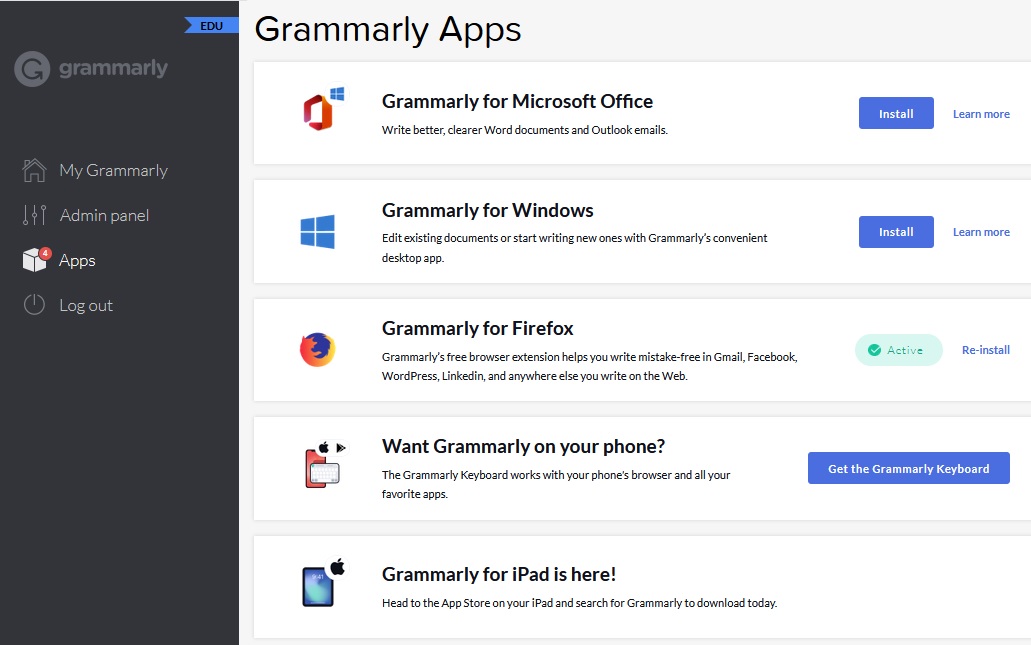
Grammarly Premium is a tool for correcting linguistic errors in English texts. Grammarly checks grammar, punctuation, style and spelling (see more info „Your Go-To Guide for English Grammar“)
Please submit your application to open an account via the registration form (an email address ending in @pw.edu.pl is required).
The number of accounts is limited within each user group.
In the event of inactivity on the account for more than 3 months, the account will be deactivated and the user will be informed by e-mail.
Grammarly allows you to use functionality that works directly when you write texts:
- in Word
- in a web browser
- as a desktop application for Windows and macOS
- and as a mobile app
The list of applications can be seen after logging in under the Apps tab (on the left-hand side of the screen).
BioRender
Is a tool for creating professional scientific illustrations to support research, teaching and publishing activities. It enables the creation of multi-coloured diagrams, charts and graphics for use in scientific publications, presentations, teaching materials and research projects.
The programme is aimed at research and teaching staff, as well as PhD students at Warsaw University of Technology. The number of available accounts is limited.
If an account remains inactive for a period of more than 6 months, the Library reserves the right to contact the user to verify whether they are still using the tool.
BioRender offers:
- over 50 000 pictograms from the fields of medical, natural and agricultural sciences
- over 5 000 ready-made templates
- icon libraries created by professional scientific illustrators
- tools for creating diagrams, charts, infographics and visual abstracts
- an AI module supporting the generation and modification of illustrations based on text commands (20 000 AI credits in the institutional pool, plus an additional one-off allocation of 50 AI credits for each user).
AI credits
Under the Warsaw University of Technology licence, users have access to a shared, institutional pool of 20,000 AI credits, which is replenished at the start of each licence period. In addition, each account has 50 individual, one-off AI credits. Credits from the institutional pool are used first. Individual credits are only used once the institutional pool has been exhausted. Users who used BioRender before joining the university licence (e.g. during a trial period) retain their projects, account history and any unused AI credits assigned to their individual accounts.
The AI credits available under the institutional licence form a shared pool for the entire academic community of Warsaw University of Technology. In order to ensure equal access to resources for all users, the Library reserves the right to impose limits on the use of AI credits if the rate of usage indicates a risk of the institutional pool being exhausted prematurely.
Creating an account
- To access the tool, please complete the registration form, providing an email address in the pw.edu.pl domain. Your account will be set up on the next working day.
- An email containing an account activation link will be sent to your email address
- If you do not receive an email with the activation link, please check the following folders: Spam / Offers / Notifications / Other. If you continue to experience problems, please contact the system administrators or the WUT Main Library Reference and Bibliometric Analysis Department.
Contact:
WUT Main Library Reference and Bibliometric Analysis Department: This email address is being protected from spambots. You need JavaScript enabled to view it.
System administrators:
Magdalena Maciąg – tel. 22 234 73 00, This email address is being protected from spambots. You need JavaScript enabled to view it.
Iwona Moroń-Chmielarska – tel. 22 234 73 00, This email address is being protected from spambots. You need JavaScript enabled to view it.
More on BioRender:
- M. Jankowski, BioRender step by step (PL), https://www.youtube.com/watch?v=dPjZjzpCk90
- M. Jankowski, Guidelines for creating medical vector graphics. How to create biological or medical graphics using the BioRender application, https://ucbsm.ump.edu.pl/zalecenia ∗https://www.biorender.com/webinar (in English) ∗ https://www.biorender.com/learn?utm_source=marketing_site_topnav (in English)
- Instructional materials and tutorials: BioRender | Learning Hub
- Help centre: https://help.biorender.com
- Developer’s website: https://www.biorender.com/
SciFlow
SciFlow is an advanced tool designed for creating and formatting scientific texts, including research articles, theses, and doctoral dissertations.
The tool offers a range of features that support authors at every stage of working on a document:
- Scientific text editor: The tool provides a dedicated editor that facilitates writing scientific texts, including features such as automatic formatting, handling footnotes, and bibliography management.
- Document templates: NIt offers ready-made templates, including manuscript templates for scientific journals, allowing easy adaptation of the document to the editorial requirements of the chosen publisher.
- Collaboration: The tool enables teamwork as well as commenting and editing texts in real time, while preserving the latest version of the document. Co-authors, supervisors, or other users (with the author’s permission) have direct access to the document and can comment on and revise it.
- Bibliography and citations: SciFlow is integrated with bibliography managers (including Zotero, Mendeley, Citavi, EndNote) and offers over 8,000 citation styles.
- Language correction: The tool supports creating scientific texts in any language; currently, language correction is available in English (LanguageTool) and German (Duden-Mentor).
- LaTeX integration: SciFlow works with the LaTeX markup language, facilitating the creation of advanced scientific documents.
- Document export: The tool allows exporting the final, professionally formatted text in various styles.
Using SciFlow helps save time on formatting and organizing the text, minimizes errors in citations and bibliography, facilitates communication with supervisors and co-authors, and ensures the document meets the requirements of publishers or scientific institutions.
SciFlow operates online and requires no additional software installation. It is accessible from various devices (computer, laptop, tablet) and enables collaboration among users from different institutions and countries.
To use SciFlow, please follow the personalized link https://www.sciflow.net/en/wut/start and register an account using an email address with the pw.edu.pl.
More information about the tool and how to use it can be found here:
Reference managers
Bibliography management programmes, known as reference managers, are tools that help to collect and manage data obtained from various sources about the materials used in the work, such as articles, books, chapters, websites, and others.
The use of such programmes is, above all, very convenient and time-saving when writing scientific or diploma theses. The advantage of reference managers is that the bibliographic data are entered into the programme only once and can be used for each subsequent article.
They allow automatic creation of bibliographic descriptions according to your own or selected style and the insertion of references and an appendix bibliography in literally a few clicks. No need to manually edit bibliographic descriptions anymore, or to think about the order of descriptions in the bibliography.
Among the most popular reference managers are:
- Zotero - Literature management programme
- Mendeley - Literature management software*
- EndNote - Literature management programme
Instruction materials on reference managers and learning tools
Change in the Mendeley software usage policy for users using the company/student MS Office software.
Until now, Mendeley Desktop software was used, which was a stand-alone desktop application (it had to be downloaded, installed and used in a local account). By decision of the software manufacturer, this version is no longer being developed and maintained. Alternatively, the manufacturer has made it possible to download and use the Mendeley Reference Manager tool, which is ultimately intended to replace Mendeley Desktop. Unfortunately, the MS Word plug-in dedicated to MS Office 365, for technical reasons, only integrates with cloud accounts (and not local accounts), hence the problem with its use in our University.
To ensure that staff/students can continue to work with Mendeley software, we recommend:
- For Microsoft Office 365 accounts in the cloud (student and doctoral accounts)
- install Mendeley Reference Manager and the Mendeley Cite plug-in
- annotation is only possible for documents in MS Word Online
- For local Microsoft Office 365 accounts (staff accounts): use the legacy version of Mendeley Desktop and install the MS Word plug-in (locally on the device in question) - until the problem is systemically resolved.
- If using versions of MS Office other than 365 (staff devices with earlier versions of MS Office)
- install Mendeley Reference Manager and the Mendeley Cite plug-in
- the plug-in will install locally on the device in question (may require assistance of the system administrator)
Engineering software
Computer terminals for WUT students and staff available In the Main Library are equipped with specialized engineering software:
- ArcGIS Pro 3.3
- MATLAB 2024A
- SOLIDWORKS 2024 SP01
- STATISTICA 13.3.721.1 64-bit (Polish language version)
The terminals also feature: MS Windows 11, MS Office Professional Plus 2019, Python, Visual Studio Community and Notepad++ text editor.
Location
Main Building, Main Library:
- Computer Lab, room 71A (ground floor, next to the Student Lending Room)
- Open Stacks – floor 2, room 242
Open during working hours of Student Lending Room and Open Stacks.
Rules for using the Computer Lab
Computer terminals are for the exclusive use of students and staff of Warsaw University of Technology. Login required:
- for employees: name.surename@prac.wut.pl
- for students: id@stud.wut.pl - where id stands for USOS ID, i.e. a part of the student mail login placed before the @ sign.
- password - same as for mail and Office365.
General characteristics of the programmes
- ArcGIS Pro – a geographic information system (GIS) package designed to operate on spatial data. Allows creation, processing, evaluation, presentation and sharing of geographic information. Includes tools for designing two-dimensional and three-dimensional views, processing images from various sources (drones, satellites, lidar and others), identifying spatial patterns with respect to their changes over time, making predictions, presenting data on interactive maps, and comprehensive data analysis and modelling. See detailed information on ArcGIS Pro
- MATLAB – a programming language and interactive environment designed to perform scientific and engineering calculations, implement algorithms, analyse data and perform computer simulations. Application areas include signal and image processing, telecommunications, control system design, financial mathematics, among others. The package includes: a proprietary high-level programming language, tools for importing data, functions to incorporate C and Java code, interactive tools for data visualisation (two- and three-dimensional graphs, animations), a library of computational functions (linear algebra, statistics, frequency analysis, optimisation), and tools for creating a graphical user interface (GUI). It is also possible to download measurement data and control external devices via the computer's ports. See detailed information on MATLAB
- SOLIDWORKS – an extensive CAD (computer aided design)software package with 3D imaging capabilities. It is designed for engineers, designers and manufacturers. On the basis of a three-dimensional component model, it enables the creation of assembly models, technical drawings, visualisations, motion and load simulations, animations, task schedules, production documentation and performance of many other specialised functions. SOLIDWORKS is designed for the development of structures with up to several thousand components.See detailed information on SOLIDWORKS
- STATISTICA – an extensive set of basic and advanced tools for statistical data analysis. It allows access to data by direct entry or import from selected files (spreadsheet or text documents), processing of data in a number of ways, and construction of queries, charts, reports and models on their basis. In addition, the programme allows you to operate on databases, perform data transformations and create applications (programmable system with built-in Visual Basic language), as well as providing machine learning procedures. The STATISTICA package finds numerous applications in science, technology, engineering, education and management. See detailed information on STATISTICA
Data Management Plans
Data Management Plans

Introduction
Research data are all data that have been collected, generated, observed during the research process aimed at obtaining scientific results.
Research data are:
- raw data (which were obtained directly as a result of a research tool),
- processed data (compiled).
Examples of research data:
- experimental notes, logbooks
- laboratory protocols, procedure descriptions
- methodological descriptions
- samples
- artefacts, objects
- textual documents
- questionnaires, surveys
- audio or video recordings
- photographs, images
- database content (images, texts, audio and video recordings)
- software (scripts, input files)
- results of computer simulations
- mathematical models and algorithms
Open research data – is data produced in the course of research and used in scientific work, to which any user has free and unrestricted access. These data can be used, modified and shared legally.
Some data may be archived in a closed model, due to:
- commercialisation of research results, e.g. applying for patent protection for an invention
- national security
- protection of personal data
- copyright restrictions
Dataset – a structured set of data, made available in a given repository, that relates to a given topic and is provided with metadata describing its content.
Metadata of research data
Appropriate preparation, organisation and description of the data will enable its efficient retrieval.
Data should be provided with metadata in such a way that the recipient knows what kind of data it is, how it was produced and under what conditions it can be used.There is no single universally applicable metadata description standard for research data, so it is a good idea to familiarise yourself with the metadata description standards used by the repository where you intend to deposit your data.
The following fields may appear in the metadata description standards that you will need to complete:
- title
- source
- creators (persons or bodies holding copyrights on research data)
- date of production
- format
- language
- information on openness (including licence and possible embargo)
- related project
- related publication, etc.
These tools can help in choosing the most suitable standard:
Publicly available file formats should be used. For this purpose, it is advisable to use uncompressed file formats that do not require commercial software and use standard encoding (ASCII, Unicode).
In some cases, the migration of data to an open format may result in the loss or distortion of some data/metadata. It is then acceptable to deposit data in closed formats.
If the data is readable by commercial tools, but ones that are commonly used in the discipline, then it is also acceptable to deposit such data.
Before preparing datasets, check that the repository allows the data to be deposited in the format of your choice.File formats
Data should be deposited in such a way as to ensure its long-term readability and accessibility. When sharing research data, consideration should be given to:
- the software with which they will be readable
- the sustainability of the chosen file formats.
Publicly available file formats should be used. For this purpose, it is advisable to use uncompressed file formats that do not require commercial software and use standard encoding (ASCII, Unicode).
In some cases, the migration of data to an open format may result in the loss or distortion of some data/metadata. It is then acceptable to deposit data in closed formats.
If the data is readable by commercial tools, but ones that are commonly used in the discipline, then it is also acceptable to deposit such data.
Before preparing datasets, check that the repository allows the data to be deposited in the format of your choice.
Sharing research data
Data should be open as much as possible and closed as much as necessary. To help researchers prepare and share data appropriately, FAIR principles have been developed, according to which data should be:
Findable – easy to find; the dataset must be provided with metadata such that it is searchable by the relevant tools available in the repository
Accessible – (at least down to the metadata level) to anyone having access to Internet;
- availability in FAIR does not mean open access without restriction; it means that the exact conditions under which data are made available and reusable are specified through metadata
The following open licences are worth using:
- Creative Commons licenses
- GNU free software licenses
- Open Data Commons database licenses
Metadata should be available even if the dataset has been moved or deleted.
Interoperable – data must be described to an appropriate standard and using a correct methodology; they should also be deposited in formats that allow them to be read and processed
Reusable – this means that the description or the datasets themselves should contain information on the origin of the data, together with the entire methodology of data extraction; the possibility of re-use also requires that the licence under which the data have been shared and can be processed is indicated.
Repositories
Research data should be collected and made available in institutional, national or international repositories.
When selecting a repository, the following should be taken into consideration:- Under what conditions will the data be stored?
- How will the data be secured?
- Does the repository support a discipline-specific standard for metadata description?
- Does the repository ensure the assignment of an identifier, e.g. DOI, to datasets (this translates into better retrieval of data)?
- Is it possible to link the dataset to authors using identifiers, i.e. ORCID?
- Are other researchers in the discipline using the same repository?
- The cost of depositing data (check whether your chosen repository applies an additional fee, the so-called Data Processing Charge, or whether depositing data is free of charge)
When choosing a repository, it is also worth using the Register of Research Data Repositories. This is a global register of research data repositories from all scientific disciplines.
Some of the most popular research data repositories today are:
- WUT Data Repository –
- RepO – Repsitory for Open Data D– a national repository created as part of the Open Science Platform. It allows depositing so-called small data. Use of the service is free of charge.
- Zenodo – an OpenAIRE project, supporting open access and data movement in Europe. The repository has been developed with EU funding. It complies with the FAIR principles. There is a limit of 50 GB per dataset.
Data Management Plan (DMP)
DMP is a document required for grant applications under Horizon 2020 and its successor Horizon Europe programmes, and in National Science Centre competitions.
The plan should describe what data applicants will use in the course of their work:
- How will the data be produced (e.g. will it be self-generated or purchased, etc.)?
- Who will have the rights to the data?
- Will the data be made available to other users and under what conditions?
- Where will the data be stored?
- How will the data be described?
Please take a look at the tabs:
- DMP in NCN programmes
- DMP in the HORIZON programme
The Reference and Bibliometric Analysis Department is consulting WUT staff on the correctness of research Data Management Plans prepared for submission. Please contact us by email:
- Magdalena Maciąg: This email address is being protected from spambots. You need JavaScript enabled to view it.
- Monika Gajewska: This email address is being protected from spambots. You need JavaScript enabled to view it.
Creating a DMP is a complex process, each plan is different, so the following free tools can be useful in the creation of a DMP:
- DMPTool (US) – contains examples of DMPs. It allows you to prepare DMP templates tailored to the requirements of US grantors
- DMPonline (UK) – a tool to facilitate work with DMPs, allowing the creation of templates
- DSW - Data Stewardship Wizard – a tool to facilitate work with DMPs, allowing the creation of templates
- The Data Curation Center – a service from a UK institution specialising in research data management. Among other things, it provides: ready-made data management plans, guides, guidelines and information on metadata
DMP in NCN programmes
A Data Management Programme (DMP) is prepared at the grant application stage:
- A template is available for the plan to be submitted
- The template is divided into 6 parts - each part contains a set of questions. The individual fields can be up to 1,000 characters including spaces (except for point 2.1 - where the limit of 2,000 characters applies)
- The plan is subject to an expert evaluation at the final report assessment stage. The evaluation will consist in comparing the plan in the application with its implementation
The DMP may be subject to change during the course of the project:
- It is recommended to update the Data Management Plan during the project duration
- There is no need to inform NSC about changes in DMP
- The final report should describe the actual state of data in the project - as of the project completion date. It may be different than initially planned
- DMP should be prepared in English (excluding thumbnails)
The National Science Centre template consists of the following elements:
1.1 Data description and collection or re-use of existing data
In this section you should answer the following questions:
- How will new data be collected or produced and/or how will existing data be reused?
- How will the data be controlled and documented?
- How will the files be organised and their different versions managed?
See example
The reaction of hydrodechlorination of 1,2-dichloroethane (1,2-DCE) will be carried out at atmospheric pressure, in a glass flow reactor equipped with a fritted disk to place a catalyst charge. Prior to reaction, the catalyst will be reduced in flowing hydrogen (30 cm3/min), ramping the temperature from 20 to 600 °C (at ∼15 °C/min) and kept at 600 °C for 1 h. All reactions will be followed by gas chromatography (HP 5890 series II with FID 5% Fluorcol/Carbopack B column (10 ft) from Supelco). The results of GC analysis will be elaborated using HP ChemStation (software). XRD studies of Ni–Ru/SiO2 catalysts at various stages of their biography (after calcination, after reduction, and after hydrodechlorination) are also planned to furnished useful information. XRD experiments will be performed on a standard Siemens D5000 diffractometer using Ni-filtered CuKα radiation. Those experiments are planned to do in an external laboratory. The data set will consist of xml files and description of the methodology (if the versioning happens during the research, all versions will be available in the set).
1.2 What data (for example the kinds, formats, and volumes) will be collected or produced?
In this section you should answer the following questions about the planned format and volume of data:
- What type of data will it be (e.g. documents, spreadsheets, audio files, videos, databases, source code)?
- What format and volume the data will be in (the file format can be anything, the most important thing is to choose a format that provides universal access and openness. Open and standard formats should be considered first)?
- Whether and how will the data be encoded for storage?
See example
Results from ChemStation will be exported into XML files. The data set will have up to 10 GB size. The data does not require additional encoding. XRD analysis will be shown on pictures and graphs in jpg format.
2. Documentation and data quality
To be specified:
- The type of metadata used to make it easier for users to find them
- Is the data machine-readable?
- What international standards or schemes (i.e. Dublin Core, DDI) will be used to structure metadata?
See example 1
Data and their associated metadata will be deposed in a public repository, Zenodo. The data will be stored with a "readme" file and clear folder structure and filename descriptions. Metadata are retrievable by their identifier using a standardized communication protocol. The repository is registered in the Directory of Open Access Repositories (OpenDOAR). Zenodo registers DOIs (via DataCite) for all deposited records. In Zenodo, metadata meets one of the broadest cross-domain standards available - DataCite's Metadata Schema. The following additional article level fields are supported: journal title/volume/issue/pages, conference title/acronym/dates/place/website, book publisher/place/ISBN/title/pages, alternate persistent identifiers. Results from ChemStation will be exported into XML files - which is a machine readable format. Results of XRD analysis will not have a machine readable format because of its specificity (jpg format).
See example 2
The data will be stored in Dryad repository. The data will be stored with "readme" file and clear folder structure and filename descriptions. The description of the "read me" files will be prepared in a consistent and descriptive manner following the repository rules. Dryad welcomes the submission of data in multiple formats to enable various reuse scenarios. Default metadata entry form is based on fields from the metadata schema of the DOI issuing agency, DataCite. Recommended minimum content for metadata in this repository is: title of the dataset, institution name, address, email information for the principal investigator (or the person responsible for collecting the data), associate or co-investigators, contact person for questions, date of data collection (can be a single date, or a range), information about geographic location of data collection, keywords used to describe the data topic, language information, information about funding sources that supported the collection of the data. Results will be exported into XML file - which is a machine readable format. Results of XRD analysis will be uploaded in (jpg format).
3. Storage and backup during the research process
To be specified:
- How will the data be stored during the research process?
- What are the back-up procedures?
- Where and how will the data be stored and who will have access to it?
- How will data security and protection of sensitive data be taken care of during the research?
- Would any other, additional documentation (e.g. any information on procedures, etc.) be necessary to reuse the data?
- Will backups be made and how? Indicate how often they will be made, by whom, on what media and where they will be stored
See example
Only researchers involved in survey will have access to the collected data. Access to the software will be protected with login data. File access privileges are defined on a per user basis for data files, methods, sequences, and results. The data will be stored on well-protected laptops (with up-to-date firewalls and virus/trojan protection) and servers (university servers). Loss of data will be prevented by making regular backups (each month). The backups will be stored in the secure faculty and/or institute storage that is in place for this specific purpose, to minimize the risk of unauthorized access.
4.1 Issues related to the processing of personal data
To be specified:
- Has there been any processing of personal data?
- How will compliance with personal data and data security legislation be ensured?
See example
The survey does not assume using any of the personal data.
4.2 Legal requirements, codes of conduct
To be specified:
- Who will be the owner of the data?
- Which licenses will be applied to the data?
- Will there be restrictions on re-use of data?
- Do you need to seek copyright clearance before sharing data?
See example 1
XRD studies of Ni–Ru/SiO2 catalysts are planned to do in the external laboratory. All necessary agreements (including copyright transfer) will be signed to ensure legal rights to use the data in this project. The data set will be opened to all users under the Creative Commons Attribution 4.0 International (CC-BY-4.0) license. More information about the licensee can be found on the European Commission webpage. Specifically, the research data will validate the results presented in the published scientific paper.
See example 2
The survey team will have all rights to the data. All necessary agreements will be signed before depositing the data in repository. The data will be released to the public domain. All files submitted to Dryad must abide by the terms of the Creative Commons Zero (CC0 1.0).
5.1 Data sharing and long-term preservation
When and how will project data be shared?
- Are there possible restrictions to data sharing or embargo reasons?
- Are there any barriers and constraints to making the research data fully or partially accessible (e.g. from the publisher of the article)?
- Does data sharing require the consent of project participants?
See example
The data will be available at the same time as the paper will be published. We do not assume any limitations and obstacles preventing full or partial data disclosure. Sharing the data will not inquire any additional consent of the project participants.
5.2 Data selection:
To be specified:
- What procedure would be used to select data to be preserved?
- What repository will you use? Does this repository comply to the FAIR Data Principles?
See example 1
The data that will be deposited will be selected in such a way that other scientists can repeat the survey. They will support and illustrate all information from the journal article that will be published. Data and their associated metadata will be deposited in a public repository, Zenodo Repository. This repository meets all FAIR requirements.
See example 2
The data and their associated metadata will be deposited in Dryad repository. All datasets in Dryad are indexed by the Clarivate Data Citation Index, Scopus, and Google Dataset Search. Each dataset is given a unique Digital Object Identifier or DOI. This repository meets all FAIR requirements. Dryad has a team of curators who check every submission to ensure the validity of files and metadata. After deposing the data in Dryad, the bibliographic description of the data will also be deposited in Institutional Repository (with a link to the Dryad repository and the data's DOI number). The deposited data will be selected in such a way that other scientists can repeat or fully understand the survey.
5.3 Software tools needed to access the data
To be specified:
- Will potential users need specific tools to access and (re)use the data?
See example
During the survey, open data formats are planned to be used (xml or jpg). Users will do not need any specific software to read the data.
5.4 Unique identifiers (e.g. DOI)
To be specified:
- How will the application of a unique and persistent identifier (such us a Digital Object Identifier (DOI)) to each dataset be ensured?
See example 1
The data will be deposited in Zendodo Repository. To every upload in Zenodo is assigned a Digital Object Identifier (DOI).
See example 2
The data will be deposited in Institutional Repository. This repository does not assign DOI to data sets. However, in the metadata scheme used there, there is a field for it. To meet all FAIR requirements, the DOI costs will be covered from the project budget. The DOI will be filled in in the repository during uploading the datasets and metadata.
6.1 Data management responsibilities
To be specified:
- Who will be responsible for data management (i.e. who will be the data steward)?
See example 1
The Project Manager will take over the main responsibilities related to the data management process. The Institute does not provide additional staff to support research data management throughout the duration of the project. The main tasks of the project manager in this area will include: taking care of data quality, creating data processing procedures in the laboratory, naming files, creating backups and their appropriate storage, long-term data archiving in the repository and taking care of this data after the end of the project (adding new versions). The Project Manager will have an additional person to help: Assistant Project Manager. He will also be involved in deposing data and sharing of the project results. He will be responsible for periodically checking if the backups are made on an ongoing basis and properly stored. In addition, the Project Manager is obliged to transfer the data to the other members of the project when any of the team members leaves the team. Both the Project Manager and the Assistant will be responsible for checking that the DMP is being followed.
See example 2
The person responsible for the data management process is the supervisor of the whole project, the same person will be responsible for DPM implementation, updating, and verification. An additional member of the staff will also be assigned to make backups and data corrections during the project. The main tasks will include: taking care of data quality, creating data processing procedures in the laboratory, creating backups and their appropriate storage, long-term data archiving in the repository, and taking care of this data after the end of the project (adding new versions).
6.2 What resources will be dedicated to managing the data and ensuring that the data is FAIR?
To be specified:
- What are the costs of ensuring FAIR standards in the project and how they will be covered?>
See example 1
The data will be deposited in a free repository. If necessary, devices for data backup will be purchased (2 external 4TB drives. The cost of one drive is PLN 420).
See example 2
The main costs for ensuring FAIR principles in the project are for the deposited data in Dryad Repository. Dryad charges excess storage fees for data totaling over 50GB. For data packages in excess of 50GB, submitters will be charged $50 for each additional 10GB, or part thereof. (Submissions between 50 and 60GB = $50, between 60 and 70GB = $100, and so on).
The Reference and Bibliometric Analysis Department is consulting WUT staff on the correctness of research Data Management Plans prepared for submission. Please contact us by email:
- Magdalena Maciąg: This email address is being protected from spambots. You need JavaScript enabled to view it.
- Monika Gajewska: This email address is being protected from spambots. You need JavaScript enabled to view it.
See also:
DMP in the HORIZON programme
The first version of the DMP should be submitted once the project has been approved and funding has started (within the first 6 months of the start of the project):
- A template of the plan to be submitted is available - the template is a set of questions to be answered
- The DMP needs to be updated on an ongoing basis - if significant changes occur (e.g. decision to file a patent, need to make research confidential, etc.)
- Costs related to open access to research data under Horizon 2020 are eligible for reimbursement during the course of the project, under the terms of the H2020 grant agreement, in particular Article 6 and Article 6.2.D.3
- The plan should be prepared in English
The DMP should include the following elements to address specific questions:
Data Summary
- What is the purpose of data collection/generation?
- What types and formats of data will be collected/generated?
- What is the origin of the data (will we generate it ourselves or use existing data)?
- Who will have the rights to the data - is it necessary to conclude agreements on the use and dissemination of the data?
- What is the expected size of the data?
- What will be the methodology of data extraction?
- Will the data be produced once or continuously?
- Will the data need to be versioned?
See example
An online survey system will be used to collect data from the respondents. The data will be interpreted and used for writing a scientific paper. The survey will be conducted by using the LimeSurvey tool. LimeSurvey is a free software. It will be downloaded and installed on the University server to ensure the data safety. Access to the software will be protected with login data. Only researchers involved in the survey will have access to the collected data. The survey will be conducted anonymously. We do not assume collecting any personal data which need to be protected. The researchers will have all legal rights to the survey output. The data will be stored on the University server in the Lime Survey software until the end of the survey. When the survey has been completed, all data will be transformed into the csv. (comma-delimited file). All questions from the questionnaire will be transferred into the text file (.odt). The survey methodology will be written and saved in text format. The data set will consist of those three files. The data set will have up to 50 GB. As the data dimensions are relatively low, no new specialist processing or storage will be required.
FAIR data (findable, accessible, interoperable and reusable)
- To what extent will the data comply with FAIR principles (findable, accessible, interoperable and reusable)?
- With which metadata description format will the datasets be described?
- Will they be assigned a unique identifier, e.g. DOI?
- Will the data be placed in a publicly accessible repository / service and made available to other users? If so, under what licence?
- Will reading the data require additional software (how and with which tools will it be readable)?
- How long will the data be available in the repository?
- Do the publishers of the journal in which the research results will be described require research data to be included with the article?
- For more on the FAIR principles, see Sharing research data
See example
The data and their associated metadata will be deposed in a public repository Zenodo. This repository meets all FAIR requirements. (Meta)data are assigned a globally unique and persistent identifier. A DOI is issued to every published record on Zenodo. Zenodo's metadata is compliant with DataCite's Metadata Schema minimum and recommended terms, with a few additional enrichments. Metadata of each record is indexed and searchable directly in Zenodo's search engine immediately after publishing. Metadata of each record is sent to DataCite servers during DOI registration and indexed there. Metadata for individual records as well as record collections are harvestable using the OAI-PMH protocol by the record identifier and the collection name. Metadata is also retrievable through the public REST API. Data and metadata will be retained for the lifetime of the repository. This is currently the lifetime of the host laboratory CERN, which currently has an experimental program defined for the next 20 years at least. Metadata are stored in high-availability database servers at CERN, which are separate from the data itself. Metadata use a formal, accessible, shared, and broadly applicable language for knowledge representation. The data set will open to all users under the Creative Commons Attribution 4.0 International (CC-BY-4.0) license. More information about the licence can be found on the European Commission webpage. Sharing of the data will follow the principle "as open as possible, as closed as necessary". Specifically, the research data will validate the results presented in a published scientific paper. The data will be available at the same time as the paper is published.
Allocation of resources
- What are the costs associated with meeting the FAIR standard?
- What will be the costs associated with storing and sharing the data (will the data be shared in a paid service and what will be the cost)?
- Who will be responsible for data management in the project?
See example
In Zenodo, the content may be uploaded free of charge. The person responsible for managing the data and creating metadata compatible with the standard used in Zenodo Repository is the supervisor of the whole project, namely, Prof. Marcin Sosnowski.
Data security
- What rules will be in place to ensure data security, including data recovery (in case of data loss)?
- If sensitive data will be collected during the project, how will it be secured?
- Will the data require additional processing to ensure its anonymity?
- Does the repository / data storage facility meet basic security principles?
See example
Regarding the secure storage of the data, the project will use an architecture based on cloud services to store the data. The used services provide the functionalities needed to address secure storage and data security. The questionnaire will be available to respondents for 3 months. Each week, it will be sent to another respondents group. Each week, a copy of the data will be created, transformed into csv. and then put into the cloud. In case of unusual situation or losing data, the .csv file can be uploaded to the LimeSurvey. Access to the LimeSurvey tool will also be protected with login data (username and password). Only researchers will have access to this tool.
Ethical aspects
- Are there any ethical or legal issues that may affect data sharing?
- If personal questionnaires were used, was respondents' consent to the sharing and long-term storage of data taken into account?
See example
The questionnaire used in this survey will contain an obligatory clause with the information about the purpose of the survey. All respondents will be informed that their answers will be interpreted and used for gathering more knowledge about social behavior. Respondents will also be ensured that their personal data will not be collected or shared.
Other issues
- Do you use specific data management procedures (e.g. national / project / university guidelines)? If yes, please specify which procedures you use.
The Reference and Bibliometric Analysis Department is consulting WUT staff on the correctness of research Data Management Plans prepared for submission. Please contact us by email:
- Magdalena Maciąg: This email address is being protected from spambots. You need JavaScript enabled to view it.
- Monika Gajewska: This email address is being protected from spambots. You need JavaScript enabled to view it.
See also:
Scientific indicators
Scientific indicators

Journals indicators
Selected indicators for scientific journals evaluation:
-
Essential indicators:
-
Impact Factor
“The annual JCR impact factor is a ratio between citations and recent citable items published. Thus, the impact factor of a journal is calculated by dividing the number of current year citations to the source items published in that journal during the previous two years”. For more information about IF see Thomson Reuters website. -
Hirsch index
The index h is defined as the number of papers with citation number >= h, as a useful index to characterize the scientific output of a researcher. An index to quantify an individual’s scientific research output.” It can be also used for journals’ evaluation. The h-index was developed by J.E. Hirsch and published in Proceedings of the National Academy of Sciences of the United States of America 102 (46): 16569-16572 November 15 2005. -
Index Copernicus
This evaluation system includes selected journals from STM (Science, Technology, Medicine). It shows the rank of journals based on about 30 parameters in five categories: scientific quality, editorial quality, international availability, market frequency, regularity and stability, technical quality. The IC Journal Master List – contains currently over 8,000 journals from all over the world, including 700 journals from Poland. The journals registered in this database underwent rigorous, multidimensional parameterization, proving high quality. The Ministry of Science and Higher Education acknowledged the IC Journal Master List by placing it on the list of scored databases. The journals indexed in IC JML get additional points during the Ministry’s evaluation process.
-
Impact Factor
-
Additional indicators:
-
SNIP
Source Normalized Impact per Paper - “SNIP measures a source’s contextual citation impact by weighting citations based on the total number of citations in a given subject field. It helps you make a direct comparison of sources in different subject fields.” -
SJR
SCImago Journal Rank- ”SJR is weighted by the prestige of the subject field, quality, and reputation of the journal – they all have a direct impact on the value of a citation.”
-
SNIP
Sources of the indicators described above:
- Journal Citation Reports - Online Access to JCR (since 1997) on Web of Science
- Journal Citation Reports (JCR) Science Edition
- Journal Citation Reports (JCR) Social Sciences Edition
When looking for JCR database, choose "Additional Resources" after entering the platform ISI Web of Knowledge. -
Master Journal List - Master Journal List is in Poland commonly called „lista filadelfijska”. The Master Journal List includes all journal titles covered in scientific products of Thomson Reuters, available on the ISI Web of Knowledge platform, among others in Web of Science (WoS) database. The Master Journal List is than broader than the list of journals available both in WoS and in JCR database.
There is no information on Impact Factor values in the Master Journal List - List of the Ministry’s scored journals - The Ministry of Science and Higher Education publish a list of scored journals once a year.
- INDEX COPERNICUS JOURNALS MASTER LIST (JML) - Current values of Index Copernicus (IC) factors for individual titles, estimated rates for the next year, journal’s publishing address, URL journal’s address, language of publication, availability in international databases). Data are available only for authorized users.
- Scopus - It is an abstract and citation database where the number of citations, the value of h-index (Hirsch index) can be found (publications since 1996). It is also possible to compare scientific journals using the Journal Analyzer feature.
Where to find citations?
Selected indicators for research output evaluation:
- number of publications
- number of citations
- total number of citations
- average number of citations per one publication
- Hirsch index. The index h is defined as the number of papers with citation number higher or equal to h. It is a useful index to quantify an individual’s scientific research output. The h-index was developed by J.E. Hirsch and published in Proceedings of the National Academy of Sciences of the United States of America 102 (46): 16569-16572 November 15 2005.
Basic services providing information about citation count of the articles published in scientific journals:
-
WoS (Web of Science)
Web of Science Core Collection provides researchers, administrators, faculty, and students with quick, powerful access to the world's leading citation databases. Authoritative, multidisciplinary content covers over 12,000 of the highest impact journals worldwide, including Open Access journals and over 150,000 conference proceedings.
It includes:- Science Citation Index Expanded / since 1945
- Social Sciences Citation Index / since 1956
- Arts & Humanities Citation Index / since 1975
- Conference Proceedings Citation Index / since 1990
- Book Citation Index– Science / since 2005
- Book Citation Index– Social Sciences & Humanities / since 2005
-
Scopus
Scopus is a bibliographic database that includes citation count and h-index for articles published after 1996.
-
Google Scholar Citations
Google Scholar Citations provides a simple way for authors to keep track of citations of their articles. You can check who is citing your publications, graph citations over time, and compute several citation metrics. You can also make your profile public, so that it may appear in Google Scholar results when people search for your name.
-
Publish or Perish
Publish or Perish is a software program that retrieves and analyzes academic citations. It uses Google Scholar to obtain the raw citations, then analyzes these and presents some statistics.
Engineering software
Computer terminals for WUT students and staff available In the Main Library are equipped with specialized engineering software:
- ArcGIS Pro 3.3
- MATLAB 2024A
- SOLIDWORKS 2024 SP01
- STATISTICA 13.3.721.1 64-bit (Polish language version)
The terminals also feature: MS Windows 11, MS Office Professional Plus 2019, Python, Visual Studio Community and Notepad++ text editor.
Location
Main Building, Main Library:
- Computer Lab, room 71A (ground floor, next to the Student Lending Room)
- Open Stacks – floor 2, room 242
Open during working hours of Student Lending Room and Open Stacks.
Rules for using the Computer Lab
Computer terminals are for the exclusive use of students and staff of Warsaw University of Technology. Login required:
- for employees: name.surename@prac.wut.pl
- for students: id@stud.wut.pl - where id stands for USOS ID, i.e. a part of the student mail login placed before the @ sign.
- password - same as for mail and Office365.
General characteristics of the programmes
- ArcGIS Pro – a geographic information system (GIS) package designed to operate on spatial data. Allows creation, processing, evaluation, presentation and sharing of geographic information. Includes tools for designing two-dimensional and three-dimensional views, processing images from various sources (drones, satellites, lidar and others), identifying spatial patterns with respect to their changes over time, making predictions, presenting data on interactive maps, and comprehensive data analysis and modelling. See detailed information on ArcGIS Pro
- MATLAB – a programming language and interactive environment designed to perform scientific and engineering calculations, implement algorithms, analyse data and perform computer simulations. Application areas include signal and image processing, telecommunications, control system design, financial mathematics, among others. The package includes: a proprietary high-level programming language, tools for importing data, functions to incorporate C and Java code, interactive tools for data visualisation (two- and three-dimensional graphs, animations), a library of computational functions (linear algebra, statistics, frequency analysis, optimisation), and tools for creating a graphical user interface (GUI). It is also possible to download measurement data and control external devices via the computer's ports. See detailed information on MATLAB
- SOLIDWORKS – an extensive CAD (computer aided design)software package with 3D imaging capabilities. It is designed for engineers, designers and manufacturers. On the basis of a three-dimensional component model, it enables the creation of assembly models, technical drawings, visualisations, motion and load simulations, animations, task schedules, production documentation and performance of many other specialised functions. SOLIDWORKS is designed for the development of structures with up to several thousand components.See detailed information on SOLIDWORKS
- STATISTICA – an extensive set of basic and advanced tools for statistical data analysis. It allows access to data by direct entry or import from selected files (spreadsheet or text documents), processing of data in a number of ways, and construction of queries, charts, reports and models on their basis. In addition, the programme allows you to operate on databases, perform data transformations and create applications (programmable system with built-in Visual Basic language), as well as providing machine learning procedures. The STATISTICA package finds numerous applications in science, technology, engineering, education and management. See detailed information on STATISTICA
Users authorization levels
Authorization levels for using the Main Library resources
The resources and services of the Main Library can be used by users with an active library account. The status of the various groups of users, the limit of loans outside WUT Main Library and the maximum single validity period of the library account are listed in the table below. The symbols used in the table mean:
C - authorization to use the Main Library resources on the spot, including electronic documents made available there;
W - authorization to borrow printed library documents outside the library;
E - access to the licensed electronic resources from any computer;
M - authorization to use the Main Library Interlibrary Loans service;
R - authorization to borrow library documents from other institutions in Warsaw as part of Interlibrary Loans (except for SWW);
S - authorization to borrow library documents as part of SWW.
* the loan limit for students studying 2 majors is 50 items.
Library Training
In accordance with the Order No. 24/2021 of the Rector of WUT dated 30/03/2021, completion of the training is mandatory for all students of:
- the first year of a first–cycle degree programme;
- the first year of a long–cycle Master's programme;
- the second–cycle degree programme who have not yet completed the training at WUT
Registration for the Library Training
- Students of the first year of a first–cycle degree programme and a long–cycle Master's programme are automatically enrolled in the course in USOSweb;
- Students of the first year of a second–cycle degree programme (who have not previously completed the training at this University) and students who have not been automatically enrolled in the course, can enrol themselves by registering to the subject in USOSweb. Select the subject 4310–00000–I0P–0001 Library Training and click ‘Register’ (registration to a supplementary group No. 21). The course will be available on the next working day after you have enrolled in USOS (usually after 10:00 am).
The Library Training is conducted online on the WUT LeOn platform. Each participant of the course must log in to the platform independently. Login instructions are always available in the News section on the WUT Main Library website at the beginning of the winter and summer semesters.
After logging on to the e–learning platform, read the materials and take the test. Passing the test is equivalent to passing the training. The training is carried out at the beginning of the semester.
Frequently Asked Questions:
- I'm a first–year student and I don't have Library Training linked in USOS, what should I do?
Check if you can independently enrol in a supplementary group in USOSweb. If yes – sign up (Registration Calendar in USOSWeb, select the current semester) and take the test on the date indicated. If not – write an email to This email address is being protected from spambots. You need JavaScript enabled to view it. – the librarian has the option to manually add students to the group. In the email indicate your name and student record book number. - I am a first–year student. I am studying at two different faculties. I only have Library Training linked to one of the programmes, what should I do?
Write an e–mail to This email address is being protected from spambots. You need JavaScript enabled to view it.. Include your name, student record book number and indicate which faculty you want to link your Library Training to. - I am starting a new course of study / I am resuming / I have already done Library Training in WUT, do I have to re–sit Library Training?
No, the credit for your Library Training can be transferred. Requests for the transfer should be made via the form. Alternatively, in more difficult cases, email This email address is being protected from spambots. You need JavaScript enabled to view it.. Include your name and student record book number in your email.- If you did the training in academic year 2017Z or later, the previous credit should be visible in USOSweb – you do not need to send a confirmation.
- If you did the training between academic years 2013Z and 2017L, we can confirm that you have done the training from the lists.
- If you did the Library Training before 2013Z, send a scan/photo of your student record book with the entry by email, so that both the credit and your personal data are visible in one photo. Alternatively, you can show the entry in person to a member of staff in Division of Scientific Information and Bibliometric Analyses (Main Building room 161b, c). If you have credit information visible in your student course record, then you can attach it in the email.
- I am starting my second–cycle degree programme at WUT, I have already passed Library Training at the first–cycle degree, do I have to get the credit transferred?
No, if you have taken the first–cycle degree programme at WUT and you have passed the Library Training, you do not need to retake it. If you still see the training linked in USOSweb at the same faculty, please send an email to This email address is being protected from spambots. You need JavaScript enabled to view it..
Include your name and student record book number in the email – the librarian will unlink the training from the relevant programme. - Is it possible to transfer the credit for the Library Training from another university?
No, because every library is unique and conveys different content to its students. - Are credits for passing the Library Training automatically uploaded to USOS? When can you expect to receive credit in USOS?
Credits are not sent automatically. They are entered after the protocols have appeared in USOS. For the training taking place in October, credits should appear in USOS at the end of November. For the summer semester training – in May. - I'm just before my diploma examination and I don't have credit for the Library Training. Can I complete it?
Write an email to This email address is being protected from spambots. You need JavaScript enabled to view it.. Include your name and student record book number in your email, we will try to add you to the current course if possible. - Does failure to pass Library Training result in no certificate of completion?
In most faculties, yes. If you would like full information on this please contact your dean’s office. - I have not done the Library Training by the deadline. Can I take it in the following term?
Yes, you can enrol yourself by registering for the course in USOSweb (Registration Calendar in USOSWeb)- Select the course 4310–00000–I0P–0001 Library Training in the current semester and then click ‘Register’ (registration to an additional group). Access to the course will be active on the next working day after registration in USOS (usually after 10:00).
Open Access - funding

Introduction
Open Access (OA)
Publishing a research article under the Gold Open Access model in a prestigious journal involves covering the publishing costs, known as Article Processing Charges (APCs). These costs cover, amongst other things, editorial processes, promotion and global distribution. They are covered by authors, academic institutions or research funding bodies. Depending on the publisher, the fees can range from 1 000 to 5 000 EUR, USD or CHF.
Funding options for open access to scientific publications
Open access publishing can be funded from the following sources:
- research project grants;
- Open access publishing programmes under the following licences:
- national (e.g. Elsevier, Springer)
- consortium programmes (e.g. ACS, RSC, IoP, CUP)
- university programmes (e.g. IDUB Open Science – for articles whose publication cannot be fully funded under national or consortium programmes)
The individual programmes are described in the following tabs. If you have any questions, please contact the Reference and Bibliometric Analysis Department:
This email address is being protected from spambots. You need JavaScript enabled to view it.
tel. 22 234 73 00
Elsevier open access publishing programme under the national licence
The programme was relaunched on 20 May 2026 with a quota of 1 084 articles. Articles accepted for publication in 2026 following the signing of a contract with Elsevier will be eligible for the programme (the date on which the article was submitted to the journal is irrelevant). The publisher does not envisage the possibility of retroactively including articles accepted for publication in 2026 prior to the launch of the programme. (information as of 21 May 2026).
Quota of articles
The programme was launched with a quota of 1 084 articles for the period from 20 May 2026 to 31 December 2026.
UPDATE (01 October 2026): 796 articles out of a total quota of 1 084 articles have been used.
Authors eligible for the programme
Corresponding author affiliated with Warsaw University of Technology.
- In the publication process, it is recommended that you provide an email address within the institution’s domain (@pw.edu.pl).
- The corresponding author is the sole author responsible for managing the publication process of the article, from submission to acceptance, and for corresponding with the publisher on this matter.
Journals covered by the programme
The 2026 programme covers 1 120 hybrid journals from seven ScienceDirect subject collections, in accordance with the national licence restriction introduced in December 2022: Biochemistry, Genetics and Molecular Biology, Computer Science, Engineering, Health Sciences, Immunology and Microbiology, Mathematics, Physics and Astronomy, as well as journals from The Lancet group.
- The list of additional journals for Warsaw University of Technology.
- Under the programme, it is also possible to publish in journal collections subscribed to individually by the Warsaw University of Technology: Environmental Science, Chemical Engineering, Energy, Materials Science, Chemistry, Business, Management and Accounting, Social Sciences, Economics, Econometrics and Finance.
Journals excluded from the programme
The programme does not cover 'gold' open access journals or certain journals co-published by Elsevier, in which publications are funded under special terms and cannot be carried out under the national programme.
Types of articles covered by the programme
The programme covers the following types of articles: case reports, data, full-length articles, micro-articles, software, reviews, replication studies, short communications, short surveys, videos, practice guidelines and protocols.
Publication charges
The only charge covered by the programme is the APC. Authors publishing under the programme are exempt from this charge, which is shown by Elsevier in the Rights and Access form as a 100% discount.
Charges for additional services, such as reprints, colour illustrations in the print version or other items ordered by the author, are billed separately, at the author's expense and without a discount. The author receives a separate invoice for these services.
Article verification process
Information about the article is forwarded by Elsevier to the local administrator at Warsaw University of Technology (contact address: This email address is being protected from spambots. You need JavaScript enabled to view it.). Using their account in the EOAP system, the administrator verifies whether the author is affiliated with the institution and whether they have correctly indicated this affiliation on the title page of the article. In case of doubt, the local administrator contacts the author directly.
Guidelines
Support materials for authors, prepared by the publisher.
- Acceptance of an article following peer review: The process begins once the author has been notified that the article has been accepted for publication (following peer review and revisions) during the programme period, provided that the programme’s funding has not yet been exhausted.
- Preliminary information from the publisher: As early as the manuscript submission stage, the author may receive information from the publisher regarding a potential discount or eligibility for the programme – this is for guidance only and does not guarantee the availability of funds.
- Email with the form: The corresponding author receives an email from the publisher containing a link to the Rights and Access form. The form allows the author to select a publication model – either subscription-based or Open Access under the programme.
- Selection of affiliation and institutional details: The author must specify an affiliation that must match the affiliation stated in the article (on the title page). The affiliation must belong to an institution covered by the programme.
- Verification of eligibility in the system: If the conditions are met (affiliation, article type, journal and availability of funding), the system automatically displays the option to publish Open Access without an APC.
- Selection of an Open Access licence: If Open Access is selected, the author specifies the licence: CC BY (required, amongst others, by the National Science Centre Poland under Plan S), CC BY-NC-ND (in some journals also CC BY-NC).
- Submitting an article to the programme: The author selects the option ‘Yes, submit for approval’. The article details are sent to the institution’s local administrator via the EOAP system.
- Institutional verification: The local administrator checks that the affiliation is correct and that the author is eligible for the programme. If in doubt, they may contact the author.
- Decision and funding for publication: If the verification is successful and programme funding is available, the article is published under an open-access model free of charge (funded by the programme). If the funding has been exhausted, the author has two publication options available – a fee-based option or a subscription-based option.
Additional information
- Supplementary materials: presentation on Programme A (updated 25 October 2021), Elsevier Library Journey, Elsevier Author Journey.
- Further information on funding can be found on the ICM – Wirtualna Biblioteka Nauki (WBN) website. Information on the Polish programme is also available on the Elsevier website.
- Any issues with an invoice issued using the details provided by the author can be reported to Elsevier at This email address is being protected from spambots. You need JavaScript enabled to view it..
- Any questions regarding the programme can be directed to Elsevier at This email address is being protected from spambots. You need JavaScript enabled to view it. and to WBN at This email address is being protected from spambots. You need JavaScript enabled to view it..
Springer open access publishing programme under the national licence
The open access publishing programme was relaunched on 24 April 2026 with a quota of 1 381 articles for 2026. From this year onwards, authors can choose the subscription model in the Publishing and rights form (although we encourage authors to opt for open access). The publisher does not provide for the retroactive inclusion of articles; only articles accepted for publication after the programme’s launch are eligible. (information as of 25 April 2026).
Quota of articles
The programme was launched with a quota of 1 381 articles for the period from 24 April 2026 to 31 December 2026.
UPDATE (30 September 2026): 1002 articles out of a total quota of 1 381 articles have been used.
Authors eligible for the programme
Corresponding author affiliated with Warsaw University of Technology. In the publication process, it is recommended that you provide an email address within the institution’s domain (@pw.edu.pl).
Journals covered by the programme
The 2026 programme includes 1 913 hybrid journals from Springer’s core collection, 62 Springer Open journals (which switched from a hybrid to a fully open access model after 2022 – see the ‘Publishing Model’ and ‘Important Note’ columns in the catalogue) and 20 ADIS hybrid journals, a list of which is available in the 2026 catalogue. Authors submitting articles to fully open-access journals covered by the programme should bear in mind that, once the quota for 2026 has been exhausted, an article may be accepted outside the quota and the author will be required to cover the publication costs. In the case of hybrid journals, alternative publication under a subscription model is possible.
Journals excluded from the programme
The programme does not include the open-access journals BioMed Central and SpringerOpen.
Types of articles covered by the programme
The programme covers the following types of articles: original paper, review paper, brief communication and continuing education. The programme does not cover editorial notes, news or letters.
Type of licence
The programme enables the publication of open-access articles under a CC BY licence in Springer’s hybrid journals.
Publication charges
The costs of publishing articles under the programme are covered by the fee for the Springer national licence, funded by the Ministry of Science and Higher Education.
Guidelines
The presentation of the submission form for authors of Open Access Systems Solution.
- Acceptance of an article for publication: Once an article has been accepted for publication, the corresponding author receives an email from the publisher containing a link to the Publishing and Rights form. The author specifies their country on the form, which triggers the next stage of the process.
- Information on the APC fee: The system displays the APC fee for Open Access publication in the journal in question. The author confirms the affiliation provided when submitting the article or selects it again from the list of institutions. The affiliation must match the affiliations indicated in the article (only English names of institutions are available on the form).
- Verification of eligibility for the programme: If the institution is covered by a national licence, and the quota of articles in the programme for the given year has not been exhausted, the system recognises the eligibility and displays the message: ‘Your article with open access – without costs’.
- Submission to the programme: The article is automatically submitted to the programme, and the author enters additional details and consents.
- Verification by the institution: The article details are forwarded to the institution’s local administrator, who checks that the author’s affiliation is correct.
- Funding decision: Following successful verification, the costs are covered by the national licence, and the author is asked to approve the final version of the article.
- Ineligible or programme quota exhausted: If the conditions are not met, the form offers the option of publication under a subscription model or publication at the author’s expense.
- Licence change: The form offers the CC BY licence by default. If the author wishes to select the CC BY-NC licence, they should indicate this at the time of, or immediately after, the initial submission of the article to the journal by contacting Springer Nature at This email address is being protected from spambots. You need JavaScript enabled to view it.. Once the request has been accepted, the author will receive a special form enabling them to select a non-standard licence.
Additional information
- For the Springer programme, the key is the date the article is accepted for publication, which determines whether the article is eligible for the programme, provided that the quota of available APCs has not been exhausted. The date the article is submitted is irrelevant.
- Further information on funding can be found on the ICM – Wirtualna Biblioteka Nauki (WBN) website. Information on the Polish programme is also available on the Springer Nature website.
- Any queries regarding the programme should be addressed to Springer Nature at This email address is being protected from spambots. You need JavaScript enabled to view it. and to WBN at This email address is being protected from spambots. You need JavaScript enabled to view it.
An open-access publishing programme under the ACM (Association for Computing Machinery) consortium licence
Quota of articles
The programme allows for the free publication of an unlimited number of articles under the Open Access model.
Authors eligible for the programme
Corresponding author affiliated with Warsaw University of Technology. In the publication process, it is recommended that you provide an email address within the institution’s domain (@pw.edu.pl).
Journals covered by the programme
The programme includes ACM journals, magazines and conference proceedings.
Open access publishing programme under the ACS consortium licence
The ACS Open Access Publishing Program has been resumed with a quota of 468 articles for 2026. The program covers articles accepted for publication in 2026.
Articles published under the subscription model in ACS hybrid journals in 2026 before the program was launched may be converted to the Open Access model under the program („retroactive conversion”). ACS has provided ICM with a list of articles eligible for retroactive conversion, and by June 25, ICM will send corresponding authors a proposal to convert these articles to the Open Access model. ICM cannot be completely certain that the list provided by ACS is exhaustive. Therefore, authors who would like to take advantage of the retroactive conversion but do not receive such a proposal by June 25 may contact the program coordinator at ICM at This email address is being protected from spambots. You need JavaScript enabled to view it.. Retroactive conversion does not apply to Open Access articles published in ACS hybrid or fully Open Access journals in 2026 before the program was launched at the authors’ expense, as it is not possible to include these articles in the program or reimburse the costs incurred by the authors. (information as of 16 June 2026.)
Quota of articles
The programme was launched with a quota of 468 articles for the period from 16 June 2026 to 31 December 2026.
UPDATE (30 September 2026): 340 articles out of a total quota of 468 articles have been used.
Authors eligible for the programme
Corresponding author affiliated with Warsaw University of Technology. In the publication process, it is recommended that you provide an email address within the institution’s domain (@pw.edu.pl).
Journals covered by the programme
The programme covers 92 journals (including 72 hybrid journals and 20 open-access journals) published by ACS, a list of which is available in the 2026 catalogue. Authors submitting articles to fully open-access journals covered by the programme should bear in mind that, once the 2026 quota has been exhausted, the article may be accepted outside the quota and the author will be required to cover the publication costs. In the case of hybrid journals, alternative publication under a subscription model is possible.
Types of articles covered by the programme
All types of articles except: additions and corrections, expressions of concern and etractions.
Type of licence
The programme enables the publication of open-access articles under a CC BY licence.
Guidelines
- Manuscript submission stage: When submitting an article for review, (online manuscript submission process) the author completes an online form. On the form, the author should select their affiliation from a list of institutions. This affiliation will determine whether the article qualifies for the Open Access programme.
- After the article has been accepted: The author receives a Journal Publishing Agreement (JPA) form. The system determines whether the affiliation indicated at the earlier stage qualifies the article for the programme. If so, the form proposes publication under the Open Access model whilst retaining copyright.
- The author selects one of the following options: (1) Open Access publication whilst retaining copyright (recommended by the ICM). (2) Open Access publication with a waiver of copyright (does not exclude the author from the programme, but is not recommended). (3) Publication under the traditional model (subscription-based, without open access).
- Verification by the ICM: If the author chooses Open Access publication, the ACS system sends the article details to the ICM. The ICM checks whether the author’s affiliation has also been stated in the body of the article. Following successful verification, the article is included in the programme and receives funding from national sources.
- No OA offer following acceptance: If an author does not receive an OA publication offer despite being affiliated with an institution covered by the programme, they should contact the ICM at This email address is being protected from spambots. You need JavaScript enabled to view it.. The enquiry must include an active DOI link to the article; if the DOI is not yet active, please indicate the pages of the accepted manuscript containing the title, authors and affiliations.
Additional information
- The quota of articles is not divided amongst institutions – articles are included in the programme in the order in which they are accepted for publication.
- Please note: The Manuscript Acceptance Date is the decisive date; in some cases, this may be marked as Revised in the article.
- Authors using the programme can obtain assistance at any stage of publication with ACS by contacting This email address is being protected from spambots. You need JavaScript enabled to view it.
Open access publishing programme under the RSC consortium licence
The programme is being continued in 2026 with no limit on the number of articles.
Quota of articles
The programme allows for the free publication of an unlimited number of articles under the Open Access model.
Authors eligible for the programme
Corresponding author affiliated with Warsaw University of Technology. In the publication process, it is recommended that you provide an email address within the institution’s domain (@pw.edu.pl).
Journals covered by the programme
The programme includes RSC hybrid journals.
Journals excluded from the programme
The programme does not include RSC titles published entirely under the gold open access model, such as Chemical Science, RSC Advances, Nanoscale Advances, RSC Chemical Biology, Materials Advances and Environmental Science: Atmospheres.
Type of licence
The programme enables the publication of open-access articles under a CC BY licence.
Additional information
To qualify for the programme, you should select the OA model in the form setting out the terms and conditions of publication.
Open access publishing programme under the Emerald consortium licence
The program has been closed due to the exhaustion of the quota of 2 articles allocated for 2026.(updated 07 September 2026).
The programme was launched with a quota of 2 articles for 2026.
Quota of articles
The programme was launched with a quota of 2 articles for the period from 1 January 2026 to 31 December 2026.
UPDATE (07 September 2026): 2 article has been used out of a quota of 2 available articles.
Authors eligible for the programme
Corresponding author affiliated with Warsaw University of Technology. In the publication process, it is recommended that you provide an email address within the institution’s domain (@pw.edu.pl).
Journals covered by the programme
The programme includes journals from the Premier collection, to which the Warsaw University of Technology subscribes.
Type of licence
The programme enables the publication of open-access articles under a CC BY licence.
Guidelines
- Submission of the article for review: The author submits the article via the ScholarOne system. In the online form, the author must specify their institution in the Primary Affiliation field (only the primary affiliation qualifies for the programme), provide an email address within the institution’s domain, and tick the option ‘Yes. I want to publish open access’ (as per the instructions in the programme brochure).
- Once the article has been accepted for publication: Emerald will contact the author regarding the choice of publication licence.
- Verification of eligibility for the programme: If the article meets the programme’s conditions (the institution is eligible, the affiliation has been correctly specified, and the quota has not yet been exhausted), Emerald will offer open access publication under a CC BY licence as part of the programme at no cost to the author (a so-called ‘voucher’).
- Ineligibility or quota exhausted: If the author is ineligible for the programme or the quota has been exhausted, the author will be offered two options: (1) free publication under the subscription model (Emerald Copyright licence) or (2) open access publication at the author’s expense.
Additional information
- Articles are included in the programme in the order in which they are accepted for publication.
- Authors using the programme can seek assistance at any stage of the publication process by emailing This email address is being protected from spambots. You need JavaScript enabled to view it..
Open access publishing programme under the IOP consortium licence
The program operates with an unlimited article quota.
Quota of articles
The programme allows for the free publication of an unlimited number of articles between 1 January 2026 and 31 December 2026.
Authors eligible for the programme
Corresponding author affiliated with Warsaw University of Technology. In the publication process, it is recommended that you provide an email address within the institution’s domain (@pw.edu.pl).
Journals covered by the programme
The programme covers IOP’s hybrid and fully open-access journals.
Types of articles covered by the programme
The programme covers all types of publications.
Type of licence
The programme enables the publication of open-access articles under a CC BY licence.
Guidelines
- Manuscript submission: The corresponding author specifies their affiliation on the form when submitting the article to the journal via the publisher’s system. Based on this affiliation, the IOP determines whether the article is eligible for the national open access publishing programme.
- Additional author form (system in place since 2021): During the peer review process or immediately after the article has been accepted, the author is provided with an additional form to complete, in which they may choose to publish under the Open Access model as part of the national programme or to retain full copyright. Please note: selecting Open Access and retaining copyright are prerequisites for inclusion in the programme.
- Verification by ICM: Once an article has been accepted for publication, IOP sends the article details to ICM. ICM checks whether the article’s text correctly states an affiliation that qualifies for the programme. If so, ICM confirms the article’s inclusion in the programme, and the publication costs are covered by national funds.
- Non-inclusion in the programme: If the author opts out of OA publication or informs the publisher that they wish to cover the costs from another source, the article is not included in the national programme.
- No offer of inclusion in the programme following acceptance: If the author does not receive an offer of OA publication despite the article having been accepted, they should contact the ICM at This email address is being protected from spambots. You need JavaScript enabled to view it. attaching the pages from the accepted manuscript showing the article title, authors and affiliations.
Additional information
- An unlimited number of articles accepted for publication this year.
- The quota of articles is not divided amongst institutions – articles are included in the programme in the order in which they are accepted for publication.
- Details of the programme are available on the publisher’s website.
Science open access publishing programme under the national licence
The programme is being continued uninterrupted in 2026 with a new quota of 10 articles. The programme may be suspended if, in the first quarter of 2026, the Ministry of Science and Higher Education does not award funding for the Science Advances licence for 2026. In 2025, the programme was launched on 28 April 2025 with a quota of 10 articles. (information as of 13 January 2026).
Quota of articles
The programme was launched with a quota of 10 articles for the period from 13 January 2026 to 31 December 2026.
UPDATE (13 January 2026): 10 articles are available for use.
Authors eligible for the programme
Corresponding author affiliated with Warsaw University of Technology. In the publication process, it is recommended that you provide an email address within the institution’s domain (@pw.edu.pl).
Journals covered by the programme
The journal Science operates exclusively on a subscription basis, whilst a separate open-access journal, Science Advances, is dedicated to open-access publishing.
Additional information
- The programme is a supplement to the national licence for access to the journal Science for the years 2019 – 2021.
- The national Science licence covers the cost of publishing up to 10 articles from Poland per year in the journal Science Advances.
- The publisher independently identifies articles eligible for the programme; however, corresponding authors whose articles have been accepted for publication may also contact the ICM at This email address is being protected from spambots. You need JavaScript enabled to view it. to confirm their participation in the programme or to obtain further details.
Open access publishing programme under the T&F consortium licence
The program has been closed due to the exhaustion of the quota of 178 articles allocated for 2026. (updated 19 August 2026).
The programme was launched on 13 May with a quota of 178 vouchers for 2026. Authors who publish open-access articles at their own expense in 2026 before the scheme is launched will not be eligible for reimbursement under the programme. (information as of 13 May 2026).
Quota of articles
The programme was launched with a quota of 178 articles for the period from 2 May 2025 to 31 December 2025.
UPDATE (8 June 2026): 178 articles out of a total quota of 178 articles have been used.
Authors eligible for the programme
Corresponding author affiliated with Warsaw University of Technology. In the publication process, it is recommended that you provide an email address within the institution’s domain (@pw.edu.pl).
Journals covered by the programme
The programme covers all Open Select hybrid journals included in the 2026 list, as well as the journals listed under the High Impact tab. The current list of Open Select journals can be generated on the publisher’s website, where you should select the ‘Open Select’ status and the publishers Routledge and Taylor & Francis.
Journals excluded from the programme
The programme does not include journals with Full open access status or publications by Dove Press.
Types of articles
The programme covers the types of articles.
Guidelines
A presentation of the Author Publishing Agreement form.
- Article submission (the ‘submission’ stage): The corresponding author submits the article to the journal via the publisher’s system. During the submission process, they provide their affiliation (which will be the basis for verification), the journal title and the article type.
- Automatic eligibility check by the publisher’s system: Once the article has been accepted for publication, the system verifies whether the author’s affiliation qualifies them for the programme, checks the availability of funds in the national quota for the given year, and, for journals in the High Impact group, additionally checks whether the separate quota for that group has been exceeded.
- Notification to the author: If the article meets the criteria, the author receives an email informing them of the opportunity to participate in the programme, and in a subsequent email they receive a link to the Author Publishing Agreement (APA) form.
- Author’s decision: On the APA form, the author indicates whether they wish to publish the article under the OA programme. Once the author has confirmed their wish to participate in the programme, the system forwards the article details to ICM.
- Verification by ICM: An administrator at ICM checks whether the author has indicated the correct affiliation in the text of the article and, if necessary, consults the author’s institution. Following verification, the article is either accepted into the programme or rejected (if the affiliation is incorrect or unauthorised).
- In the event of rejection from the programme: The author receives a notification from the publisher’s system and is asked to complete the agreement form again; they may choose open access publication at their own expense or subscription-based publication (free of charge, but without open access).
Additional information
- Articles are included in the programme in the order in which they are accepted for publication.
- General information on publishing in Taylor & Francis journals is available on the publisher’s website and on the page describing the publishing programmes under transformative agreements in individual countries.
- The administrator of the T&F publishing programme is ICM; contact email: This email address is being protected from spambots. You need JavaScript enabled to view it..
- Contact details for authors – enquiries about articles: This email address is being protected from spambots. You need JavaScript enabled to view it.; support regarding APCs: This email address is being protected from spambots. You need JavaScript enabled to view it..
Open access publishing programme under the CUP consortium licence
The programme was launched with an unlimited quota for 2026.
Quota of articles
The programme allows for the free publication of an unlimited number of articles between 1 January 2026 and 31 December 2026.
Authors eligible for the programme
Corresponding author affiliated with Warsaw University of Technology. In the publication process, it is recommended that you provide an email address within the institution’s domain (@pw.edu.pl).
Journals covered by the programme
The programme covers all Gold Open Access and Hybrid Open Access journals.
Type of licence
The programme allows articles to be published under a CC BY licence.
Guidelines
- Submitting an article for review: The corresponding author submits the article to the journal. When submitting, the author must provide details of their institutional affiliation, e.g. by providing an ORCID identifier or using an institutional email address (recommended).
- Once the article has been accepted for publication: Once the peer-review process has been completed and the article has been accepted by the editorial board, the corresponding author will receive an email containing a link to the journal’s website.
- Completing the licence form: The forms required to draw up the licence agreement are available on the website. In the Open Access Articles section, the author selects one of two forms, depending on who holds the copyright: (1) the author or authors; (2) the employer (e.g. a university or research institute).
- Selection of a Creative Commons licence: The author selects one of the available CC licences (e.g. CC BY) in accordance with the programme’s requirements or their own preferences.
- Verification by the programme coordinator: Once the form has been submitted, the article is automatically forwarded to the coordinator for approval of its inclusion in the open access publishing programme. The author’s affiliation and compliance with the programme’s terms and conditions are verified.
- Confirmation of OA publication: Once approved, the author receives an email confirming that the article will be published in open access free of charge.
Additional information
- The programme allows for publication free of charge for authors of articles accepted for publication in the given year.
- A detailed description of the entire process can be found in the Step-by-step guide to publishing Open Access in Cambridge Journals.
Open Science programme – 2026 edition
The program has been closed due to exhaustion of funds.
Pursuant to Decision No. 73/2026 of the Rector of Warsaw University of Technology dated 10 April 2026, the Open Science programme was launched at Warsaw University of Technology. As part of the Open Science programme, the project ‘Excellence Initiative - Research University’ (IDUB) offers financial support for the publication of scientific articles under the OA model.
Programme beneficiaries
The programme is open to staff at Warsaw University of Technology who hold a doctoral degree awarded no more than 12 years prior to the date of submitting the grant application (WUT Young Scientists), and whose research output is taken into account in the evaluation of the university’s research activities.
Journals eligible for publication support
Financial support is provided for publications in which a WUT Young Scientist is the corresponding author or first author:
- in a journal ranked in the top decile according to the ranking established for the current CiteScore (Scopus)
- or a full-text post-conference publication awarded 200 points on the Ministry of Science and Higher Education’s list.
Lists of journals are available on the IDUB project website.
Levels of funding for scientific publications
Financial support is provided up to a net amount of PLN 25 000, as follows:
- 100% of the publication fee, if the WUT Young Scientist is the sole corresponding author (maximum PLN 25 000.00 net)
- 100 per cent of the publication fee, if all corresponding authors are WUT Young Scientists and are affiliated with WUT (maximum PLN 25 000.00 net)
- 75% of the publication fee if the WUT Young Scientist is the first author but not the corresponding author (maximum PLN 18 750.00 net)
- 50% of the publication fee if the WUT Young Scientist is one of the corresponding authors and the other corresponding authors include individuals who are not WUT Young Scientists or do not have an affiliation with WUT (maximum PLN 12 500.00 net)
Terms and Conditions and Application Form
The Terms and Conditions of the Open Science programme and the application form are available on the Warsaw University of Technology – Research University website.
Frequently Asked Questions
-
How long does it take to process an application?
Applications are processed within 5 – 10 working days.
Does the programme cover funding for additional services (e.g. front cover, colour printing, graphical abstract) offered by the publisher?
No. Under the programme, financial support is available solely for the publication of research articles in open access format. The programme does not cover funding for additional services offered by the publisher, such as colour printing or a graphical abstract.
Is there a limit on the number of publications submitted by a single applicant?
Yes, each WUT Young Scientist may receive funding no more than twice in a calendar year.
When can I apply for funding from the Open Science programme?
You can submit an application once your article has been positively peer-reviewed and accepted for publication.
I’m planning to publish an article in an Open Access journal; can I reserve funding from the programme?
It is not possible to reserve funding from the programme. Only publications that have successfully passed the peer-review process and have been officially accepted for publication are eligible for funding.
I have been awarded funding. To whom should the invoice be made out?
The invoice should be made out to the institution for the net amount, i.e. it should not include VAT, which must be calculated and paid by the institution in Poland in accordance with applicable law (the current rate for publication services is 23%).
Invoice details:
Warsaw University of Technology
pl. Politechniki 1
00-661 Warsaw
NIP (VAT number/tax registration number) 525 000 58 34If the form includes a field regarding tax exemption, please indicate that Warsaw University of Technology is not exempt from VAT (e.g. in the ‘Tax Exemption’ field, select ‘No – not tax exempt’). The publisher may charge additional fees, e.g. for the chosen payment method.
The journal in which I intend to publish is covered by a national or institutional funding scheme. Can I apply for funding from the Open Science scheme?
No. Journals covered by other full-funding schemes should be funded primarily from those schemes. Only once the quota set for a given year has been exhausted may you apply for funding from IDUB Open Science.
Submit your work to WUT Base of Knowledge

WUT Base of Knowledge
WUT Base of Knowledge is an open information platform used to collect, present and share the scientific achievements of Warsaw University of Technology employees and doctoral students. It serves as an institutional repository and a tool supporting the promotion of the University's scientific activities.
Benefits
- Archiving scientific achievements in one – the repository allows for the collection of scientific achievements (including scientific publications and research data) of a given author in one place.
- Compliance with open access policy requirements – more and more research funding institutions require that research results be made publicly available.
- Building scientific reputation – the presence of publications in the repository increases the credibility of the researcher, supports the promotion of their achievements and can facilitate evaluation processes and grant applications.
- Facilitating scientific collaboration – the availability of publications and research data in the repository increases the chance of establishing contacts with other researchers working on similar topics.
Depositing scientific works
Every employee of Warsaw University of Technology is required to regularly submit information about their scientific achievements. This data should be submitted to the appropriate faculty editor, in accordance with one’s organisational unit assignment. Employees can also independently supplement data about their scientific publications by importing it from external systems.
Instructions on how to deposit scientific works in the WUT Base of Knowledge are available in the WUT Base of Knowledge tab and in the user and editor manuals.
Additional information
- If you have any questions or difficulties, please contact the faculty editor or the WUT Base of Knowledge team at This email address is being protected from spambots. You need JavaScript enabled to view it..
Branch Libraries
Branch libraries
LIBRARY OF SOUTHERN CAMPUS
This email address is being protected from spambots. You need JavaScript enabled to view it.
tel. 22 234 8229, 22 849 9350
Narbutta Street 86, 2nd floor, room 206
Opening hours
| Days of the week | Opening hours |
|---|---|
| Mon.-Fri. | 9:00 - 17:00 |
| Sat. | 9:00 - 16:00 |
| Sun. | closed |
LIBRARY OF FACULTY OF CHEMISTRY
This email address is being protected from spambots. You need JavaScript enabled to view it.
tel. 22 234 7809, 22 234 7280
Noakowskiego Street 3, room 58, 157
Opening hours
| Days of the week | Opening hours |
|---|---|
| Mon.-Fri. | 9:00 - 17:00 |
| Sat. | closed |
| Sun. | closed |
LIBRARY OF THE WARSAW UNIVERSITY OF TECHNOLOGY IN PLOCK
This email address is being protected from spambots. You need JavaScript enabled to view it.
tel. 24 367 2111, 24 367 2123
Płock, Łukasiewicza Street 17, room 3, 32
Opening hours
| Days of the week | Opening hours |
|---|---|
| Mon.-Fri. | 9:00 - 17:00 |
| Sat. | 9:00 - 16:00 |
| Sun. | closed |
Main Library
LEVEL 0
COMPUTER LAB
tel. 22 234 5508
Main Building, room 71 a
Opening hours
| Days of the week | Opening hours |
|---|---|
| Mon.-Fri. | 8:00 - 19:00 |
| Sat. | 9:00 - 16:00 |
| Sun. | closed |
Services
Access to computers equipped with MS Windows 11, MS Office Professional Plus, Mozilla Firefox web browser, Notepad++ text editor and the following specialist engineering software packages:
- ArcGIS Pro,
- MATLAB,
- SOLIDWORKS,
- STATISTICA (Polish language version).
Computer workstations are for the exclusive use of students and staff of Warsaw University of Technology. Login required:
- for employees: This email address is being protected from spambots. You need JavaScript enabled to view it.
- for students: This email address is being protected from spambots. You need JavaScript enabled to view it. - where id stands for USOS ID, i.e. a part of the student mail login placed before the @ sign.
- password - same as for mail and Office365.
ML STUDENTS LENDING ROOM (STOCKROOM)
This email address is being protected from spambots. You need JavaScript enabled to view it.
tel. 22 234 7580
Main Building, room 71
Opening hours
| Days of the week | Opening hours |
|---|---|
| Mon.-Fri. | 8:00 - 19:00 |
| Sat. | 9:00 - 16:00 |
| Sun. | closed |
Services
Borrowing books from the students’ stock room. It is necessary to pre-order online
SPECIAL COLLECTIONS READING ROOM
This email address is being protected from spambots. You need JavaScript enabled to view it.
tel. 22 234 5113
Main Building, room 70
Opening hours
| Days of the week | Opening hours |
|---|---|
| Mon.-Fri. | 8:00 - 16:00 |
| Sat. | closed |
| Sun. | closed |
Services
- On-site access to books and journals from Special Collections
- On-site access to cartographic and photographic collections
LEVEL I
REFERENCE AND BIBLIOMETRIC ANALYSIS DEPARTMENT
This email address is being protected from spambots. You need JavaScript enabled to view it.
This email address is being protected from spambots. You need JavaScript enabled to view it. (Base of Knowledge)
22 234 7300; tel./fax: 22 628 7184;
22 234 6074 (Base of Knowledge)
Main Building, room 161 b, 161 c
Opening hours
| Days of the week | Opening hours |
|---|---|
| Mon.-Fri. | 8:00 - 17:00 |
| Sat. | closed |
| Sun. | closed |
Services
- Bibliographic and catalogue information.
- Assistance in searching literature and using electronic resources.
TRAINING ROOMS
This email address is being protected from spambots. You need JavaScript enabled to view it.
tel. 22 234 7300
Main Building, room 162 b, c
Opening hours
| Days of the week | Opening hours |
|---|---|
| Mon.-Fri. | 8:00 - 19:00 |
| Sat. | closed |
| Sun. | closed |
LEVEL II
ML OPEN STACKS / JOURNALS
This email address is being protected from spambots. You need JavaScript enabled to view it.
tel. 22 234 5598
Main Building, room 242
Opening hours
| Days of the week | Opening hours |
|---|---|
| Mon.-Fri. | 8:00 - 19:00 |
| Sat. | 9:00 - 16:00 |
| Sun. | closed |
Services
- Onsite access to current printed journals (published during last 2 years) and annuals located in stock rooms
- Collections of books available onsite, borrowing and returning books
- Special computers available:
- Standards – access to Polish Standards Database
- PhD and master theses - a database of theses registered in WUT Base of Knowledge
- Computer for the blind and visually impaired (service temporarily unavailable)
- Academica - a database of National Library digital collections
- Special Collections from the fields of spatial management, housing and architecture
- Self-service printer and scanner
LEVEL IIa
ML OPEN STACKS
This email address is being protected from spambots. You need JavaScript enabled to view it.
tel. 22 234 7034
Main Building, room 243
Opening hours
| Days of the week | Opening hours |
|---|---|
| Mon.-Fri. | 8:00 - 19:00 |
| Sat. | 9:00 - 16:00 |
| Sun. | closed |
Services
- Books available onsite, borrowing and returning books.
- Collecting pre-ordered books.
LEVEL III
ML OPEN STACKS
This email address is being protected from spambots. You need JavaScript enabled to view it.
tel. 22 234 7176
Main Building, room 336
Opening hours
| Days of the week | Opening hours |
|---|---|
| Mon.-Fri. | 8:00 - 19:00 |
| Sat. | 9:00 - 16:00 |
| Sun. | closed |
Services
- Access to books onsite, borrowing and returning books. ML Interlibrary Loans – Warsaw institutions.
- On-site access to PhD theses (paper versions) before and after the defense.
INTERLIBRARY LOANS
This email address is being protected from spambots. You need JavaScript enabled to view it.
tel. 22 234 7401
Main Building, room 336
Opening hours
| Days of the week | Opening hours |
|---|---|
| Mon.-Fri. | 11:00 - 15:00 |
| Sat. | closed |
| Sun. | closed |
Services
Ordering documents from Polish and foreign libraries.
Instructions

Introduction
Instructions addressed to the employees and doctoral students whose scientific achievements are taken into account in the evaluation of scientific disciplines at WUT have been collected here. They apply to the provisions indicated in the Rector's regulation regarding Criterion I in the evaluation.
Base of Knowledge-ORCID Integration
It is obligatory for research staff, research and teaching staff and doctoral students of the Warsaw University of Technology and for other persons doing research at the Warsaw University of Technology to obtain the ORCID ID and to authenticate their researcher’s profile on the ORCID platform (based on the Regulation no. 56/2021 of the Warsaw University of Technology Rector of 28 June 2021).
Instructional materials::
- The WUT Base of Knowledge profile authentication in ORCID
- Sending publications from the WUT Base of Knowledge to ORCID
- Grouping multiple versions of the same work together
FAQ
Where should I include the official name of the Warsaw University of Technology in English in the ORCID profile?
If you are:
- an employee - fill in the "Employment" section; you can also fill in the "Department" field by entering the name of the main organizational unit, e.g. faculty, as well as the "Education and qualifications" section
- a doctoral student - fill in the "Education and qualifications" section.
How do I set up my ORCID profile to make it open and accessible to the public?
- go to the drop-down menu under the account holder's name (upper right corner)
- select "Account settings"
- under "Visibility preferences", click "Edit"
- tick "Everyone".
Do I have to provide information about my ORCID ID if it has already been registered in the Base of Knowledge?
- No, the obligation applies to new employees and new doctoral students. Most people have this number registered on their Base of Knowledge profile.
How to link the ORCID profile with the Scopus profile, if you have a publication record registered in the Scopus database?
- See instructions.
How to check if my ORCID profile is already associated with a Scopus profile?
If Scopus-ORCID profiles are linked, then:
- their "Scopus Author ID" is displayed on the ORCID profile under the person's ORCID number, in the "Other IDs" section,
- their ORCID number is displayed on the Scopus profile, under the person's surname and the first name.
I have no publications in Scopus, can I link my ORCID profile to the Scopus database?
- No, integration is possible only if Scopus records the work of the person concerned. Scopus collects publication descriptions only from the indexed sources.
During the export of publications to ORCID, a message about a partial export appears. What should I do in such a situation?
- Please, check if publications from 2017-2021 such as books, book chapters, journal articles have been uploaded. They are particularly important due to the fact that they are taken into account in the evaluation of scientific disciplines. If publications published in the period covered by the evaluation have not been sent, then please, report the examples to This email address is being protected from spambots. You need JavaScript enabled to view it..
PBN-POLon-ORCID Integration
Regulation No. 56 /2021 of the Rector of the Warsaw University of Technology of 28 June 2021 requires research staff, research and teaching staff and doctoral students of the Warsaw University of Technology to set up an account in the Polish Scientific Bibliography (PBN) system. This results from the necessity to process authorized ORCID numbers in the Integrated System of Information on Science and Higher Education - POL-on (PBN is a POL-on subsystem).
Registration of an account in PBN can be done on PBN website.
If you already have an account in PBN, you can log in with your current data.
Instructions:
What are the benefits of connecting ORCID to PBN?
- after adding ORCID to the PBN account, the identifier will be permanently linked to the PBN account holder
- the identifier will be presented in the Analytical Module in the profile of the author who made the link
- the identifier will be presented with each publication of the corresponding author
- if a scientific unit reports a new publication to the system, the author's ORCID will also be visible next to it
- wherever ORCID is presented in the PBN system, it is also a link to the ORCID account of the person
Questions related to ORCID and ResearcherID should be sent to This email address is being protected from spambots. You need JavaScript enabled to view it..
Statement 3
The persons referred to in the Rector's Regulation No. 36/2022 of 26/05/2022 (as amended) shall submit a declaration authorizing Warsaw University of Technology to disclose their achievements within the specific disciplines indicated in Declarations No. 1 and No. 2. The declaration shall be submitted by 31 January each year. The declaration shall be accompanied by a list of scientific achievements generated from the Knowledge Base of the Warsaw University of Technology, in accordance with the specimen given in Appendix 4 to the Regulation.
The Statement includes patents for inventions and protection rights for utility models.
Instructions in PDF for persons submitted the Statement 1:
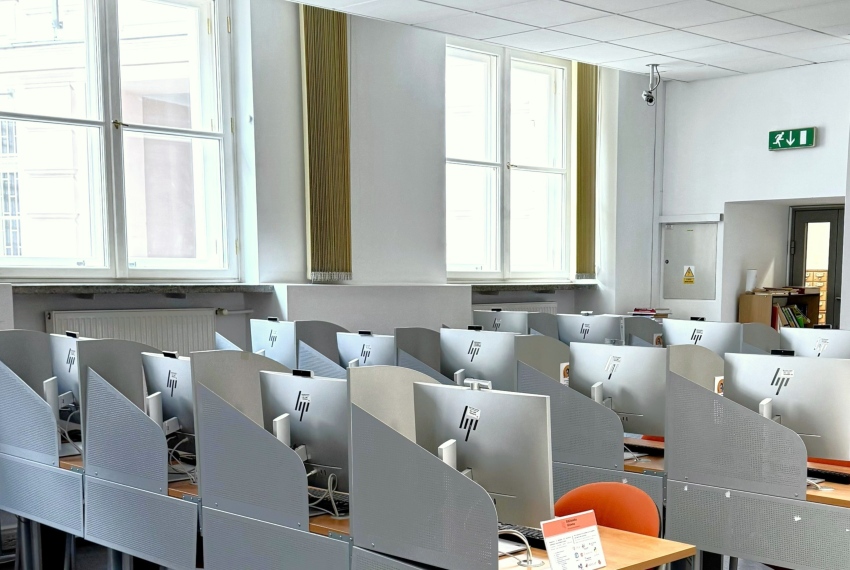
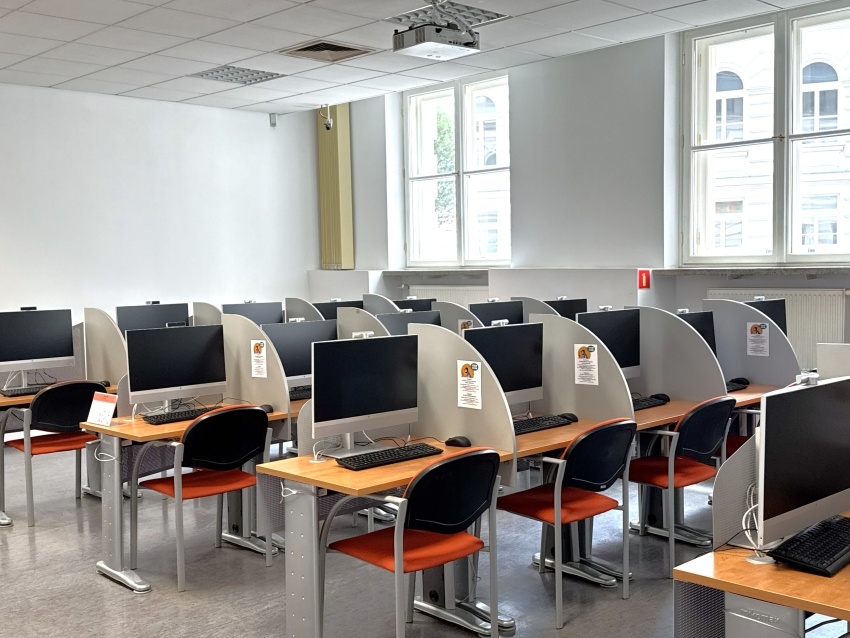
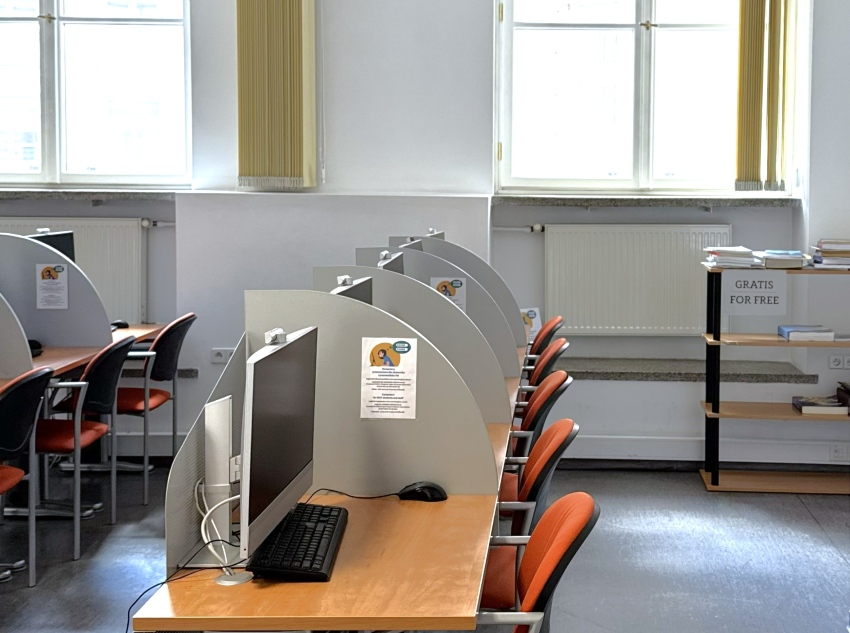
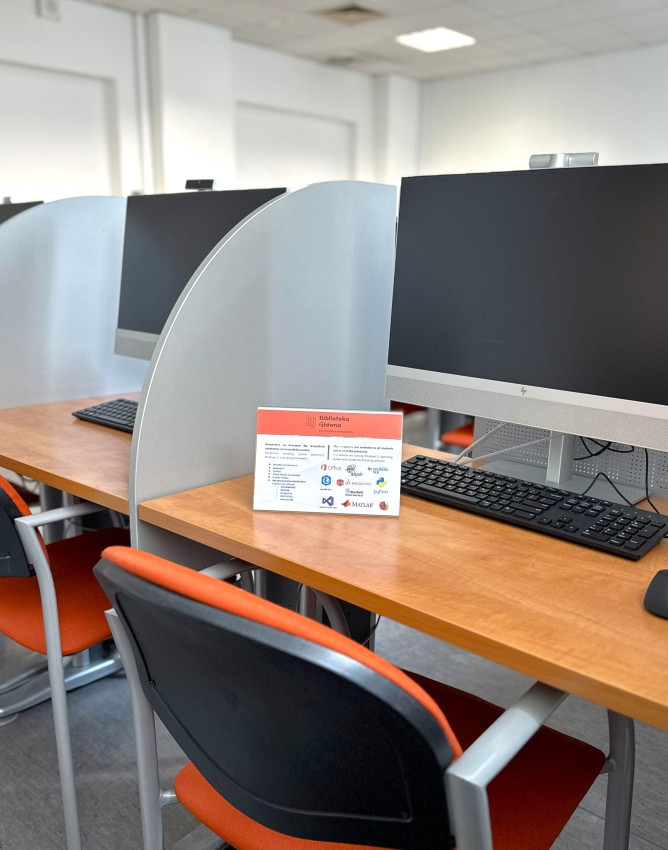
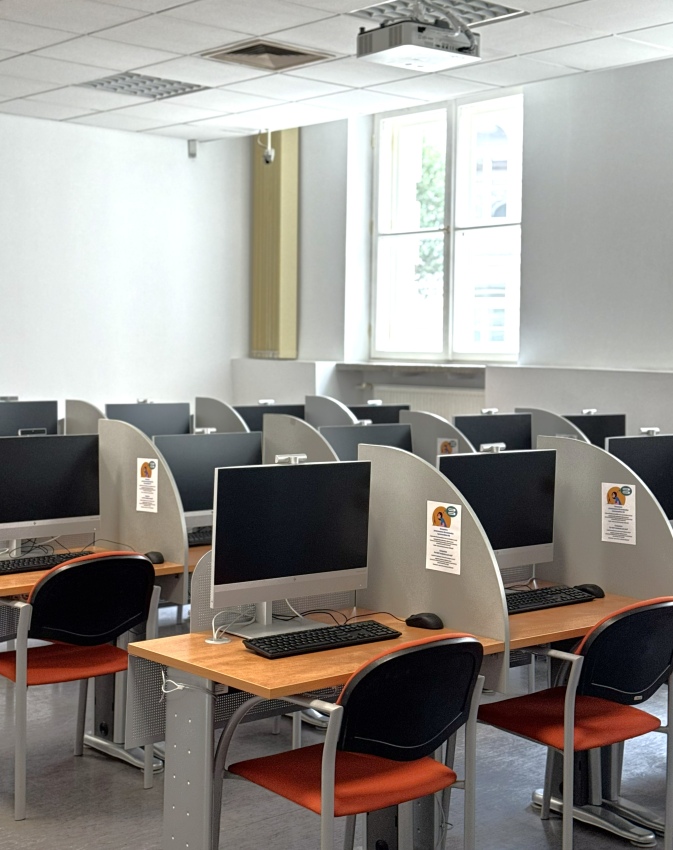
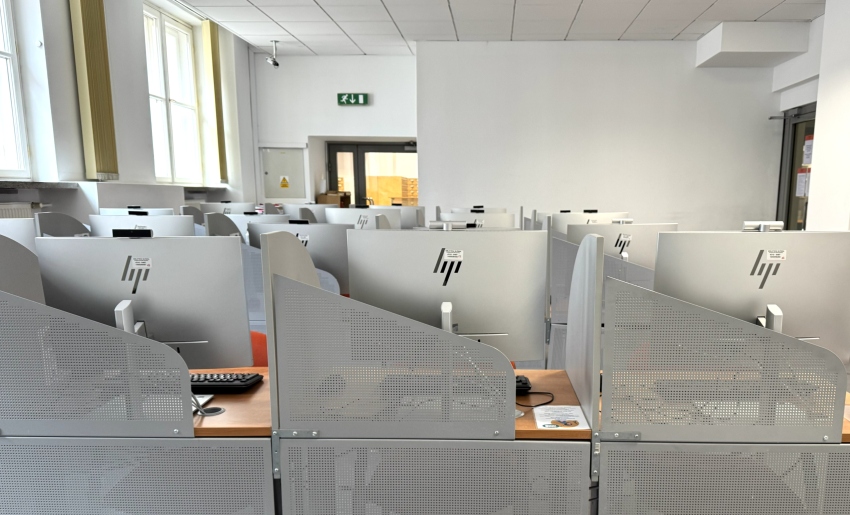
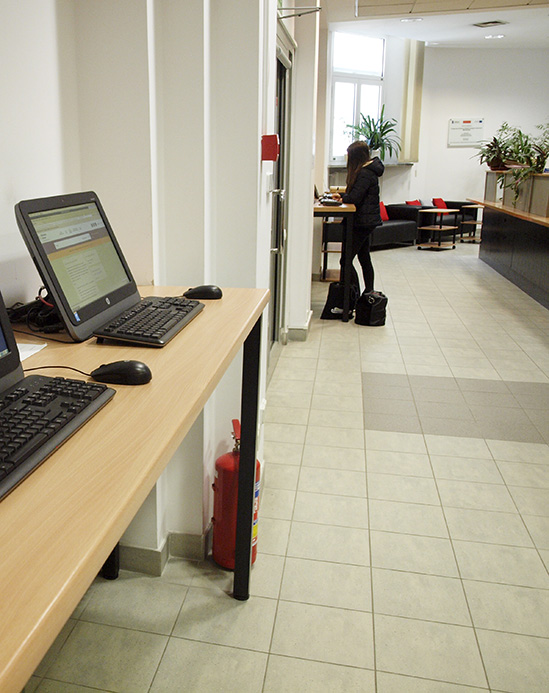

Level III Open Stacks
Library space
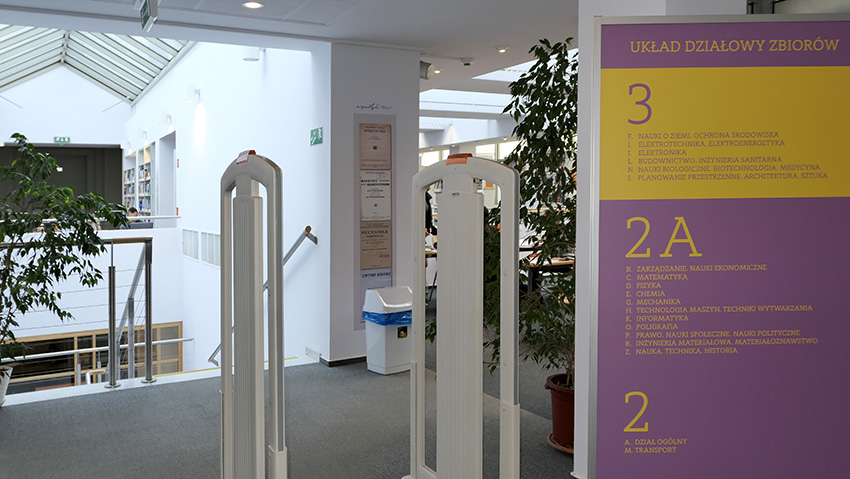

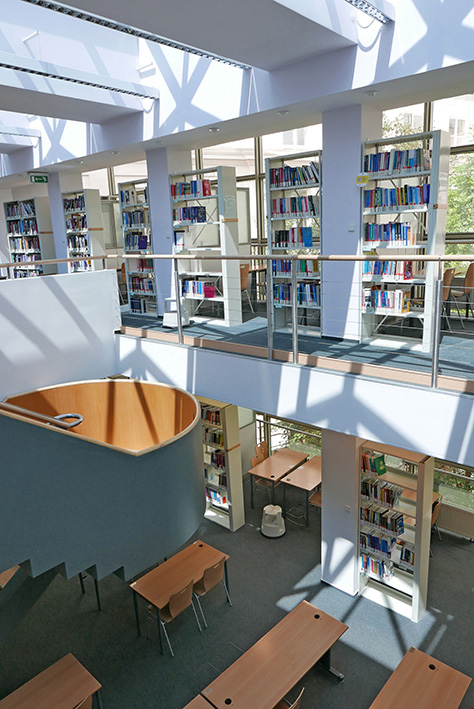


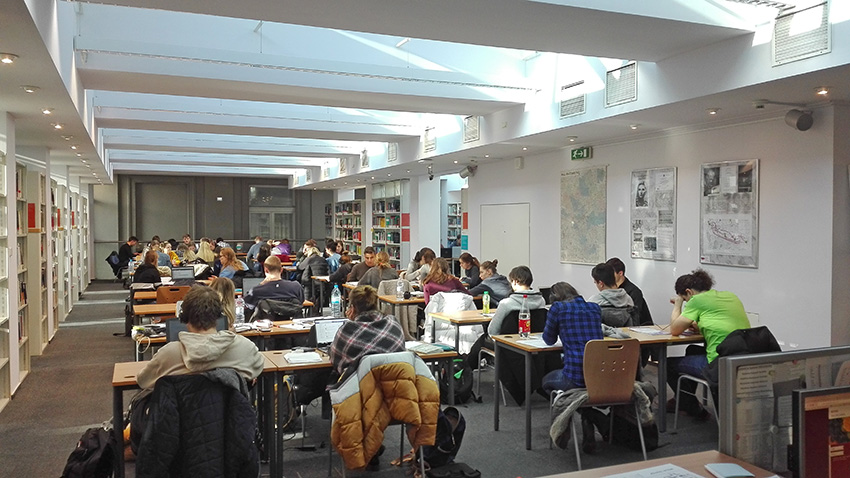


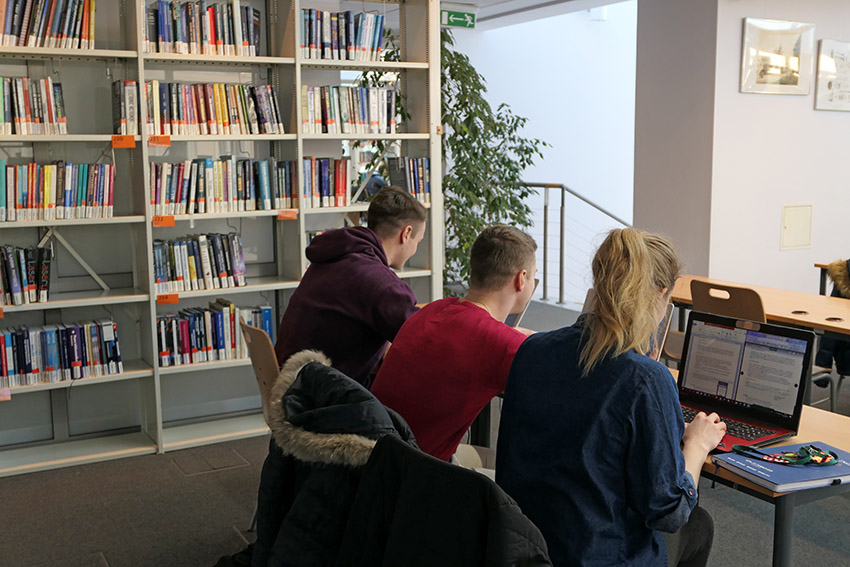

Interlibrary Loans
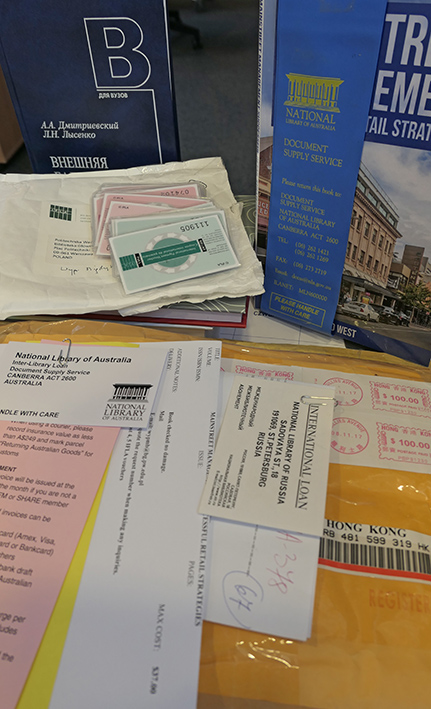
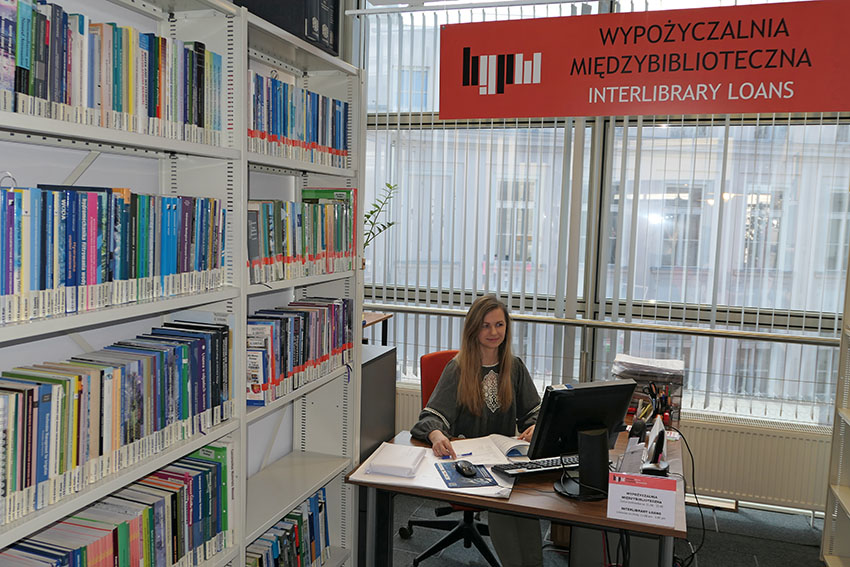
Level IIA Open Stacks
Work space

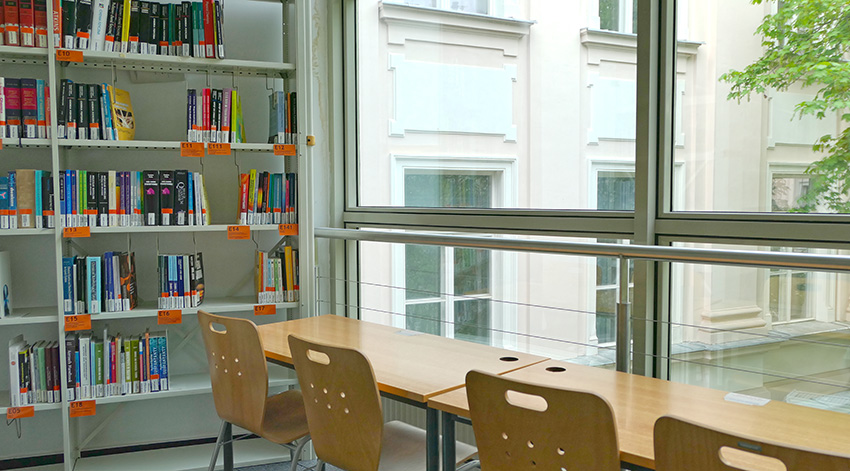


Library space
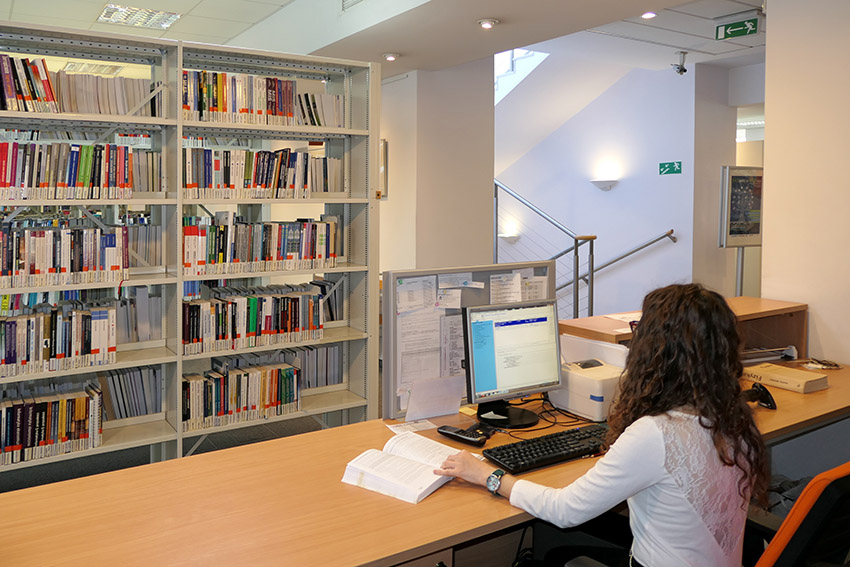
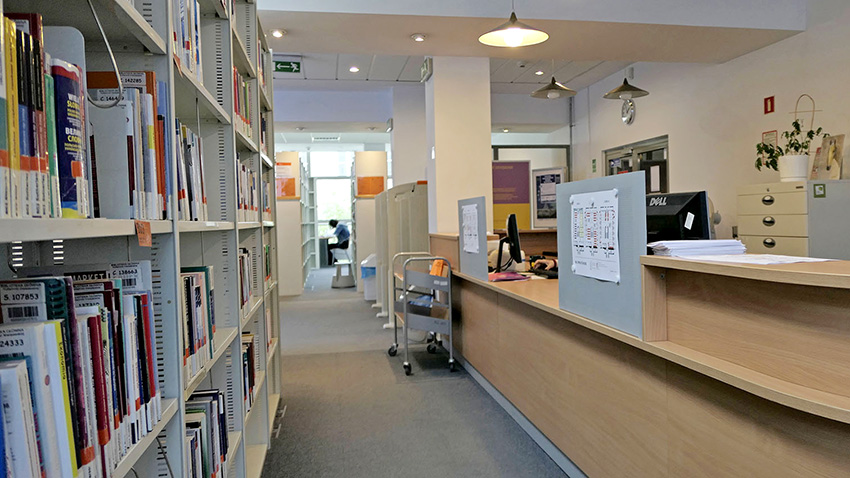

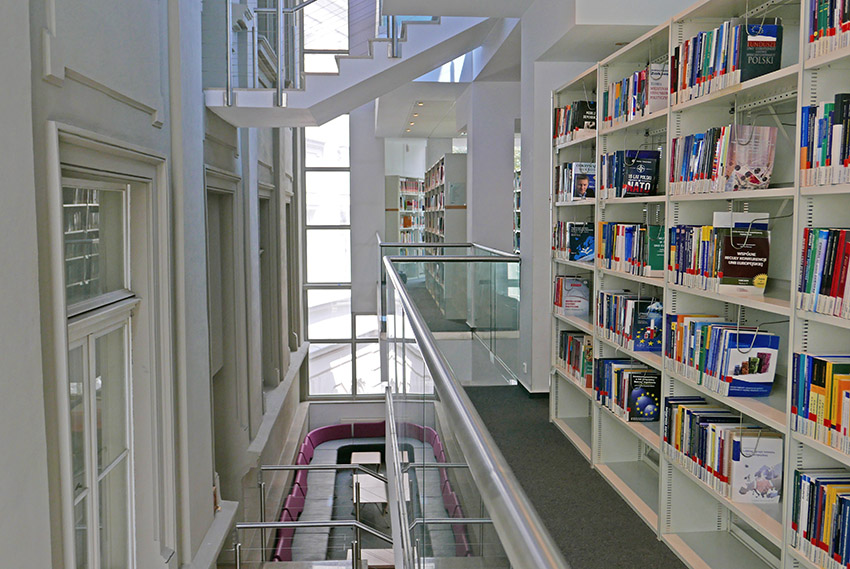

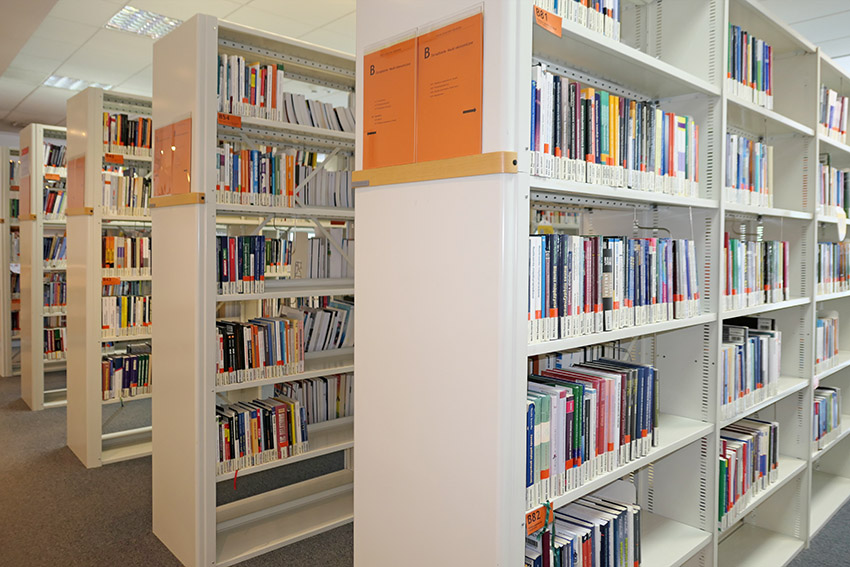
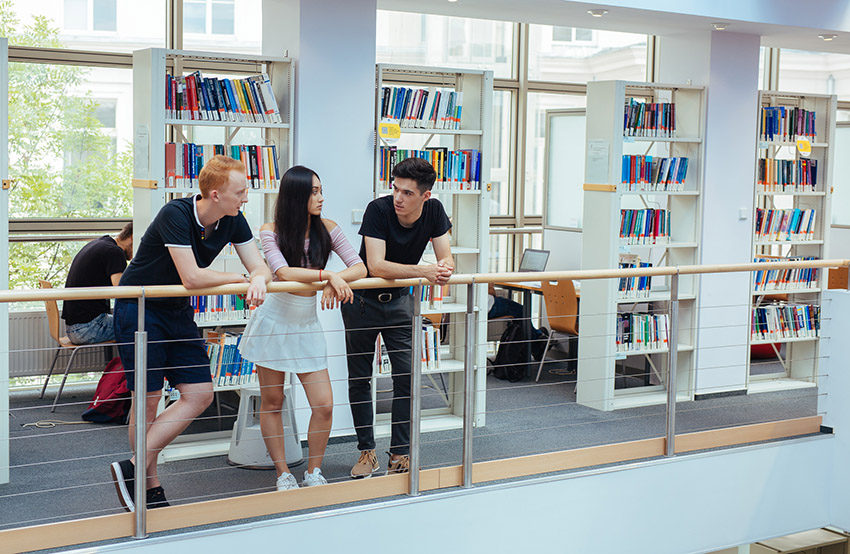











Other pictures
Exterior view of the Library
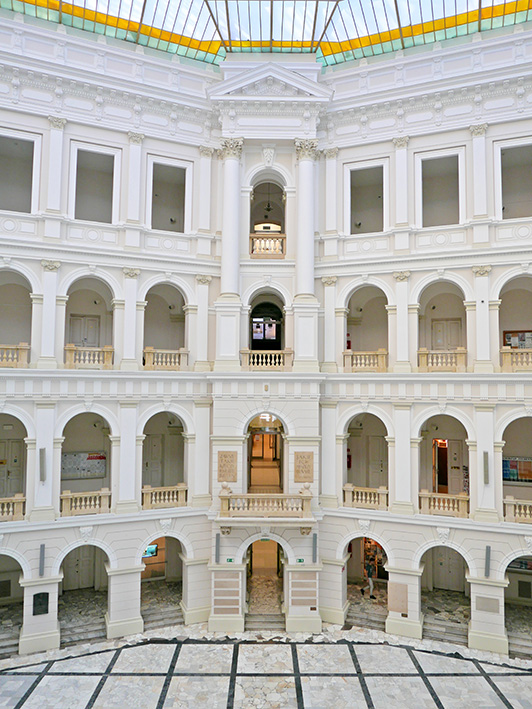
Library stocks


Level II Open Stacks
Library space
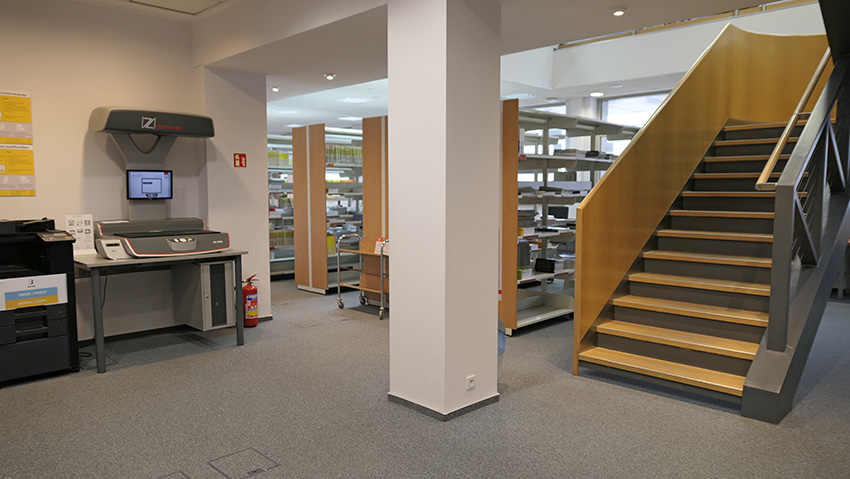
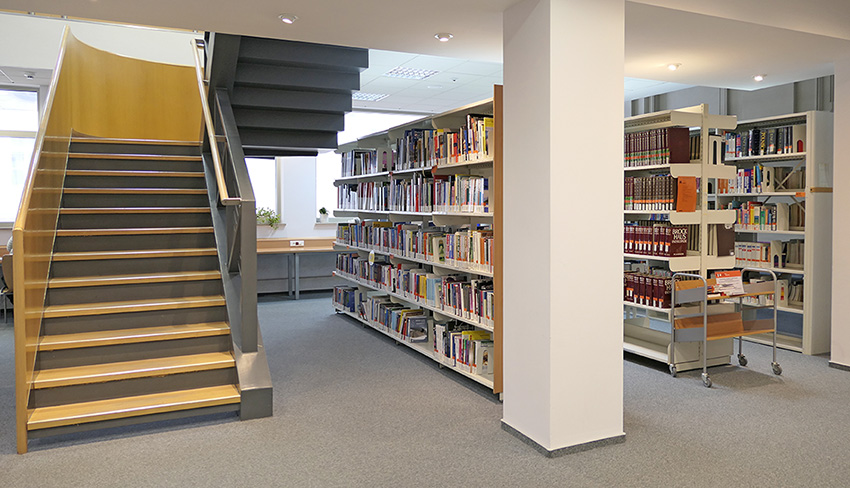


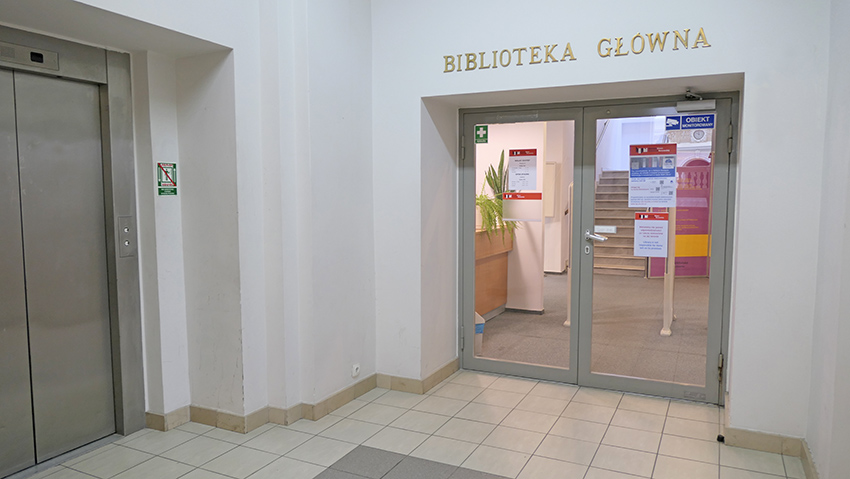
Journals
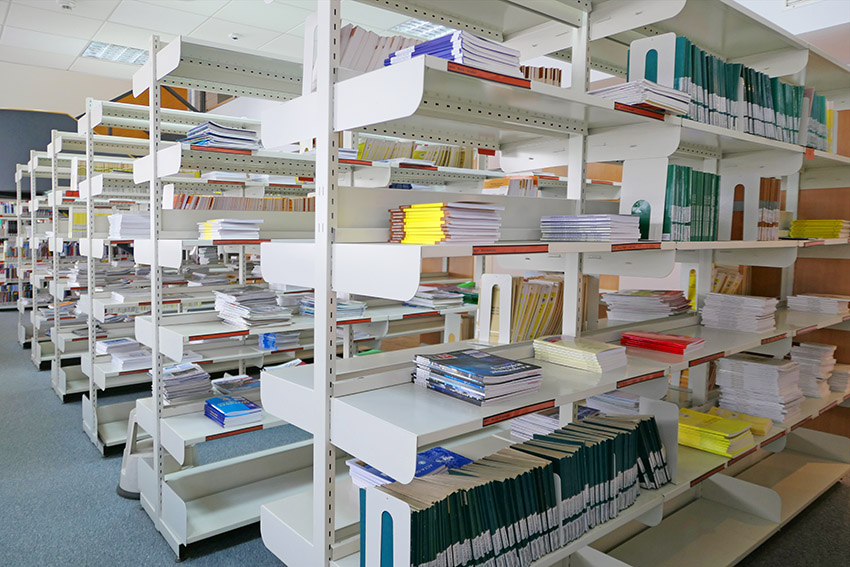
Computer equipment and local databases
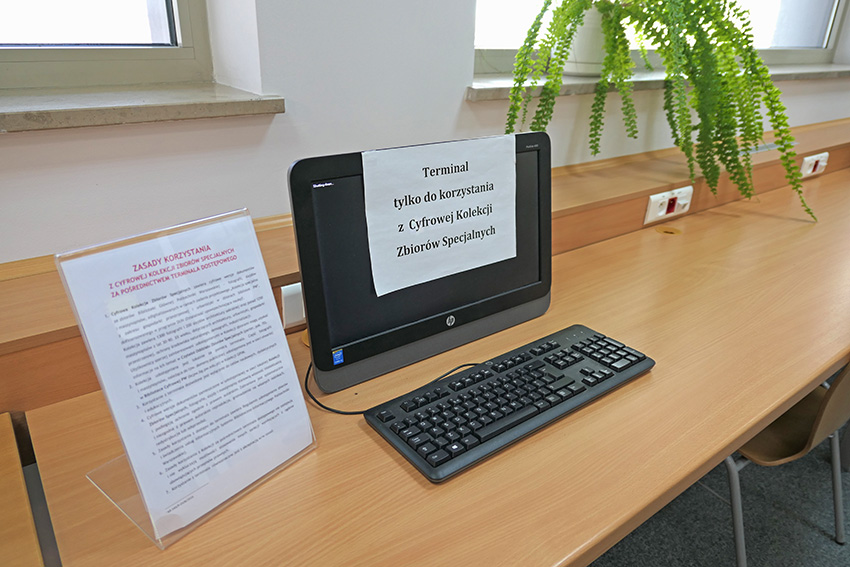

Quiet study area
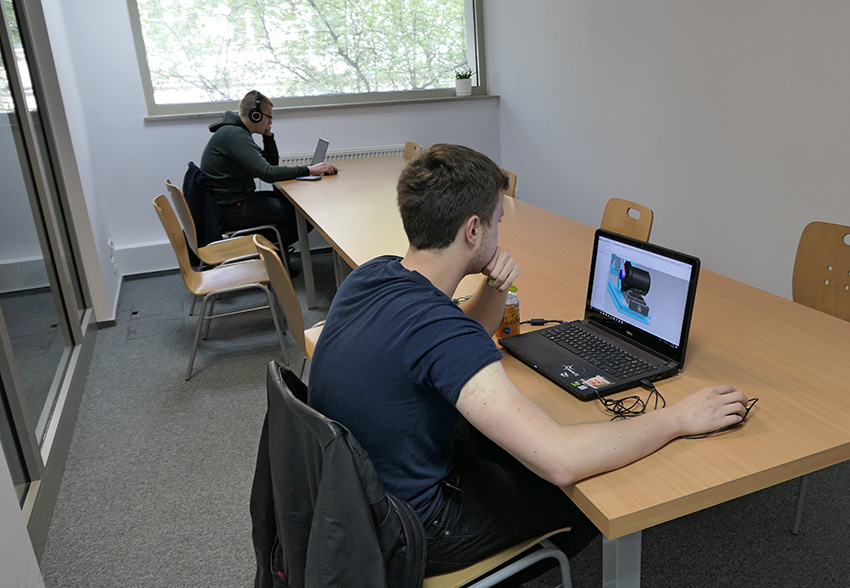
Relaxation area

Self-service copying machines
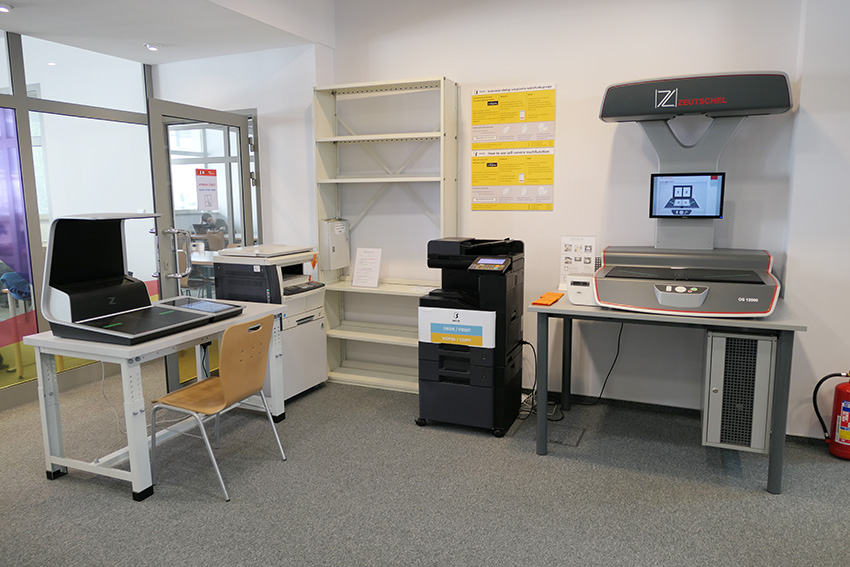
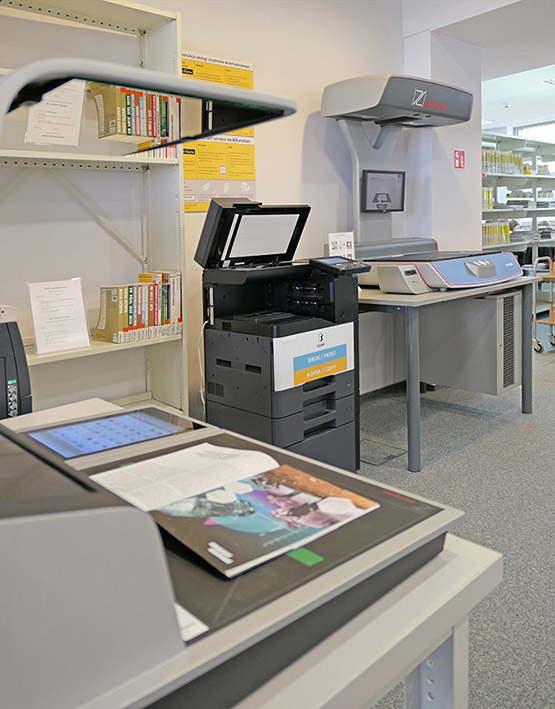
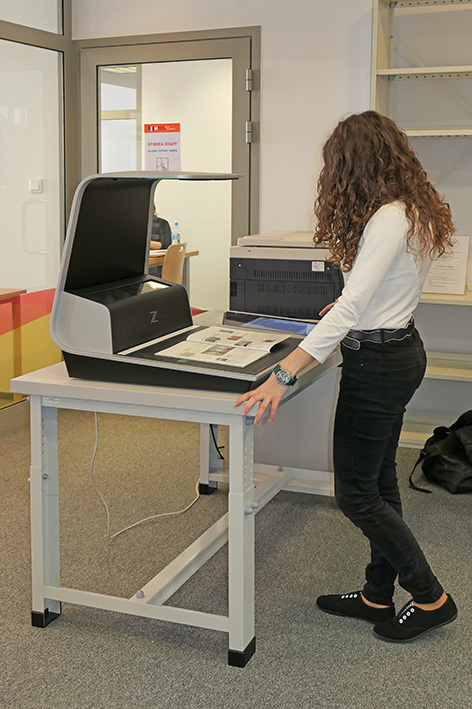
Privacy Policy
Information clause for users of the library system
Pursuant to Article 13 of Regulation (EU) 2016/679 of the European Parliament and of the Council of 27 April 2016 on the protection of natural persons with regard to the processing of personal data and on the free movement of such data, and repealing Directive 95/46/EC (OJ EU L 119/1 of 4 May 2016), hereinafter referred to as “GDPR”, Warsaw University of Technology informs that:
- The Administrator of your personal data is Warsaw University of Technology, with the official seat at Pl. Politechniki 1, 00-661 Warsaw.
- The Administrator has appointed a Data Protection Officer (DPO) within its scope to supervise the correctness of personal data processing, who can be contacted via the following email address: This email address is being protected from spambots. You need JavaScript enabled to view it.
- The Administrator shall process your personal data in the following scope: first name, surname, date of birth, address, e-mail address, telephone number, PESEL number.
- Your personal data shall be processed by the Administrator for the purpose of performing the tasks of the Warsaw University of Technology libraries in the field of user services and protection of library resources. The basis of the processing of your personal data is Article 6(1)(c) of the GDPR and the provision the Act of 27 June 1997 on libraries.
- Warsaw University of Technology does not intend to transfer your personal data outside the European Economic Area, with the exception of the Alma library software manufacturer based in Israel – a country that ensures an adequate level of protection pursuant to the Commission Decision of 31 January 2011 pursuant to Directive 95/46/EC of the European Parliament and of the Council on the adequate protection of personal data in the State of Israel with regard to the automated processing of personal data.
- Your personal data will not be disclosed to other entities (administrators) except for:
- entities authorised under the law;
- entities entrusted by Warsaw University of Technology with the processing of personal data on the basis of concluded agreements, including the National Library.
- Warsaw University of Technology does not use automated decision-making in relation to you, including profiling.
- You have the right to access your personal data and the right to rectify it, the right to request its deletion, restriction of processing, the right to transfer personal data, the right to object to the processing of personal data, the right to withdraw consent at any time without giving a reason, without affecting the lawfulness of the processing that was carried out on the basis of consent before its withdrawal.
- Providing your personal data is voluntary, but failure to do so will prevent you from using the Alma library software.
- Your personal data may be stored until the purpose of processing has been fulfilled, and thereafter during the period of pursuing claims or performing other tasks resulting from legal provisions. Verification of users' liabilities and blocks, preceding the liquidation of library accounts, is carried out systematically once a year.
- You have the right to access your data and the right to report any changes to your personal data at one of the libraries of the Warsaw University of Technology Library and Information System.
- You have the right to withdraw your consent to the processing of your personal data, which is tantamount to terminating your use of the services of the Warsaw University of Technology Library and Information System.
- You have the right to lodge a complaint with the supervisory authority – the President of the Personal Data Protection Office – if you believe that the processing of your personal data violates the provisions of the GDPR.
Information clause for the users of the Warsaw Reciprocal Borrowing Programme (BiblioWawa)
Pursuant to Article 13 of Regulation (EU) 2016/679 of the European Parliament and of the Council of 27 April 2016 on the protection of natural persons with regard to the processing of personal data and on the free movement of such data, and repealing Directive 95/46/EC (OJ EU L 119/1 of 4 May 2016), hereinafter referred to as “GDPR”, Warsaw University of Technology informs that:
- The Administrator of your personal data is Warsaw University of Technology, with the official seat at Pl. Politechniki 1, 00-661 Warsaw.
- The Administrator has appointed a Data Protection Officer (DPO) within its scope to supervise the correctness of personal data processing, who can be contacted via the following email address: This email address is being protected from spambots. You need JavaScript enabled to view it.
- The Administrator shall process your personal data in the following scope: first name, surname, PESEL number, date of birth, address, telephone number, e-mail address, student/city/employee card number.
- Your personal data shall be processed solely for the purpose of implementing the Agreement on the establishment the Warsaw Reciprocal Borrowing Programme, concluded on 2 November 2017 and to present data on your personal account in the application supporting the Warsaw Reciprocal Borrowing Programme (BiblioWawa), which is managed by the University of Warsaw Library. The basis for the processing of your personal data is Article 6(1)(a) of the GDPR.
- Your personal data may be shared for the purpose of providing the BiblioWawa services to the following partner libraries of the Warsaw Reciprocal Borrowing System:
- The Maria Grzegorzewska University, with its registered office at ul. Szczęśliwicka 40, 02-353 Warsaw;
- Józef Piłsudski University of Physical Education in Warsaw, with its registered office at ul. Marymoncka 34, 00-968 Warsaw;
- Warsaw University of Technology, with its registered office at Plac Politechniki 1, 00-661 Warsaw;
- Cardinal Stefan Wyszyński University in Warsaw, with its registered office at ul. Dewajtis 5, 01-815 Warsaw;
- University of Warsaw, with its registered office at ul. Krakowskie Przedmieście 26/28, 00-927 Warsaw;
- Warsaw Medical University, with its registered office at ul. Żwirki i Wigury 61, 01-091 Warsaw;
- Military University of Technology, with its registered office at ul. Gen. S. Kaliskiego 2, 01-476 Warsaw.
- Warsaw University of Technology does not intend to transfer your personal data outside the European Economic Area.
- You have the right to access your personal data and the right to rectify it, the right to request its deletion, restriction of processing, the right to transfer personal data, the right to object to the processing of personal data, the right to withdraw consent at any time without giving a reason, without affecting the lawfulness of the processing that was carried out on the basis of consent before its withdrawal.
- Your personal data will not be disclosed to other entities (administrators) except for entities authorised by law.
- Access to your personal data may be granted to entities (processors) commissioned by Warsaw University of Technology to perform activities that may involve the processing of personal data.
- Warsaw University of Technology does not use automated decision-making in relation to you, including profiling.
- Your personal data may be stored until the purpose of processing has been fulfilled, and thereafter during the period of pursuing claims or performing other tasks resulting from legal provisions.
- Providing personal data is voluntary, but for the provision of services to the programme user.
- You have the right to access your data and the right to report any changes to your personal data at the Student Lending Room of the Main Library of Warsaw University of Technology, Pl. Politechniki 1, 00-661 Warsaw.
- You have the right to withdraw your data, which is equivalent to terminating your use of the Warsaw Reciprocal Borrowing Programme (BiblioWawa).
- You have the right to lodge a complaint with the supervisory authority – the President of the Personal Data Protection Office – if you believe that the processing of your personal data violates the provisions of the GDPR.
Information clause – contact form and other forms of collecting personal data
In accordance with Article 13 of the a regulation of the European Parliament and of the Council 2016/679 of April 27, 2016 on the protection of individuals with regard to the processing of personal data - General Data Protection Regulation (Journal of Laws UE L 119/1 of May 4, 2016 “GDPR”) – the Warsaw University of Technology informs that:
- The data controller of your personal data is the Warsaw University of Technology, represented by the Rector, located at Plac Politechniki 1, 00-661 Warsaw.
- The data controller has appointed a Data Protection Officer that supervises the adequacy of the personal data processing. You can contact the DPO by sending an e-mail to: This email address is being protected from spambots. You need JavaScript enabled to view it.
- The personal data included in the contact form will be used for communication purposes or for providing services on the WUT Main Library website, particularly for processing your enquiry.
- Your personal data will not be transmitted and made available to external parties, except:
- cases laid down by law;
- external parties which concluded contracts with the Warsaw University of Technology on processing the personal data.
- Your personal data will be kept for the duration of providing services and communication, not later than lodging an effective objection.
- Providing personal data is voluntary, however it is obligatory for the purpose they have been collected.
- You have the right of access, rectification and erasure of your personal data, limitation of the data processing, lodging an objection, withdrawal of the consent at any time.
- If you consider that processing of your personal data infringes the regulations of General Data Protection Regulation, you have the right to submit a complaint to the President of the Office of Personal Data Protection.
Cookies
The service uses Cookies for analysis and research and for auditing the website statistics, particularly for creating anonymous statistics which allow to better understand the website traffic. For tracking the actions of the service users, the Google Analytics is used as an analysis tool.
Cookies are not used for collecting personal data or any other confidential information from the user’s device.
The user can change the cookies settings by altering the settings of the browser. The user agrees to use cookies and can deactivate the use of cookies in the Internet browser settings.
Gallery
Ground Floor
Level I
Level II - Open Stacks
Level IIA - Open Stacks
Level III - Open Stacks / Interlibrary Loans
Other pictures
Regulations
- I. GENERAL PROVISIONS
- II. LIBRARY ACCOUNT
- III. ACCESS TO COLLECTIONS
- Forms of Access to Collections
- Access on the Spot
- Free Access
- Requesting Library Documents
- External Loans
- Keeping the Library Document Past the Due Date
- Loss or Destruction of a Library Document
- Inter-library Loans
- Individual Loans from or to Other Institutions
- Access to Electronic Documents
- Information Services
- Reprography
- IV. RULES OF CONDUCT
- V. FINAL PROVISIONS
- ANNEXES
REGULATIONS OF ACCESS TO THE COLLECTIONS AND PROVISION OF IT SERVICES OF THE LIBRARY AND INFORMATION SYSTEM OF THE WARSAW UNIVERSITY OF TECHNOLOGY
I. GENERAL PROVISIONS
Introductory Regulations
§ 1
- Regulations of Access to the Collections and Provision of IT Services of the Library and Information System of the Warsaw University of Technology, hereinafter referred to as “Regulations”, shall apply to all units constituting the library and information system of the Warsaw University of Technology.
- As used in these Regulations, the terms below shall have the following meanings ascribed to them:
- Library- shall mean a unit of the Library and Information System at WUT.
- Specialist library - shall mean a library being a part of a faculty, institute, chair, department, or another organizational unit at WUT.
- BG PW - shall mean the WUT Main Library including the branches and library outlets.
- Blocked library account - shall mean suspension of all services: requests, loans, and extending the loan period for library documents and remote access (outside the area of WUT) to licensed electronic resources.
- Central Catalogue of WUT Library Resources – shall mean a common BG PW catalogue of specialist libraries operating in the integrated library system.
- Library document - shall mean a material published in any form (in print, electronic format, microforms) and unpublished material; stored and/or shared in the or through the library, under the principles specified in the Regulations.
- Document entitling to use the library - shall mean an Electronic Student Card (ELS), Electronic Doctoral Student Card (ELD), Electronic Staff Card issued by the WUT library.
- Library card - shall mean a document entitling its holder to use the library, issued by the WUT Library.
- Head of the library - shall mean a person supervising the management of the library: director of BG PW or head of a specialist library.
- Library account - shall mean personal data of a library user, their rights in the integrated library system, current requests, library documents currently borrowed and history of loans/returns, and charges for overdue documents.
- Deletion of library accounts - shall mean deleting the account from the integrated library system, including the user’s rights.
- Maximum number of documents borrowed - shall mean a maximum number of library documents to be taken out of the library.
- Parent specialist library - shall mean a library constituting a WUT organizational unit in which the user studies or works.
- Special fee - shall mean a fee charged for not returning the borrowed library documents by the due date.
- Extended due date - shall mean a change in the due date for the borrowed item before the expiry of the due date.
- Reservation - shall mean registering a request for an item borrowed by another user, which means queuing for the first copy of the item available in a location selected by the user.
- SBI PW (the Library and Information System of the Warsaw University of Technology) - shall mean the Main Library and specialist libraries operating at the University, hereinafter referred to as the “System” or “SBI PW”.
- SWW (System of Warsaw Loans BiblioWawa) - shall mean a service of loans of printed resources offered as part of an inter-university agreement signed by the Warsaw universities.
- Type of user rights - shall mean the extent of the user’s rights to use the library resources (e.g. the right to borrow documents outside the library, maximum number of documents borrowed, right to use electronic resources).
- USOS (University System of Service for WUT Studies) - shall mean an IT system used for managing the course of studies at WUT.
- User - shall mean a person/ institution using the library following the principles specified in the Regulations.
- Free access - shall mean a designated space in the library in which the user may collect the items themselves from the shelves.
- Free access at BG PW - shall mean an area in the WUT Main Library (in the Main Building) including three floors: II, IIA, III.
- Loan - shall mean making a library item available outside or in the library.
- WMB - shall mean an inter-library loan - sprowadzenie i udostępnienie dokumentu z innych bibliotek na zamówienie uprawnionego użytkownika lub wypożyczenie dokumentu bibliotecznego ze zbiorów własnych innym bibliotekom;
- Request - shall mean selecting a library item from the integrated library system or by a printed order, which the user wants to borrow outside the library or which they intend to use in the library.
- Integrated Library System - shall mean an electronic system that contains: the Central Catalogue of WUT Libraries Resources and the database of library accounts.
- The current list of libraries operating in the integrated library system of the University is available on the website of the Warsaw University of Technology
Personal Data
§ 2
- Information on personal data processing is available in the information clause in Annex 7 - Information clause for the user of the integrated library system.
- The user shall update their personal data and address. Changes shall be reported:
- at the Dean’s office (for users specified in § 4 section 2 items 1, 3-6),
- at the library (for users specified in § 4 section 2 items 2, 7-13).
Fees
§ 3
- Using the resources and services of the libraries within the System is free of charge except for section 2.
- SBI PW Libraries may charge fees for:
- failing to return the borrowed library documents by the due date;
- creating previously ordered reprographic and digital copies and computer printouts;
- information services provided upon the request of users from outside the University;
- servicing inter-library loans for foreign institutions.
- The type and amount of fees specified in section 2 shall be defined:
- for BG PW - a price list approved by the Rector upon the request of the director of the Main Library,
- for specialist libraries, the head of the WUT organizational unit in which the library operates.
II. LIBRARY ACCOUNT
Library Account: Terms of Use
§ 4
- The user has the right to have only one library account in the libraries in the integrated library system.
- The library account in the integrated library system may be owned by:
- academic teachers employed at WUT;
- WUT staff who are not academic teachers;
- WUT doctoral students;
- WUT students;
- students in inter-university exchange;
- WUT postgraduate students;
- persons with a status of a retired WUT Professor – Professor Emeritus;
- retired staff and disability pensioners of WUT;
- persons formally not connected with the University but with a documented activity at WUT (i.e., staff of other scientific institutions temporarily at WUT, doctoral students who are not participants of WUT doctoral studies), based on an application for opening a library account whose template constitutes Annex 2 - Application for opening a library account;
- Third Age University Students;
- institutions within WMB;
- individual users from outside WUT who are entitled based on an SWW agreement or other agreements with WUT;
- users utilizing the resources in the library based on a registration form whose template constitutes Annex 1 - Registration Form.
- The library accounts of users defined in section 2 item 1, 3-6, are opened following automatic data synchronization (once in 24 hours) with the WUT University-Study Oriented System (USOS). Accounts created automatically require activation. To activate a library account, these users are eligible to use a valid:
- Electronic Student Card;
- Electronic Doctoral Student Card;
- post-graduate studies participation card with proof of identity;
- Electronic WUT Staff Card or documents confirming employment at WUT (a document issued/ confirmed by a WUT organizational unit) and proof of identity;
- re-entry card including an Electronic Student Card/Electronic Doctoral Student Card.
- To start/ activate a library account, the users specified in section 2 item 2, 7-13 are entitled to use a valid:
- Electronic WUT Staff Card or other documents confirming employment at WUT (a document issued/ confirmed by a WUT organizational unit) and proof of identity;
- a document confirming the status of Third Age University student and proof of identity;
- card of WUT pensioner or WUT disability pensioner;
- card or any other document entitling to use the library in the parent institution which has signed a contract for library services WUT;
- declaration on cooperation regarding inter-library loans, constituting Annex 6 - Declaration on cooperation regarding inter-library loans;
- application for opening a library account plus proof of identity (shall apply to persons specified in section 2 item 10);
- proof of identity for persons using the library on the spot.
- The library account is active for the period compliant with:
- the expiry date of Electronic Student Card/ the expiry date of Electronic Doctoral Student Card /the expiry date for the agreement in the USOS system for users specified in section 2 item 1, 3-6;
- the account validity period specified in section 8 for other groups of users.
- Extending the validity of the library account is done:
- automatically, in accordance with the expiry date of Electronic Student Card/ the expiry date of Electronic Doctoral Student Card/ the expiry date for the agreement in the USOS system;
- upon presenting a document confirming a current user’s right to activate an account (sections 3-4).
- Users have the following authorization levels in the integrated library system:
- C - authorization level to use the resources on the spot (excluding library documents mentioned in § 10 section 5), including electronic documents made available;
- W - authorization level to borrow library documents outside the library (excluding library documents mentioned in § 13 section 7); specialist libraries may use additional regulations on loans outside the library;
- E – authorization level to access licensed electronic resources from any computer;
- M - authorization level to use the services of the BG PW inter-library, to import documents from national and foreign libraries;
- R - authorization level to borrow library documents from other institutions in Warsaw as part of inter-library loans (except for SWW);
- S - authorization level to borrow library documents as part of SWW.
- Authorization levels of individual user groups, the maximum number of documents borrowed outside the library, and the maximum validity period of a library account are listed in Table 1, except for section 9.
Table 1
No. User type Authorization level (section 7) Max. number of documents borrowed outside the library in the integrated library Max. single extension period/account validity period 1. WUT staff - academic teachers C,W,E,M,R,S 50 items In compliance with the expiry date of the agreement in the USOS 2. WUT staff who are not academic teachers C,W,E,M,R,S 15 items 3 years 3. WUT doctoral students C,W,E,M,R,S 20 items In compliance with ELD expiry date in the USOS 4. WUT students C,W,E,M,R,S 20 items In compliance with ELS expiry date in the USOS 5. Students of inter-university exchange C,W,E,M 10 items In compliance with ELS expiry date in the USOS 6. WUT post-graduate students C,W,E,M,R,S 5 items In compliance with ELS expiry date in the USOS 7. Professor Emeritus C,W,E,M,R,S 50 items unlimited time 8. WUT pensioners and disability pensioners C,W,E,M 15 items 2 years 9. Persons formally not connected with WUT,
but with a documented activity at WUTC,W,E 3 items 1 year 10. Third Age University students C,W 3 items 1 semester 11. Institutions as part of inter-library loans C,W 10 items 1 year 12. Individual users outside WUT as part of SWW or other agreements with WUT C,W 3 items 1 year 13. On the spot users C 1 year - Students doing more than one major at WUT at the same time may borrow up to 50 items.
- Users who have been refused permission to use BG PW or specialist libraries shall have the right to appeal within 7 days:
- for BG PW, to the WUT Main Library director and then to the WUT Rector; or
- for a specialist library, to the head of a specialist library, and then to the head of the WUT organizational unit within which the specialist library operates.
- Specialist libraries may apply additional regulations depending on the specific work of a given unit on defining groups of users eligible to use the library, the maximum number of borrowed documents, the maximum extension of account validity. These regulations shall be approved by the head of the WUT organizational unit in which the library operates.
Activating the Library Account
§ 5
- A library account in the integrated library system may be activated:
- online - for users defined in § 4 section 2 items 1, 3-6;
- after the user reports to the library and presents a document proving eligibility, in compliance with § 4 sections 3-4.
- Online activation of a library account involves entering an individual log-in password.
- By activating the account, the user shall follow these Regulations.
Document Entitling to Use the Library
§ 6
- A document entitling to use the library is used to identify the user in the integrated library system and the library.
- A document entitling to use the library may not be shared with other persons.
- For a specified time, a holder of a document entitling to use the library may authorize another person to borrow library documents in their library account after submitting an authorization form to BG PW Annex 3 - Authorization To borrow library documents for the template.
- If the card or any other document authorizing its holder to use the library is lost or destroyed, the holder shall immediately notify the library (in person, by phone, or email). The holder shall be held liable for any damage resulting from failure to do so. A copy of the library card 1 may be received after submitting a written declaration, in compliance with the template in Annex 4 - Statement on loss of the library card.
Blocking the Library Account
§ 7
- Blocking the library account shall occur:
- if the user keeps any documents past due date from:
- BG PW,
- specialist libraries operating in the integrated library system,
- specialist libraries not operating in the integrated library system provided that they inform BG PW and other specialist libraries about overdue library documents,
- other libraries (outside WUT) in which the user is authorized to use based on these Regulations;
- if the amount of calculated special fees in the library account exceeds PLN 5;
- after the expiry date of the library account specified in § 4 section 8 unless the user, has presented a document entitling them to continue using the library or the library has not received such data from any other sources (e.g., the USOS system);
- after deleting the user from the student register;
- after terminating an employment contract;
- after clearing all accounts with WUT libraries following the termination of the employment contract or completing studies;
- after reporting by the parent institution on the expiry of authorization to use (shall apply to users specified in § 4 section 2 item 12);
- if the user has breached the provisions of these Regulations specified in § 21.
- if the user keeps any documents past due date from:
- As specified in section 1 item 1, the library account shall remain blocked until all documents are returned in all libraries listed.
- Blockades specified in section 1 items 2-7 shall last until:
- all calculated special fees are paid; or
- the user presents to the library staff a document authorizing them to continue using the library; or
- the information from another source is received (e.g., from the USOS);
- the user presents to the library staff the decision to re-enter the University.
- The blockade specified in section 1 item 8 shall last until the decision on temporary refusal to grant authorization to use WUT libraries expires.
- The user shall have current access through the Internet to the information on their library account, including the expiry date, current loans, current requests and reservations, and calculated special fees. WUT Library shall not be held be responsible for sending individual notifications about the account.
- The user shall control their account on a current basis, pay any fees due and immediately report any errors.
Closing the Library Account
§ 8
- Closing the library account is possible provided that the user:
- has returned all borrowed library documents and library checkout sheets for inter-library loans;
- has paid all calculated special fees;
- has cleared all accounts within SWW and WUT agreements with other institutions.
- To close the library account, the user may receive a confirmation of a clean loan and fee record at WUT libraries:
- in the USOS web system (this shall apply to WUT organizational units, which use EDMS);
- in the student clearance form at the library.
- To close the library account, users listed in §4 section 2 items 9, 11-13 shall report the closure to the WUT library.
III. ACCESS TO COLLECTIONS
Forms of Access to Collections
§ 9
- SBI PW libraries provide access to their collections:
- on the spot;
- outside the library to persons with an active library account and authorized to external loans (W authorization level);
- outside the library to institutions as part of inter-library loans;
- in the WUT computer network or remotely, from any computer if the user is eligible to use this service (E authorization level).
- Providing access to collections deposited at the WUT libraries shall be specified in terms of deposit agreements about which the users are informed separately.
Access on the Spot
§ 10
- All interested users may use the library collections on the spot. Upon the request of library staff, users shall present a document entitling them to use the library.
- Documents that can be used on the spot include:
- documents located in reading rooms and warehouses with free access, documents shared on the Internet and own materials;
- documents located in closed warehouses after making a request;
- documents printed and imported as part of inter-library loans;
- documents located in the collections of the Division of Special Collections and Creation of Digital Resources of BG PW under the following principles:
- upon presenting a valid document authorizing to use the library,
- the number of a single access provided to a user shall be limited to 3,
- access to the originals of library documents under special protection shall be provided with the consent of the head of the Division of Special Collections and Creation of Digital Resources based on a completed lending form,
- due to the technical state of the document, the head of the Division of Special Collections and Creation of Digital Resources may refuse to provide access to the original or provide access to its copy.
- Using the collections on the spot shall be possible only in designated locations.
- As concerns the resources listed in section 2 items 2-3, the user shall leave the document authorizing them to use the library with the library staff on duty for the time of being granted access to them.
- Theses of WUT students shall be made publicly available provided that the writer has given consent in the declaration on granting the Warsaw University of Technology a license.
- The following library documents shall not be made publicly available:
- library documents with “Archived” status;
- library documents in poor technical condition.
Free Access
§ 11
- Free access shall involve the following:
- users search for, and transfer library documents themselves in the designated area of the library;
- users use the selected library documents on the spot or borrow them outside the library;
- users leave the used library documents in the designated areas and do not put them away on the shelf.
- Library documents located in BG PW Free Access may not be requested. It is possible to reserve them if they are borrowed by another user.
- Specialist libraries may apply additional regulations on providing free access, in compliance with the specifics of the collections of a given unit.
Requesting Library Documents
§ 12
- Library documents located in closed warehouses shall be requested.
- The user may request an item:
- electronically, in the integrated library system if the item description contains the “Request” option;
- on a paper lending form if:
- requesting a book in the integrated library system (does not apply to items made available as part of free access to collections),
- the item is not registered in the integrated library system.
- The request may be fulfilled on the day of its placement provided it is made no later than half an hour before closing the library.
- Requested library documents shall be stored for the ordering person no longer than:
- 4 working days from fulfilling the request;
- 12 working days from the day of fulfilling the request – this solely applies to WUT extramural and post-graduate students.
- The collection spot for the requested item shall be specified in the integrated library system or by the library staff when accepting the request on a paper lending form.
External Loans
§ 13
- The loan period shall be governed by the following principles:
- the basic loan period shall be specified for each item in the integrated library system;
- the real loan period shall be no longer than the validity period of the library account;
- for inter-library loans, the maximum loan period shall be 60 days.
- The library item purchased by a person eligible to have a library account with funds for scientific work (e.g., research, implementation, project) and transferred for registration in the library may be borrowed once for a period equal to the implementation period of this work. As soon as that period expires, the period for the next loan is equal to a basic loan period specified in the integrated library system.
- Under justified circumstances, the head of the library may:
- request a shorter loan period upon lending the item;
- request the borrowed item to be returned before the due date.
- The user may extend the due date for the borrowed item provided that the item has not been requested by another reader. The extension can be done:
- once for the period no longer than the basic loan period, specified in the integrated library system for a given item; the extension period shall be calculated from the day on which it is extended;
- in the integrated library system, by users themselves or by the library staff, without the necessity of presenting the item, in compliance with the maximum loan period for a given library. When using the maximum period, another extension shall require presenting the item at the library in which the user borrowed it. At BG PW, it is possible to extend the due date three times, to the exclusion of inter-library loans.
- Loans of documents whose loan period specified in the integrated library system is shorter than 7 days may not be extended.
- Depending on the location, borrowing a document of extraordinary value, i.e., registered in the fixed assets inventory of the University or unique for other reasons, requires the consent of the BG PW director or the head of the specialist library and concluding an agreement whose template constitutes Annex 5 - Agreement on lending a document of extraordinary value.
- External loans are not possible for:
- library documents with “Archived”, “In the reading room”, “On the spot”, “Request to the reading room”, “Request to BD Journals”, “Own use”, “Reserved” status;
- special collections (iconography, norms, maps, manuscripts, documents being a part of the historical collection);
- documents imported as part of inter-library loans;
- newspapers;
- documents with manuscript rights, including dissertations;
- doctoral theses;
- microforms;
- library documents with numerous tables, maps, drawings, and portfolios with loose cards.
- The user shall:
- monitor the due date for the borrowed item and its return by the due date;
- return the library item borrowed outside the spot in which the loan was made.
Keeping the Library Document Past the Due Date
§ 14
- Keeping the library document past the due date will block the library account until the account is cleared and a special fee is calculated, as specified in § 3 section 2 item 1.
- Keeping the library document past the due date, borrowed at any library will block the account at every SBI PW library that the member uses based on the Regulations.
Loss or Destruction of a Library Document
§ 15
- In the event of loss or destruction of the borrowed library document, the user shall provide the library with an identical item.
- If it is impossible to provide an identical item, to compensate for the loss the user shall provide a different item or items suggested by the library (with a value approximating the value of the lost one).
- The price of the item compensating for the loss borne by the library may not exceed:
- a double price of the lost/destroyed document in the book market;
- a double average purchasing price of documents for the past year, as defined in the principles in section 4 if the item’s market price is unknown;
- a triple value of the library document stated in the agreement if the loan was made as specified in § 13 section 6.
- An average purchasing price of library documents, defined separately for Polish and foreign documents, is available on the BG PW homepage, and is updated in February every year.
Inter-library Loans
§ 16
- For users with M authorization level, BG PW shall import documents from national libraries located elsewhere (excluding those located in Warsaw) and foreign libraries under the following principles:
- from national libraries only documents missing in Warsaw’s libraries shall be imported; from foreign libraries, only documents not owned by national libraries shall be imported; documents are made available in BG PW Free Access;
- inter-library lending forms are issued for Warsaw’s libraries with which BG PW has concluded appropriate agreements (this does not apply to the libraries participating in the SWW BiblioWawa agreement);
- requests for documents can be made:
- via the Internet, filling in a request form on the website of the Main Building in the bookmark Inter-library Loans,
- via email of Inter-library Loans,
- personally in the Inter-library Loans section.
- BG PW shall make inter-library loans for out-of-town national and foreign institutions under the following principles:
- BG PW shall lend its own collections to institutions outside WUT for a maximum of 60 days, calculated from the day of dispatching the item(s);
- Instead of borrowing the original, BG PW may create a copy of the searched item at the expense of the requester (under the Act of 4 February 1994 on Copyright and Related Rights, Journal of Laws of 2021, item 1062);
- BG PW shall fulfill requests sent to the email address of Inter-library Loans;
- The delivery cost of sending the requested documents by post shall be paid by BG PW, the cost of return shall be paid by the requester;
- Documents borrowed from BG PW may be made available in the requesting institution only on the spot;
- Documents returned to BG PW shall be sent by insured or registered mail and properly secured against damage.
- BG PW shall fulfill inter-library loans for institutions in Warsaw under the following principles:
- The institution requesting the library documents from BG PW shall sign and deliver a declaration on cooperation in inter-library loans whose template constitutes Annex 6 - Declaration on cooperation regarding inter-library loans;
- The institution requesting the library documents shall annually renew the declaration and update any changes to the data included in the declaration;
- The requests are accepted in paper lending forms with a stamp of a requesting institution and data and signature of an authorized person.
- The provisions on the maximum number of loans, expiry date of the account, extension, charges for not returning the items by the due date, or loss of documents shall apply to all institutions making inter-library loans, as specified in these Regulations.
Individual Loans from or to Other Institutions
§ 17
- Upon closing the library account at SBI PW, the WUT user eligible for individual loans at other libraries (R and S authorization levels) shall clear all accounts with those libraries in which they activated a library account.
- The institution with which WUT has concluded an agreement to make the collections available shall specify the terms of using the collections for WUT users.
- WUT users, defined in § 4 section 8, with R and/or S authorization level, who use external institutions and users outside WUT, defined § 4 section 2 item 12, who use WUT libraries, shall follow the principles in these Regulations and the regulations defined in an agreement concluded between WUT and an external institution.
Access to Electronic Documents
§ 18
- Terms of using and accessing specific electronic documents arise from an agreement concluded with their provider or publisher. Users shall be informed about the terms on the BG PW website.
- Access to electronic documents for the use of which WUT has bought a license or author’s consent shall be provided:
- to any computer registered in the University network;
- to any computer in an extended network based on the user’s authorization (E authorization level).
- Electronic documents may be used by users exclusively:
- for their own use, for scientific, teaching, or educational purposes;
- abiding by the copyright and terms of the user’s license applying to a given item.
- In the event of improper use of electronic documents (incompliant with section 3 item 2) the user shall suffer the consequences arising from the terms of license and/ or copyright.
- Electronic documents recorded on external information carriers (CD, DVD), which are not restricted by licenses in making available, shall be borrowed outside the library under the same principles as for printed items.
Information Services
§ 19
- Libraries shall provide free information services regarding the collections available in SBI PW and the collections of other libraries, except for the services listed in § 3 section 2 item 3.
- Libraries shall organize free-of-charge training on using the available information sources.
- Usługi informacyjne wykonywane w bibliotece nie obejmują sporządzania zestawień literatury przedmiotu, m.in. do prac dyplomowych.
Reprography
§ 20
- Reprographic services shall be provided in libraries that own appropriate copying equipment.
- In the libraries specified in section 1, users may request or make themselves copies of parts of library documents for their own academic needs.
- Libraries shall have the right to refuse to provide access to a library document to make a photocopy due to its technical state or other (unique) features, which may exclude photocopying.
- Dissertations and doctoral theses may not be recorded or copied in any form and using any technique.
- It is prohibited to systematically reproduce the library documents, violating copyright laws, to collect the items on your own carriers, to redistribute and re-sell them (pursuant to the Act of 4 February 1994 on Copyright and Related Laws Journal of Laws of 2021, item 1062).
IV. RULES OF CONDUCT
User’s Obligations
§ 21
- The user shall follow these Regulations, Rules of Conduct applicable at the Warsaw University of Technology and follow the recommendations and guidelines of the library staff.
- In the library, the user shall behave properly and respectfully.
- The library user shall:
- leave their coats and luggage in the cloakroom;
- upon the library staff’s request, the user shall present a document entitling them to use the library or a valid proof of identity;
- respect the available library collections, report any noticed losses or damage to the library staff, put away the used items solely in the designated spaces;
- use respectfully the computer and other equipment in the library, report any faults and breakdowns to the library staff;
- upon the library staff’s request, present any library items held (e.g. when the anti-theft alarm goes off);
- remain quiet (e.g. put the phone on silent mode, avoid talking on mobile devices);
- maintain order on the spot (e.g. not leave any rubbish);
- not leave personal items unattended – the library shall not be held responsible for them.
- It is prohibited to:
- disturb other users by talking loudly, listening to loud music, among other things;
- smoke tobacco, use electronic cigarettes, consume alcohol, and take mind-altering substances in the library;
- enter the library under the influence of alcohol or mind-altering substances, or with clear signs of poor hygiene;
- eat and drink (except for bottled water);
- bring dangerous objects (e.g. weapons, knives, gas spray);
- unplug the computers and devices belonging to the library and change any system configurations of the equipment;
- take away any library collections and devices owned by the library without the librarian’s consent;
- conduct advertising, promotional, or any other campaign in the library, specifically take photos, film the interior of the library, place posters and notices on the noticeboards and leave leaflets; such actions require the consent of the head of the library.
Breach of the Rules
§ 22
- You will be banned from using the library collections for taking away items owned by the library or unborrowed library documents. Legal action may be taken against WUT staff, doctoral students, and students to punish them with a fine or disciplinary penalty specified in the laws applicable at WUT.
- When breaching these Rules, the user may:
- be given a warning by the library staff;
- be removed from the library by the WUT Academic Guards upon the request of the library staff;
- have their library user rights temporarily suspended by the order of the head of the library;
- the head of the library may notify the user’s superior about breaching the Rules of Conduct.
- The sanctions defined in section 2 are not mutually exclusive and these Rules shall not replace or exclude imposing other sanctions arising from generally applicable laws.
- The user may appeal against the decisions taken in compliance with section 2 items 1-2 within 7 days to the BG PW director or head of the library; the user may appeal against decisions taken in compliance with section 2 items 3-4 to the Rector or the head of the organizational unit in which the specialist library operates, respectively.
V. FINAL PROVISIONS
§ 23
The text of these Rule and Regulations is available on the website of BG PW and in all units of the WUT Library and Information System.

Annexes to the Regulations
- Annex 1 - Registration Form
- Annex 2 - Application for opening a library account
- Annex 3 - Authorization To borrow library documents
- Annex 4 - Statement on loss of the library card
- Annex 5 - Agreement on lending a document of extraordinary value
- Annex 6 - Declaration on cooperation regarding inter-library loans
- Annex 7 - Information clause for the user of the integrated library system
WUT Base of Knowledge
The aim of Knowledge Base of the Warsaw University of Technology is to promote the scientific achievements of the faculty, university PhD students and students. The operation of the WUT Knowledge Base was approved by a resolution of the WUT Senate on 21 November 2012.
The policy of depositing and archiving scientific achievements and the repository was defined by Ordinance No. 3/2014 of the Rector of the Warsaw University of Technology dated 29 January 2014.
The repository – an integral part of the system - collects and archives metadata and full text digitalized materials such as:
- Publications - monographs, journals articles, book chapters, reports;
- Artworks - architectural & artistic works
- Research data
- Multimedia – multimedia materials
- PhD theses
- Diploma theses – the MSc and BSc theses
All the functions of the WUT Knowledge Base provide functionalities of the full fledge Current Research Information System (CRIS). More details about the system can be found in the document:
OMEGA-PSIR – a University Research Information System
Acknowledgment:
The concept, technical design and software of the WUT Base of Knowledge were implemented at the Faculty of Electronics and Information Technology. Main Library was in charge of organizing the project implementation, preparation of legal documents, training and verification of the data records.
The List of libraries
Libraries that cooperate in creating the WUT Central Catalogue:
- WUT Main Library
- Main Libray Branches:
- Branch Library - Library of Southern Campus
- Branch Library of Faculty of Chemistry
- Branch Library - Library of the Warsaw University of Technology in Plock
- Library of Students' Hall of Residence "Akademik"
- Faculty Libraries
- Library of Faculty of Architecture
- Library of Faculty of Automobiles and Heavy Machinery Engineering
- Library of Faculty of Chemical and Process Engineering
- Library of Faculty of Civil Engineering
- Library of Faculty of Electronics and Information Technology
- Library of Institute of Control and Computation Engineering
- Library of Institute of Computer Science
- Library of Institute of Telecommunications
- Library of Faculty of Environmental Engineering
- Library of Faculty of Materials Science and Engineering
- Library of Faculty of Mathematics and Information Science
- Library of Faculty of Mechatronics
- Library of Faculty of Physics
- Library of Faculty of Power and Aeronautical Engineering
- Library of Institute of Aeronautics and Applied Mechanics
- Library of Institute of Heat Engineering
- Library of Faculty of Transport
- Library of Institute of the Theory of Electrical Engineering and Electrical Measurement - Faculty of Electrical Engineering
Uczelniany Program Badawczy
Uczelniany Program Badawczy — 2010 rok
W 2010 roku Wydziały: EiTI, IŚ i Chemiczny wspólnie z BG PW prowadziły prace w zadaniu zatytułowanym: Projekt i implementacja pilotowego systemu repozytorium dla prac dyplomowych (inżynierskich, magisterskich i doktorskich) oraz publikacji pracowników Politechniki Warszawskiej. BG PW konsultowała projekt na etapie opracowania struktury metadanych i raportów z systemu oraz prowadziła prace testowe systemu, a także uczestniczyła w przygotowaniu programów do importu / eksportu metadanych z różnych systemów ewidencji publikacji stosowanych na Uczelni do bazy Biblio prowadzonej od wielu lat w BG PW.
Projekt dofinansowany ze środków Rektora PW.

PASSIM / SYNAT
PASSIM / SYNAT — lata 2010-2013
W okresie 2010-2013 Biblioteka Głównej uczestniczyła w realizacji projektu finansowany ze środków NCBiR PASSIM / SYNAT (Utworzenie uniwersalnej, otwartej, repozytoryjnej platformy hostingowej i komunikacyjnej dla sieciowych zasobów wiedzy dla nauki, edukacji i otwartego społeczeństwa wiedzy) realizowanym przez konsorcjum instytucji naukowych (jednostką wiodącą dla części PASSIM jest Wydział EiTI). BG PW była odpowiedzialna za realizację etapu B3: Analiza cyfrowych zasobów informacyjnych PW wraz z ich rozbudową oraz źródeł krajowych i zagranicznych, tradycyjnych i elektronicznych (cyfrowych) w zakresie nauk ścisłych i technicznych. Adaptacja słowników/tezaurusów/ontologii w dziedzinie techniki i nauk ścisłych. Zadania Biblioteki Głównej PW koncentrowały się na opracowaniu metody wyboru, selekcji i trybu rejestracji polskich stron internetowych z zakresu techniki, a także nad oceną różnych metod prowadzenia retrokonwersji.
Projekt finansowany ze środków NCBiR


Uruchomienie i bieżąca aktualizacja Repozytorium Politechniki Warszawskiej
Uruchomienie i bieżąca aktualizacja Repozytorium Politechniki Warszawskiej — 2012 rok
Działania zmierzające do utworzenia w PW Repozytorium PW, zainicjowano w 2010 roku, wspólnym projektem Wydziałów: EiTI, Chemicznego i Biblioteki Głównej realizowanym w ramach Uczelnianego Programu Badawczego. Następnie prace projektowe realizowane były przede wszystkim na Wydziale EiTI (w ramach projektu SYNAT / PASSIM – więcej zob. s. 7), gdzie powstawał wydziałowy system ewidencji dorobku pracowników EiTI połączony z systemem archiwizacji pełnych tekstów tych publikacji.
W 2012 roku działania Biblioteki Głównej koncentrowały się przede wszystkim na opracowaniu stałych elementów opisu i weryfikację danych w tworzonej w Bibliotece Głównej bazie BIBLIO i DOKTO (jako ważnych źródeł danych dla centralnego systemu ewidencji i Repozytorium PW), a także na przygotowaniu narzędzi informatycznych dla przejmowania danych z innych systemów funkcjonujących na uczelni lub systemów zewnętrznych. Celem projektu było także przygotowanie rozwiązań organizacyjnych dla wdrożenia projektu, przygotowanie szkoleń i materiałów instruktażowych, a także opracowanie strony domowej Repozytorium PW.
Repozytorium, działające na bazie oprogramowania Omega-PIR wykonane w ramach projektu PASSIM / SYNAT uruchomiono w styczniu 2013 roku i jest dostępne pod adresem: https://repo.pw.edu.pl
Projekt był dofinansowany ze środków MNiSW na działalność upowszechniającą naukę w 2012 roku.
Repozytorium oraz Baza Wiedzy PW są aktualizowane i rozbudowywane na bieżąco, ze środków własnych PW. W rozbudowie Oprogramowania Omega-PSIR uczestniczą członkowie grupy instytucji wspierających jego rozwój.

Scalanie i aktualizacja Centralnego Katalogu Bibliotek PW
Scalanie i aktualizacja Centralnego Katalogu Bibliotek Politechniki Warszawskiej – od 2012 roku
Celem projektu było włączenie do Centralnego Katalogu Zbiorów Bibliotek PW zbiorów tych bibliotek PW, które nie przystąpiły jeszcze do współpracy w systemie, lub też współpracują tylko częściowo. Projekt, zapoczątkowany został w sierpniu 2012.
Do Centralnego Katalogu Zbiorów Bibliotek PW wprowadzono księgozbiór z sześciu bibliotek, oraz nieskatalogowane w systemie zbiory Biblioteki Głównej PW. W latach 2012-2013 zadaniem retrokonwersji objęto zasoby :
1. Biblioteki Wydziału Administracji i Nauk Społecznych (zbiory przejęte w 2012 roku przez BG)
2. Biblioteki Wydziału Mechatroniki
3. Biblioteki Wydziału Architektury (prace sa kontynuowane)
4. Biblioteki Wydziału Transportu
5. Biblioteki Wydziału Samochodów i Maszyn Roboczych
6. Biblioteki Wydziału Inżynierii Chemicznej i Procesowej
7. Kolekcji Instytutu Gospodarki Przestrzennej i Mieszkalnictwa w Bibliotece Głównej PW (prace sa kontynuowane)
8. Wydawnictwa Biblioteki Głównej z zakresu sygnatur C.000001 – C.090000 (w ramach skanowania inwentarzy Biblioteki Głównej) .
Realizacja projektu pozwoliła w znaczący sposób poprawić jakość informacji o dostępności najnowszego piśmiennictwa naukowego z zakresu: mechatroniki, transportu, inżynierii chemicznej, mechaniki, architektury, nauk społecznych i administracji. W ramach projektu Scalanie katalogów [...] prowadzono także prace nad reklasyfikacją części zbiorów.
Łącznie do Centralnego Katalogu Zbiorów Bibliotek PW, ogólnie dostępnego w Internecie, w okresie realizacji zadania wprowadzono 102 512 egzemplarzy książek i czasopism. Pozwala to na lepsze ich wykorzystanie zarówno w środowisku pracowników naukowych i studentów PW, jak i osób z terenu całego kraju.
Na bieżąco prowadzone są prace nad aktualizacją katalogu, a retrokonwersja obejmuje kolejne sygnatury z Kolekcji Gospodarki Przestrzennej i Mieszkalnictwa oraz ze zbiorów Biblioteki Wydziału Architektury.
W okresie 2012-2013 projekt był dofinansowany przez MNiSW, ze środków na działalność upowszechniająca naukę. W 2014 roku projekt kontynuowany pod tytułem: Kolekcje specjalne i zbiory dawne - uzupełnienia i poprawa jakości centralnego katalogu Bibliotek Politechniki Warszawskiej.

Kolekcje specjalne i zbiory dawne
Kolekcje specjalne i zbiory dawne - uzupełnienia i poprawa jakości centralnego katalogu Bibliotek Politechniki Warszawskiej
Nowa edycja projektu realizowanego w latach 2012-2013 (Scalanie katalogów bibliotek PW).
Celem projektu było uzyskanie większej kompletności informacji o zbiorach bibliotek PW w Centralnym Katalogu Zbiorów Bibliotek PW. W 2014 r. uzupełniano Katalog o opisy z kolekcji Gospodarki Przestrzennej i Mieszkalnictwa, Biblioteki Wydziału Architektury oraz Biblioteki Wydziału Samochodów i Maszyn Roboczych, a także sukcesywnie katalogowano zbiory ikonograficzne.
Łącznie wprowadzono w tym okresie 18 471 egzemplarzy książek, czasopism i zbiorów specjalnych oraz 450 fotografii. Reklasyfikacja, będąca elementem działań na rzecz poprawy jakości opracowania zbiorów, objęła 18 867 rekordów.
Jednym z zadań projektu było przeprowadzenie korekty opisów w obrębie katalogu. Prace te wykonywał specjalnie przygotowany zespół, wyłoniony spośród pracowników Biblioteki Głównej oraz pracowników bibliotek specjalistycznych. Korekcie poddano prawie 9000 opisów, w tym usunięto: 1 343 dubletów oraz w wyniku scalania opisów podczepiono 7 593 egzemplarzy książek, już istniejących w bazie. Przejrzano indeksy i zweryfikowano kilka tysięcy drobnych błędów literowych. W efekcie prowadzonych prac jakość danych uległa poprawie, choć zadanie to powinno być prowadzone w sposób ciągły z podobną intensywnością.
Na bieżąco prowadzone są prace nad aktualizacją katalogu oraz jego korektą, a retrokonwersja obejmuje kolejne sygnatury z Kolekcji Gospodarki Przestrzennej i Mieszkalnictwa oraz ze zbiorów Biblioteki Wydziału Architektury.
W 2014 roku projekt był dofinansowany przez MNiSW, ze środków na działalność upowszechniająca naukę, przy czym dofinansowanie przyznane zostało we wrześniu (na okres od kwietnia do grudnia 2014), co ograniczało warunki jego realizacji.
Życie i dzieło prof. Jana Czochralskiego
Życie i dzieło prof. Jana Czochralskiego — lata 2013-2014
W związku z ogłoszeniem roku 2013 Rokiem Prof. Jana Czochralskiego, Biblioteka Główna aktywnie uczestniczyła w działaniach podejmowanych w PW, których celem było uczczenie pamięci Profesora. Ważnym zadaniem BG było dokumentowanie informacji o odbywających się w związku z obchodami: wystawach, prezentacjach, seminariach i innych formach upamiętnienia Jego dokonań.
Biblioteka Główna gromadziła i przekazywała na stronę domową PW kalendarium imprez, linki do dokumentów (filmów, audycji radiowych) i wydawnictw związanych z obchodami Roku Jana Czochralskiego. Biblioteka Główna przygotowała i upowszechniała gadżety oraz materiały informacyjne związane z obchodami.
W kwietniu 2013 roku BG uczestniczyła wraz z Muzeum PW w przygotowaniu wystawy 60 Rocznica śmierci prof. Jana Czochralskiego, a w październiku przygotowała własną 12 planszową wystawę zatytułowaną Życie i dzieło prof. Jana Czochralskiego. Równocześnie przygotowano prezentację multimedialaną (lekcję biblioteczną) poświęconą sylwetce Profesora. Była ona prezentowana w okresie 2013-2014 młodzieży szkolnej podczas spotkań informacyjnych dla maturzystów odwiedzających PW, a także w kilku warszawskich szkołach średnich oraz podczas przez
W 2013 roku otwarto w Muzeum PW stałą wystawę poświęcona Profesorowi Janowi Czochralskiemu, na której prezentowane są między innymi dokumenty archiwalne, pamiątki osobiste, a także płytki krzemowe i monokryształy krzemu wykonane w Instytucie Technologii Materiałów Elektronicznych.
W 2014 roku przygotowano do druku 3 częściową publikację:
Rok Jana Czochralskiego. - T.1: Zarys biografii i dokumentacja historyczna + Dodatek multimedialny, T.2: Pamięci Profesora Jana Czochralskiego: Wybór publikacji / współautor i redaktor naukowy Mirosław Władysław Nader. — Warszawa: Oficyna Wydawnicza Politechniki Warszawskiej, 2014. – (Zeszyty Historyczne Politechniki Warszawskiej T.15-16/2014).
Celem publikacji było utrwalenie wydarzeń 2013 roku związanych z upamiętnieniem dokonań Profesora Jana Czochralskiego. Publikacja, wydana w nakładzie 300 egz., została przekazana bezpłatnie do instytucji, w których odbywały się obchody, do osób zainteresowanych.
Więcej informacji o obchodach roku Profesora Jana Czochralskiego na stronie PW:
http://www.pw.edu.pl/Uczelnia/Profesor-Jan-Czochralski-patronem-roku-2013
W latach 2013-2014 projekt był dofinansowany przez MNiSW, ze środków na działalność upowszechniająca naukę.

Forward your publication to the WUT Digital Library
Forward your publication to the WUT Digital Library
Database List
 Access to the list of databases without logging.
 Access to databases only for students and employees of the Warsaw University of Technology using two-factor authentication:
- LOGIN - e-mail address in WUT domain
- PASSWORD - password for e-mail account in WUT domain
- Plus additional MFA authentication using Microsoft Authenticator application / token / sms
email: This email address is being protected from spambots. You need JavaScript enabled to view it. ; phone: 22 234 7300
| Database name | Field of science | Database type | Access | Language | Details |
|---|---|---|---|---|---|
| Database type | Access | Language | |||
| WUT Traditional alphabetical card catalogue | interdisciplinary | catalogue |
See details
|
||
| ACM Digital Library | information technology, computer science | full-text | See details
|
||
| ACS Publications | chemistry | full-text | See details
|
||
| AIP | physics | full-text | See details
|
||
| APS | physics | full-text | See details
|
||
| Legal Acts Internet systems of Legal Acts - ISAP | interdisciplinary | full-text | See details
|
||
| Traditional alphabetical card catalogue of the Institute of Spatial Management and Residential Architecture | architecture, civil engineering, urban planning | catalogue |
See details
|
||
| Polish Technical Approvals | science and technology | full-text, access to selected titles |
See details
|
||
| SIGMA-NOT – journals | interdisciplinary | full-text, access to selected titles |
See details
|
||
| ASCE | civil engineering, environmental engineering, architecture, geotechnic, transportation | bibliographic |
See details
|
||
| WUT Base of Knowledge | interdisciplinary | bibliographic, full-text of selected titles |
See details
|
||
| BazEkon | economic science | bibliographic, full-text of selected titles |
See details
|
||
| BazTech- Database of content of polish technical journals | science and technology | bibliographic, full-text of selected titles |
See details
|
||
| BazTOL- Polish web resources in science and technology | science and technology | subject guide |
See details
|
||
| Polish National Library databases | interdisciplinary | catalogue |
See detailsInformation about Polish journals and foreign documents collected by Polish libraries (including their exact localization)
|
||
| WUT Digital Library | interdisciplinary | full-text |
See details
|
||
| BIOSIS Citation Index | biomedical sciences, agricultural sciences | bibliographic | See details
|
||
| ChemSpider | chemistry | bibliographic |
See details
|
||
| Current Contents Connect | interdisciplinary | full-text, access to selected titles | See details
The subscription includes:
The database is available on the Web of Science platform. After entering the site, use the Select database option and select Current content Connect. |
||
| Data Citation Index | interdisciplinary | bibliographic | See details
|
||
| De Gruyter | science and technology | bibliographic | See detailsFull-text access to the STM (Science, Technology and Medicine) collection on the de Gruyter platform, which includes approximately 80 titles in the fields of science, technology and medicine. |
||
| DOAJ (Directory of Open Access Journals) | interdisciplinary | full-text |
See details
|
||
| EBSCOhost Web | interdisciplinary | full-text, access to selected titles | See detailsfull-text databases:
|
||
| Elektronische Zeitschriftenbibliothek | interdisciplinary | bibliographic, full-text of selected titles |
See details
|
||
| Emerald | management, marketing, library science, automation, robotics, mathematics, computing, electronics, materials science | bibliographic, full-text of selected titles | See details
|
||
| EMIS Emerging Markets Information Service | economics, finance, politics | full-text | See details
|
||
| European Mathematical Information Service | mathematics | full-text |
See details
|
||
| Google Scholar | interdisciplinary | Internet subject engine |
See details
|
||
| IBUK Libra | economics, mathematics, social science, computer science | full-text |
Contains ebooksSee details
|
||
| IEEE/IEE Electronic Library | science and technology | full-text | See details
|
||
| Ikonografia | urban planning, architecture | catalogue |
See details
|
||
| InCities | interdisciplinary | bibliometric tool | InCites is a scientiffic output research analytics tool See details
|
||
| Ingenta | interdisciplinary | bibliographic, full-text of selected titles |
See details
|
||
| IoPscience | physics, astronomy and astrophysics, computer science, mathematics, nanotechnology, medical sciences | full-text | See details
|
||
| Journal Citation Reports | interdisciplinary | factual | See details
|
||
| JSTOR | interdisciplinary | full-text | See details
JSTOR provides access to over 12 million publications from 75 disciplines, including articles in scientific journals and books.
|
||
| KaRo / catalogue Rozproszony Bibliotek Polskich | interdisciplinary | catalogue |
See details
|
||
| WUT Central Computer Catalogue | interdisciplinary | catalogue | See details
|
||
| Knovel | science and technology | full-text, access to selected titles | Contains ebooks Individual account in database is required for using it outside the WUT campusSee details
|
||
| MEDLINE | medicine | bibliographic | See detailsAccess to 3 different publisher’s databases:
|
||
| Polish Standards PKN searching engine | interdisciplinary | bibliographic | See details
|
||
| NUKAT | interdisciplinary | catalogue |
See details
|
||
| OCLC (Online Computer Library Center) - WorldCat | interdisciplinary | bibliographic | See details
|
||
| OECD Publications OECD Data Explorer |
agriculture, education, atomic energy, ecology, information technologies, taxes, rural areas, statistical methods, science, health, etc. | full-text | See details
|
||
| Patents Esp@cenet | interdisciplinary | bibliographic, full-text of selected titles | See details
|
||
| Patents E-Register | interdisciplinary | bibliographic, full-text of selected titles | See detailsNew search engine for current entries in the registers kept by the Polish Patent Office. Information on applications and exclusive rights granted: inventions, utility models, industrial designs (including decorative designs), trademarks. |
||
| Patents E-Search | interdisciplinary | bibliographic, full-text of selected titles | See detailsNew search engine of the Patent Office of the Republic of Poland. Information on applications and exclusive rights granted: inventions, utility models, industrial designs (including decorative ones), trademarks, geographical indications. |
||
| PROLA (Physical Review Online Archive) | physics | full-text | See details
|
||
| ProQuest ABI/INFORM Collection | business, economic science, management, finance and accounting science | full-text | See detailsPackage contains:
|
||
| ProQuest Ebook Central | interdisciplinary | full-text, access to selected titles | Contains ebooks See details
|
||
| ProQuest Central | science and technology | full-text, access to selected titles | See details
|
||
| ProQuest Dissertations & Theses Global | interdisciplinary | full-text, access to selected titles | See details
|
||
| Reaxys - previous platform Reaxys - new platform (access from the WUT network only) |
organic chemistry, organometallic and inorganic chemistry, chemical engineering, medical sciences | bibliographic | See details
Natural Science Collection:
|
||
| RSC (Royal Society of Chemistry) | chemistry | full-text | See details
|
||
| Sage Research Methods | interdisciplinary | full-text, access to selected titles | SAGE Research Methods is a database that includes books, articles, videos, and interactive tools focused on research methodology. It offers access to over 1,000 books, reference works, journal articles, and instructional videos, as well as interactive tools such as the Project Planner and Methods Map. The platform supports planning and conducting research and helps users develop their research skills. More information | ||
| Science Direct on Line on publisher server | interdisciplinary | full-text, access to selected titles | See details
|
||
| SciFinder Discovery Platform: | biomedicine, chemistry, engineering, materials science, agricultural science | bibliographic | Individual account in the database is required for using it outside the WUT campus Using SciFinder for the first time? Register here See details
The platform includes access to chemicals structures, reaction diagrams, other chemical data and abstracts from scientific literature and patents. The platform consists of modules:
|
||
| SCImago Journal and Country Rank | interdisciplinary | factual |
See details
|
||
| SciVal | interdisciplinary | bibliometric tool | SciVal is a scientiffic output research analytics tool See details
|
||
| Scopus | interdisciplinary | bibliographic | See details
|
||
| SPIE Digital Library | astronomy, optics, biomedical optics, photonics, information technology, micro-and nanotechnologies | full-text | See details
|
||
| Springer Nature Link / on publisher server | interdisciplinary | full-text, access to selected titles | See details
|
||
| Taylor and Francis Online | science and technology | full-text, access to selected titles | See detailsThe Taylor & Francis Online journal website contains peer-reviewed journals addressed to representatives of the pharmaceutical, biological sciences and clinical medicine sectors.
|
||
| Ulrich's Periodicals Directory | interdisciplinary | bibliographic | See details
|
||
| US Department of Energy. Office of Scientific and Technical Information (OSTI) | science and technology | full-text, access to selected titles | See details
|
||
| Wiley Online Library | science and technology, social science | full-text, access to selected titles | Contains ebooks See details
|
||
| WoS (Web of Science Core Collection) | interdisciplinary | bibliographic | See details
There are also available databases:
|
||
| Zentralblatt MATH | mathematics | bibliographic | See details
|
||
| Zoological Record | animal biology, veterinary science | bibliographic |
See detailsThe world’s leading taxonomic reference and oldest continuing database of animal biology |
||
| Ebookpoint BIBLIO | interdisciplinary | full-text; access to selected titles | Contains ebooks
Individual account in database is required for using it outside the WUT campus See details
|
||
| Statista | interdisciplinary | factual |
See details
|
||
| VLeBooks | interdisciplinary | full-text, access to selected titles | Contains ebooks
See details
|
||
| Total Materia | interdisciplinary | full-text | Attention, the database is temporarily available only from computers in the WUT network (entering directly via the link: https://portal.totalmateria.com). Remember to click the Log out button when finishing using the Total Materia database.
See detailsTotal Materia is a material properties data database. Total Metals module contains over 350,000 metallic alloys with a range of unique additional modules perfectly designed to meet engineering needs. It contains:
|
||
| Cambridge University Press | interdisciplinary | full-text of selected titles | See details
|
||
| ASME Digital Library | mechanical engineering | full-text of selected titles | See detailsPublisher The American Society of Mechanical Engineers. Access to the following titles:
|
||
| ARIANTA | interdisciplinary | bibliographic |
See details
|
||
| SAE Mobilus Academic Library | civil engineering, environmental engineering, architecture, geotechnic, transportation | full-text |
See details
The SAE Mobilus platform provides access to the most valuable publications issued by SAE International, relating to automotive transport, commercial ground vehicles, industrial machinery, and aerospace engineering technology. The SAE Mobilus Academic Library provides access to the following content collections:
|
Subject librarians
We are a team of subject librarians. We can guide you through the collections of the WUT Main Library and its branches.
We are responsible for formation of resources within the subject areas and for taking care of the book collection. We provide assistance with the subject areas and with the usage of library materials. One of our tasks is to realize purchase requests for new books needed in the academic community. We are open to your suggestions.
All users are invited to browse the library subject online guides. To do that, just select the subject area from the menu below.
If you have any questions, please email us: This email address is being protected from spambots. You need JavaScript enabled to view it.
Contact to the subject librarians
| Subject | Librarian |
|---|---|
| Architecture. City planning. Art | This email address is being protected from spambots. You need JavaScript enabled to view it. |
| Building Construction | This email address is being protected from spambots. You need JavaScript enabled to view it. |
| Chemistry | This email address is being protected from spambots. You need JavaScript enabled to view it. |
| Economics. Management | This email address is being protected from spambots. You need JavaScript enabled to view it. |
| Electrotechnics | This email address is being protected from spambots. You need JavaScript enabled to view it. |
| Physics | This email address is being protected from spambots. You need JavaScript enabled to view it. |
| Geodesy and Cartography | This email address is being protected from spambots. You need JavaScript enabled to view it. |
| Computer Science | This email address is being protected from spambots. You need JavaScript enabled to view it. |
| Materials Engineering |
This email address is being protected from spambots. You need JavaScript enabled to view it. |
| Mathematics | This email address is being protected from spambots. You need JavaScript enabled to view it. Subject librarians' team manager |
| Mechanics | This email address is being protected from spambots. You need JavaScript enabled to view it. |
| Biological Sciences. Biotechnology. Medicine |
This email address is being protected from spambots. You need JavaScript enabled to view it. |
| Law. Social sciences. Political science | This email address is being protected from spambots. You need JavaScript enabled to view it. |
| Environmental Engineering | This email address is being protected from spambots. You need JavaScript enabled to view it. |
| Machine Technology and Manufacturing Technology | This email address is being protected from spambots. You need JavaScript enabled to view it. |
| Transport | This email address is being protected from spambots. You need JavaScript enabled to view it. |
Training programmes
The library training addresses the WUT students and faculty and all interested users.
Training programmes at WUT Main Library:
Training for undergraduate students
- The library training for the university beginners - The training is addressed to all students who have just started their studies at WUT. The training programme is obligatory. Each student has the possibility to take part in the training which is usually organize at the beginning of the winter term between October and December. The training lasts 2 hours and helps students become acquainted with the whole range of possibilities offered by our library.
The program consists of:- general information about our library system
- opening hours
- library structures and organization
- information about the library holdings and access to possibilities
- library Catalogues and multi-search engine
- traditional lecture - 2 hours lecture in the Main Library or in in some faculty libraries
- online course
Contact: Reference Cetre, phone: 22 234 73 00, e-mail: This email address is being protected from spambots. You need JavaScript enabled to view it. - Regular course: “Scientific and Patent Information” - The course is addressed to undergraduate students and the programme has been developed in accordance with the requirements of the National Qualifications Framework and the Polish Ministry of Science and Higher Education. Currently implemented by Faculty of Civil Engineering (studies in English as medium of instruction).
Contact: Reference Cetre, phone: 22 234 73 00, e-mail: This email address is being protected from spambots. You need JavaScript enabled to view it.
- The library training for the university beginners - The training is addressed to all students who have just started their studies at WUT. The training programme is obligatory. Each student has the possibility to take part in the training which is usually organize at the beginning of the winter term between October and December. The training lasts 2 hours and helps students become acquainted with the whole range of possibilities offered by our library.
Training for graduate and postgraduate students
- The library training for graduate students - “The Library step by step and the guide to electronic resources“. It is addressed to the students who have just started their graduate studies at WUT.
The training programme includes:- General information about our library system
- The WUT Computer Central Catalogue and multi-search engine
- Access to printed and electronic resources
- E-resources (how to search a specific journal or book titles; how to search literature on a specific subject)
- Standard and patent information
Contact: Reference Cetre, phone: 22 234 73 00, e-mail: This email address is being protected from spambots. You need JavaScript enabled to view it. - Regular course “Information Literacy” - The course is conducted by librairans and addressed to graduate students. WUT ML specialists conduct lectures, workshops and also offer e-learning.
The programme includes the following topics:- Review of bibliographical databases
- Review of information sources on the Internet
- building a search strategy for literature in databases
- evaluating search results and gathering data
- Citation Managers - managing downloaded information and attachments
- Librarians' support to the faculty regular course - The programme includes the following topics:
- reviewing of bibliographical databases
- reviewing of information sources on the Internet
- building a search strategy for literature in databases
- evaluating search results and gathering data
- Citation Managers - managing downloaded information and attachments
Contact: Reference Cetre, phone: 22 234 73 00, e-mail: This email address is being protected from spambots. You need JavaScript enabled to view it. - “Informacja o zasobach bibliotecznych” (Information Literacy) for the PhD students - An obligatory course for PhD students. 4 hours of lectures + e-learning. The aims are:
- acquainting students with the WUT Main Library holdings, including both printed and electronic resources
- building a search strategy for literature in databases
- managing scientific information from various sources
- introducing the principles of preparing footnotes, citations and references
- introducing the regulations concerning intellectual and industrial property and review of patents’ databases
- acquainting students with databases and tools like Web of Science, Scopus, Publish or Perish etc.
- introducing the principles of making a proper assessment
- selection of search results and applying them in a scientific work
- Tailored (subject) workshops for graduate and postgraduate students on searching literature and creating their own bibliographic database
The training can be organized for a particular faculty or individually for interested groups of students. It consists of a lecture followed by workshops.
Up to 20 students can participate in one workshop session which lasts 2 teaching hours (90 minutes). The structure and content of each session depend on the students and the course specialization. The course comprises (among other topics):- Electronic Information Sources (e.g. E-Books, E-Journals, bibliographic databases and central catalogues)
- searching for literature in databases
- searching for patents and standards etc.
Contact: Reference Cetre, phone: 22 234 73 00, e-mail: This email address is being protected from spambots. You need JavaScript enabled to view it.
- The library training for graduate students - “The Library step by step and the guide to electronic resources“. It is addressed to the students who have just started their graduate studies at WUT.
Individual library training
Searching literature:
The session can be organized on request of the students or staff of our University during the semester.
Contact: Reference Cetre, phone: 22 234 73 00, e-mail: This email address is being protected from spambots. You need JavaScript enabled to view it.Library training for the WUT staff
- General library training
- Advanced library training
- E-learning
Each module will be prepared on request and tailored to the needs of indywidual WUT departments (in the field of electronic information sources, the literature search strategy, Web of Science and other databases for citations of the scientific literature).
Contact: Reference Cetre, phone: 22 234 73 00, e-mail: This email address is being protected from spambots. You need JavaScript enabled to view it.Online training
The training, placed on the Main Library E-Learning Platform can be used by interested library users as separate teaching material or can complement traditional methods and forms of training offered by the Main Library, see E-Learning Platform
Interlibrary Loans
Delivering materials from other libraries
Main Library of Warsaw University of Technology (WUT ML) offers readers with an active library account a free service of bringing in library materials that are not available in the resources of WUT libraries. The service is provided by Interlibrary Loans (see Address and opening hours).
Principles
- only documents which are not available in Warsaw libraries are imported from other domestic libraries; only documents which are not available in domestic libraries are imported from foreign libraries;
- interlibrary order slips are issued to Warsaw libraries1, with which WUT ML has concluded relevant agreements (this does not apply to the libraries participating in BiblioWawa Reciprocal Borrowing Programme).
1 With exclusion of the National Library and the library of SGH Warsaw School of Economics
Orders
Documents from domestic and foreign libraries can be ordered:
- by e-mail sent to: This email address is being protected from spambots. You need JavaScript enabled to view it.
- by phone at 22 234 7401;
- in person at the WUT Main Building, Open Stacks, 3rd floor (room 336).
Delivery
The way in which the imported materials are made available to the readers depends on the form in which they have been delivered:
- borrowed books - are made available only on the spot in Main Library, Open Stacks, 3rd floor, under the pledge of a document with a photograph;
- photocopies - readers are notified by telephone or e-mail when the copies are available for collection;
- scan copies - a file is sent by e-mail; if not possible (files secured by DRM) – a printout is available for collection in person.
Borrowing books from the ProQuest Ebook Central database
ProQuest Ebook Central gives access to more than 810,000 titles from nearly 650 professional, scientific and academic publishers (mainly in English). The database operates on the principle of e-book lending. All orders are sent to the WUT ML Interlibrary Loans service. A Library staff member decides whether the particular publication can be borrowed and then sends the information to the user's e-mail address. If the order is accepted, a link to the full text is sent to the user's e-mail address. More about the database
Loans of own collections to other libraries
Loans to other Warsaw libraries
Not applicable to the libraries participating in BiblioWawa Reciprocal Borrowing Programme.
We lend our own collections to libraries located in Warsaw on the basis of the rules adopted in the WUT ML Regulations (see Regulations). The service is available at the Open Stacks, location, 3rd floor, room 336, Mon.- Fri. 9:00-19:00, Sat. 9:00-16:00.
In order to create/renew a library account, a registration form must be completed and delivered in person or sent by post to Open Stacks (original document needed). To renew the account, the library must not have any unpaid fees or overdue books. Registration form
Loans to domestic and foreign libraries
The Library lends its own collections to domestic and foreign libraries for up to 30 days from the date of receipt. Maximum number of documents per account: 10. Instead of lending the original, the Library may make - by agreement and at the requesting party's expense - a copy of the requested document. The shipping costs of the requested documents are covered by WUT ML, while the return shipping costs are covered by the requesting party.
The following regulations regarding: prolongations, renewals, fees for not meeting due dates or for losing borrowed documents apply to all libraries using Interlibrary Loans. Requests can be made by email to This email address is being protected from spambots. You need JavaScript enabled to view it.. When ordering copies, please include the full name of the requesting unit, the address with postcode and the VAT number.
Resources
WUT Main Library’s collections contain scientific and didactic literature on technical sciences such as:
- basic sciences: mathematics, physics and chemistry;
- engineering sciences: environmental engineering, materials, civil, chemical, and mechatronics, computer science, electronics, electrical engineering, transport, engineering, construction, production organization and architecture;
- natural sciences: biology, agriculture, geodesy and cartography;
- socio-economic sciences: organization and management, political science and law.
List of divisions describes subject classes of collection.
WUT Main Library’s collections contain about 1,000,000 volumes:
- including over 570 000 volumes of printed books (scientific, monographs, handbooks, manuals, lexicons etc.);
- about 760 subscribed titles of printed scholarly journals;
- over 8 300 titles of electronic journals;
- 160 000 titles of electronic books;
- access to 150 licensed databases (see: database list);
- 188 000 items of special collection (antique books, dissertations, audiovisual materials, microforms, etc.);
- 82 000 Polish standards or European and international standards harmonized with Polish;
- and many other sources of information.
WUT Main Library is constantly expanding collections by systematically buying new publications, subscribing to the most important journals in the field of technical sciences and constantly updating resources.
In addition, it creates and develops Digital Library WUT, which collects digital versions of publications constituting historical scientific achievements of university, as well as materials related to the history of WUT. There are also selected digitized scripts, journals and PhD theses representing contemporary DL WUT participates in Digital Libraries Federation (DLF). There you can search more than 2 700 000 resources from over 110 other digital libraries in Poland, using one interface. Additionally, DL WUT resources are visible in the European Digital Library - Europeana.
Instructions for authors of scientific papers, dissertations, theses
I. Why cite sources?
II. Citations and Footnotes
Citations allow readers to locate and further explore the sources you consulted, show the depth and scope of your research, and give credit to authors for their ideas. Citations provide evidence for your arguments and add credibility to your work by demonstrating that you have sought out and considered a variety of resources. In written academic work, citing sources is standard practice and shows that you are responding to this person, agreeing with that person, and adding something of your own. Think of documenting your sources as providing a trail for your reader to follow to see the research you performed and discover what led you to your original contribution.
III. There are different ways to invoke cited theses:
- You can cite literally, but then you have to separate the citation from your own text.
- In case you want to shorten the citation, please replace the part you want to leave out like this (…)
Example:
Advances in physics often translate to the technological sector, and sometimes influence the other sciences, as well as mathematics and philosophy. [27].
Shortened version:
Advances in physics often translate to the technological sector(.) as well as mathematics and philosophy. [27].
The number given at the end of the citation indicates the position of the source in the bibliography.
You can refer to somebody’s ideas, publications, etc. in various ways, e.g.:
Example:
As Kwiatkowski wrote in [7] (…)
The number [7] informs us that we can find the title of the book written by Kwiatkowski in the list of references.
If the author wants to give additional information about his own text, she/he can do it using footnotes.
IV. How do you cite sources?
Citations within your text link specific fragments to the sources you consulted or quoted. This can be done through in-text brackets notes, footnotes, or endnotes. In addition, a bibliography or list of works cited is almost always placed at the end of your paper. The citation style and format you use will be determined by the style you choose. Only one bibliographic style format should be used for the entire paper
See more - examples of citation styles:
Oxford:
Harvard:
http://education.exeter.ac.uk/dll/studyskills/harvard_referencing.htm
Gathering literature and creating references
How to manage your research (resources and references)
During your research and looking for input from books, journals or other materials, you will have to deal with a lot of information, while searching scientific information you are building up a collection of relevant literature – it means managing and processing references. You have to put it all together and manage references using special programme.
WUT ML recommends the following free programmes, for creating your own database. Special programmes can help you put it all together and create references automatically:
- Zotero - free access
- EndNote Web - free access for teaching and research staff via ISI Web of Knowledge platform
- Mendeley - free reference manager
References management software programme offers tools helping you “organize” all searching results. Here is what the programme can do:
- Your references will be in your own searchable database
- You can import descriptions from online databases, catalogues, journal indexes, full text sources
- Your searching results will be automatically formed for your references in the style you choose
If you collect references from many different resources, you have to remember to refer to the source you have been using, you should develop the list of cited papers as footnotes or endnotes
Copyrights
All researchers and students have follow the copyright law if they cite other authors` articles, books or the Internet links.
Remember to inform about authors` names and titles of the sources.
Plagiarism
Accusations of plagiarism can have devastating consequences:
- People in academic and scientific communities have lost their jobs and reputation for copying somebody work without giving credit to it, also financial consequences
- More details - see Polish civil and criminal law
See also useful publications:
- Martin, P. [online]. Introduction to basic legal citation. United States, 2012. Dostępny pełny tekst https://open.umn.edu/opentextbooks/textbooks/99.
- Wytrębowicz, J. How to Write a Good Thesis. Some Tips [online]. Warszawa, 2018. Dostępny pełny tekst http://bcpw.bg.pw.edu.pl/dlibra/docmetadata?id=8245
Finding literature
Choose what you are looking for and check the recommended sources below:
Literature on a given topic
- Primo multi-search engine
enabling simultaneous searching of multiple information resources, including library catalogues, electronic sources (databases, e-journals, e-books), as well as other digital sources. The search engine consists of two tabs available on the home page of the Main Library of Warsaw University of Technology:- WUT resources (print + online) – simultaneous searching of all WUT library resources (print and electronic)
- National collections (print) – searching the catalogues of several hundred libraries included in the national library network (e.g. National Library, many academic and public libraries)
- Primo Research Assistant
An innovative tool available in Primo, supported by artificial intelligence, which allows asking questions in natural language:- analyses the content available in the Library's electronic resources;
- selects 5 publications that best answer the question asked;
- extracts key information from the descriptions or abstracts of these sources;
- presents them in the form of a concise summary.
See Research Assistant
- Database List
A tabular list of databases subscribed to by the Library, as well as selected publicly available sources. Please note the symbols and descriptions next to each database. The table includes, among other things:- Bibliographic and abstract databases
- enable quick review of literature: from one or many fields, many publishers, in different languages;
- contain abstracts of articles, conference materials, and sometimes books;
- offer advanced search tools (dictionaries, classifications, thesauruses);
- enable redirection to the publisher's platform with access to the full text - only if WUT subscribes to a given title (if the publication is not available online, you can check the printed version in library or request it through the Interlibrary Loans)
- Full-text databases
- databases of individual publishers or platforms collecting publications from multiple publishers;
- contain full texts of articles, books, and other documents;
- journals available in full-text databases are also largely recorded in bibliographic and abstract databases;
- e-book databases (marked in red on the Database List)
- Bibliographic and abstract databases
- WUT Digital Library
Digitised, selected WUT collections of historical and cultural significance; educational resources; scientific achievements of the University's staff.
A specific book or journal title
- Primo search engine WUT resources (print + online)
You can check the availability of journals and books in print or electronic form in WUT libraries (use the available filters - Resource type). - Primo search engine Journal Search tab
Search for journals by title, ISSN number or subject category. - Primo search engine National collections (print) tab
Search the catalogues of several hundred libraries included in the national library network (including the National Library, numerous academic and public libraries). If a publication in print is not available in the WUT resources, after logging into Primo, you will have access to the Interlibrary Loans Request tab with a completed request form.
For more information, see the Interlibrary Loans tab.
Polish and foreign standards
Information about Standards can be found under the tab Circulation / Collections available on site only / Standards.
Patents
- WUT resources (print + online), then Database List:
- Patents Espacenet
Access to over 150 million patent documents from around the world (since 1836), including applications and granted patents. The database has a Polish language interface and allows you to search documents from over 80 countries (Worldwide), WIPO (WO), the European Patent Office (EP) and selected countries, including Poland (PL) - Patents E-Search
Database of the Patent Office of the Republic of Poland (UPRP), containing information on applications and exclusive rights granted for: inventions, utility models, industrial designs (including decorative designs), trademarks, geographical indications, and integrated circuit topographies - Patents E-Register
The register search engine provides online access to current entries in the registers maintained by the UPRP (history of changes, legal status) for: inventions, utility models, industrial designs, trademarks, supplementary protection rights - Derwent Innovations Index / on the Web of Science platform
An international patent database offering access to patent information (since 1963) and its citation index (since 1973). The subscription includes: Chemical Section; Electrical and Electronic Section and Engineering Section - Google Patents
Wyszukiwarka umożliwiająca dostęp do ponad 120 milionów dokumentów patentowych z ponad 100 urzędów na świecie, m.in. USPTO, EPO i WIPO. Obejmuje zarówno pełne teksty patentów, jak i zgłoszeń, w tym historyczne dane od 1790 roku (USA) i 1978 roku (EPO/WIPO).
A search engine providing access to over 120 million patent documents from over 100 patent offices worldwide, including USPTO, EPO and WIPO. It covers full texts of both patents and applications, including historical data from 1790 (USA) and 1978 (EPO/WIPO).
- Patents Espacenet
Diploma, doctoral and habilitation theses defended at WUT
Information about theses defended at Warsaw University of Technology can be found under the tab Circulation / Collections available on site only / Diploma, doctoral and habilitation theses
Properties of chemicals and materials
- WUT resources (print + online), then Database List:
- CAS SciFinderN and Reaxys
Bibliographic and abstract databases enabling the search for chemical substances and reactions. They contain, among other things, names, identification numbers, structural formulas, literature data, properties, information about suppliers, conditions of use, and reaction schemes with yields and catalysts - Knovel
The Data Search tab enables searching for specified values of chemical and physical properties of substances and materials - Total Materia
A comprehensive material database containing the properties of over 450,000 materials (metals, polymers, ceramics, composites). It enables searching for materials by their designations, chemical composition or mechanical properties, as well as searching for standards
- CAS SciFinderN and Reaxys
Company financial statements, industry reports, stock market quotations, statistics and macroeconomic data
- WUT resources (print + online), then Database List:
- EMIS NEXT Academic Research
Enables searching and analysing market, industry and company data - ProQuest ABI/INFORM Collection
Offers nearly 3,900 full-text publications in fields such as business and economics, corporate strategy, management techniques, and information on competitiveness and products - EBSCO Business Searching Interface (BSI)
Enables searching and viewing of both economic data on the country and profiles of foreign companies, as well as SWOT analyses, industrial information and market research reports
- EMIS NEXT Academic Research
Legal regulations
- WUT resources (print + online), then Database List:
- Legal acts Internet System of Legal Acts – ISAP
Full-text access to legal acts published in: the Journal of Laws and Monitor Polski (Official Gazette of the Republic of Poland)
- Legal acts Internet System of Legal Acts – ISAP
Textbooks written by university staff and lecture materials
- WUT resources (print + online), then Database List:
- OKNO – textbooks educational resources Multimedia textbooks developed by the WUT Distance Learning Centre – OKNO PW
- Educational resources Educational platform for teaching computer science
- Open AGH educational resources Materials developed by employees and students of the AGH University of Science and Technology
- MIT OpenCourseWare educational resources Massachusetts Institute of Technology Open Learning programme
Scientific achievements of WUT employees
- WUT Base of Knowledge
Data on various aspects of the scientific and research activities of WUT employees, including: publications (articles, books, scripts), reports, translations, projects, patents, products, implementations, research data, professional activities and achievements.
For more information, see the WUT Base of Knowledge tab - Printed bibliography yearbooks available on site at the Reference and Bibliometric Analysis Department. The following years are available:
- 1944-1974
- 1975-1978
- 1979-1980
- 1981-1982
- 1983-1984
- 1985-1986
A Brief History
The history of WUT Main Library is closely connected with the history of the university.
- 1824 - The first idea of establishing a higher technical school - The Institute of Technology (Instytut Politechniczny)
- 1825 - April. The Library Council was established to elaborate the final project of The Institute of Technology (Instytut Politechniczny)
- 1826 - January 4 - Inauguration of the Preparatory School for the Institute of Technology. The first principal of the school was Kajetan Garbiński and the first librarian was Dionizy Lanckoroński.
- 1831 - All universities in the Kingdom of Poland were closed as a consequence of the November Uprising.
- 1895 - Opening of the Mechanical and Technical School of Wawelberg and Rotwald in Warsaw. In 1951, the collection of this school became a part of the WUT Library Collection.
- 1898 - Opening of the Emperor Nicolas II University of Technology, with Russian as a medium of instruction.
- 1915 - November 15 - Inauguration of the Warsaw University of Technology with Polish as a medium of instruction. Organizing the library collections after the damages of the World War I.
- 1918 - Opening the Library with collections of 32,000 volumes.
- 1939 - The Library collections amounted to almost 90,000 volumes.
- 1939 - October - WUT Main Building occupied by the German Army.
- 1944 - The Main Building and the Main Library Collection were burned down during the Warsaw Uprising.
- 1945 - The Commission for the University Restoration decided to rebuild the Library collection.
- 1996 - The extension of WUT Main Building to accommodate the Main Library started.
- 1999 – September - Opening of the new facilities of the Main Library.
- 2011 - WUT Main Library organized a IATUL conference.
Faculty and Institute Libraries
FACULTY OF ARCHITECTURE
Faculty Library
This email address is being protected from spambots. You need JavaScript enabled to view it.
tel. 22 234 5547
Koszykowa Street 55, ground floor, room 2
Opening hours
| Days of the week | Opening hours |
|---|---|
| Mon. - Wed. | 8:30 - 15:30 |
| Thu. - Fri. | 9:00 - 18:00 |
| Sat. | closed |
| Sun. | closed |
FACULTY OF AUTOMOTIVE AND CONSTRUCTION MACHINERY ENGINEERING
Faculty Library
This email address is being protected from spambots. You need JavaScript enabled to view it.
tel. 22 234 8449
Narbutta Street 84, 3rd floor, room 3.17
Opening hours
| Days of the week | Opening hours |
|---|---|
| Mon., Wed., Thu. | 9:00 - 15:00 |
| Tue., Fri. | 9:00 - 18:00 |
| Extramural studies Saturday session | 10:00 - 14:00 |
| Sun. | closed |
FACULTY OF CHEMICAL AND PROCESS ENGINEERING
Faculty Library
This email address is being protected from spambots. You need JavaScript enabled to view it.
tel. 22 234 6335
Waryńskiego Street 1, 6th floor, room 601
| Days of the week | Lending Room | Reading Room |
|---|---|---|
| Mon.-Fri. | 9:00 - 16:00 | 8:00 - 22:001 |
| Sat. | closed | closed |
| Sun. | closed | closed |
1 technical break on Fri.: 18:00 - 19:00
FACULTY OF CIVIL ENGINEERING
Faculty Library
This email address is being protected from spambots. You need JavaScript enabled to view it.
This email address is being protected from spambots. You need JavaScript enabled to view it.
tel. 22 234 6590
Armii Ludowej Street 16, 6th floor, room 607
Opening hours
| Days of the week | Opening hours |
|---|---|
| Mon. - Thu. | 9:00 - 16:00 |
| Fri. | 9:00 - 18:00 |
| Extramural studies Saturday session | 10:00 - 15:00 |
| Sun. | closed |
FACULTY OF ELECTRICAL ENGINEERING
Library of Institute of Theory of Electrical Engineering, Measurement and Information Systems
This email address is being protected from spambots. You need JavaScript enabled to view it.
tel. 22 234 7326
Koszykowa Street 75, stairwell B, 2nd floor, room 209
Opening hours
| Days of the week | Opening hours |
|---|---|
| Mon., Wed., Fri. | 10:00 - 14:00 |
| Thu. | 10:00 - 17:00 |
| Extramural studies Friday sessions | 12:00 - 18:00 |
| Sat. | closed |
| Sun. | closed |
FACULTY OF ELECTRONICS AND INFORMATION TECHNOLOGY
Faculty Library
This email address is being protected from spambots. You need JavaScript enabled to view it.
tel. 22 234 7625
Nowowiejska Street 15/19, ground floor, room 40
Opening hours
| Days of the week | Opening hours |
|---|---|
| Mon. - Fri. | 9:00 - 18:00 |
| Sat. | closed |
| Sun. | closed |
Library of Institute of Control and Computation Engineering
This email address is being protected from spambots. You need JavaScript enabled to view it.
Nowowiejska Street 15/19, 5th floor, room 518
Opening hours
| Days of the week | Opening hours |
|---|---|
| e-mail contact | |
| Mon. - Fri. | 11:00 - 13:00 |
| Sat. | closed |
| Sun. | closed |
FACULTY OF ENVIRONMENTAL ENGINEERING
Faculty Library
This email address is being protected from spambots. You need JavaScript enabled to view it.
Facebook.com/BibliotekaWIBHiIS
tel. 22 234 7689
Nowowiejska Street 20, 3rd floor, room 320
Opening hours
| Days of the week | Opening hours |
|---|---|
| Mon. - Fri. | 9:00 - 16:00 |
| Extramural studies Saturday sessions | 9:00 - 14:00 |
| Sun. | closed |
FACULTY OF MATERIALS SCIENCE AND ENGINEERING
Faculty Library
This email address is being protected from spambots. You need JavaScript enabled to view it.
This email address is being protected from spambots. You need JavaScript enabled to view it.
tel. 22 234 8301
Wołoska Street 141, 1st floor, room 102
Opening hours
| Days of the week | Opening hours |
|---|---|
| Mon. - Tue. | 9:00 - 17:00 |
| Wed., Thu., Fri. | 9:00 - 15:00 |
| Sat. | closed |
| Sun. | closed |
FACULTY OF MATHEMATICS AND INFORMATION SCIENCE
Faculty Library
This email address is being protected from spambots. You need JavaScript enabled to view it.
tel. 22 234 5444
Koszykowa Street 75, 2nd floor, room 227
Opening hours
| Days of the week | Opening hours |
|---|---|
| Mon. - Fri. | 9:00 - 18:00 |
| Sat. | closed |
| Sun. | closed |
FACULTY OF PHYSICS
Faculty Library
This email address is being protected from spambots. You need JavaScript enabled to view it.
tel. 22 234 5444
Koszykowa Street 75, 2nd floor, room 227
Opening hours
| Days of the week | Opening hours |
|---|---|
| Mon. - Fri. | 9:00 - 18:00 |
| Sat. | closed |
| Sun. | closed |
FACULTY OF POWER AND AERONAUTICAL ENGINEERING
Faculty Library
This email address is being protected from spambots. You need JavaScript enabled to view it.
tel. 22 234 5768
Nowowiejska Street 21/25, ground floor, room 10
Opening hours
| Days of the week | Opening hours |
|---|---|
| Mon.-Tue., Thu.-Fri. | 9:00 - 17:00 |
| Wed. | 9:00 - 16:00 |
| Extramural studies Saturday sessions | 10:00 - 14:00 |
| Sun. | closed |
Library of Institute of Heat Engineering
This email address is being protected from spambots. You need JavaScript enabled to view it.
tel. 22 234 5768
Nowowiejska Street 21/25, ground floor, room 9
Opening hours
| Days of the week | Opening hours |
|---|---|
| Mon.-Tue. | 9:00 - 17:00 |
| Wed. | 9:00 - 16:00 |
| Thu.-Fri. | 9:00 - 17:00 |
| Extramural studies Saturday sessions | 10:00 - 14:00 |
| Sun. | closed |
Library of Institute of Aeronautics and Applied Mechanics
This email address is being protected from spambots. You need JavaScript enabled to view it.
Nowowiejska Street 24, 1st floor, room 133
Opening hours
| Days of the week | Opening hours |
|---|---|
| e-mail contact | |
FACULTY OF TRANSPORT
Faculty Library
This email address is being protected from spambots. You need JavaScript enabled to view it.
tel. 22 234 7702
Koszykowa Street 75, room 9
Opening hours
| Days of the week | Opening hours |
|---|---|
| Mon. - Fri. | 9:00 - 15:00 |
| Extramural studies Saturday sessions | 10:00 - 14:00 |
| Sun. | closed |
Library on Sundays
Sections of the Main Library open on Sundays:
10.00 – 16.00 ML Students Lending Room (room 71)
10.00 – 16.00 ML Open Stacks (level II - room 242, level IIa - room 243, level III - room 336)
Services offered on Sundays:
- space for learning
- sharing and borrowing items available in Open Stacks and Students Lending Room
- returning items
- renewing
Note! If you want to use items from ML Stockroom Collection on Sunday, you should order them earlier (last orders will be accepted on Saturday before 6.30 pm) by phone: 22 234 7176 or via mail: This email address is being protected from spambots. You need JavaScript enabled to view it.
Services not available on Sundays:
- charging fees for overdue library items
- sharing items from ML Stockroom
- sharing periodicals from ML Stockroom
- Interlibrary Loans from Warsaw libraries
- getting request slips
ML Open Stacks
It’s a part of the ML WTU where users are allowed to pick library items (journals and books) from the shelves by themselves. ML Open Stacks section is located: Level 2 – journals, magazines and books; Level 2A and Level 3 – books.
Printed Open Stacks maps for people with visual impairment are available on levels 2, 2a, 3.
See also: Library is not horror - Open Stacks
Arrangement of items
Items in the ML Open Stacks section are arranged by 18 subject classes, which in turn are marked by letters. Within the class items are arranged alphabetically by the title or the author's name.
For example: Modern control engineering by Katsuhiko Ogata - is located in H20 section under the keyword Ogata (H20.Ogata - is the classe name for this item).Item searching
If you want to find an item(s) in the ML Open Stacks section, first of all you need to check the item's class name in the computer catalogue and then find the item on the shelf. You can find this information in Details tab.
Borrowing
You can borrow from among the items without the red label. The items with the red label cannot be borrowed. They can only be used on site. Lending and returns can be done at every level of the ML Open Stocks section.
Items which are borrowed by another user can be requested online from the ML Open Stacks section.
Circulation
Requests
Online requests
Key information about the Main Library's collections can be found in the library catalogue.
Most books available at WUT Main Library can be requested online by logging into your library account. For copies where this option is available, the ‘Request’ button will be visible after selecting location.
The ‘Request’ option is also active for books currently on loan to other users. In this case, when requesting a borrowed copy, you join the queue (this also applies to books in the Open Stacks location).
The ‘Request’ button is not visible to users who have reached their borrowing limit (check out: User authorisation levels) or whose library account has been blocked.
Pickup time
The requested book is ready for pickup when the message ‘On Hold Shelf until [pick-up date]’ appears in the ‘Requests’ tab of the user's library account. The requested material can be picked up within 4 working days from the date of its completion, or within 12 days in the case of extramural and postgraduate students.
Pickup location
To pick up your requested book, please go to the location indicated in the library catalogue as the pickup location. It is also visible in your library account in the “Requests” tab.
Loans
Persons with an active library account may borrow items from WUT libraries. Read more: User authorisation levels. Detailed provisions concerning user groups eligible to borrow items from WUT libraries and their authorisation are set out in the Regulations.
Loan period
The loan period for books is specified for each copy in the library catalogue after selecting the location, visible as ‘Available (…) for [specified period]’. After borrowing a book, the due date will appear in your library account under the ‘Loans’ tab. In justified cases, the library may request that the book be returned before the due date.
Borrowing limits
The status of individual user groups, borrowing limits and the maximum single validity period of a library account are listed in the table on the User authorisation levels page.
The borrowing limit applies to all loans on the user's library account, regardless of their location (Main Library, branches, and faculty and institute libraries). Other WUT libraries (faculty and institute libraries) may apply additional restrictions on loans from their collections.
BiblioWawa inter-university library loans
The Main Library of Warsaw University of Technology participates in BiblioWawa Warsaw Reciprocal Borrowing Programme, under which registered users from WUT can borrow library materials from affiliated libraries. Register at Student Lending Room (Main Building, ground floor, room 71). More information about BiblioWawa
- The loan period depends on the regulations of the participating libraries
- Borrowing limit: 3 books at a time per user in each participating library
Loan renewal
The loan period for each book can be extended three times. You can extend the loan period yourself - after logging into your library account - or with the help of a librarian.
The loan period for a given book may be extended each time for the same period as the original loan period (for example, a book borrowed for a month can be extended for another month). It is best to renew a few days before the due date (the new loan period is counted from the date of renewal, not from the original due date).
Renewal won’t be possible in the following cases:
- the book has been reserved by another user
- your library account has been blocked (check out: library account)
- you have reached the maximum number of renewals
Returning books
Borrowed books must be returned to the locations from which they were borrowed.
Overdue books
If a borrowed book is not returned by the due date, the library account will be automatically blocked and a fee will be charged (PLN 0.3 per day). For more information about account blocking, check out: library account.
See also: Regulations and fees
Loss or damage of a book
If a borrowed book is lost or damaged, the user is required to provide the library with an identical copy. If it is not possible to purchase an identical copy, the librarian will indicate another book of similar value to the damaged/lost book.
On-site use only
Resources of the Main Library are available to all interested parties, including those without a library account, but in this case only on site. In the library catalogue, collections that cannot be borrowed can be identified by their status: ‘in the reading room’, ‘in the reading room (upon request)’, ‘in the reading room (consent required)’. These include books in the Open Stacks section, marked with a red label on the spine, as well as:
Diploma, doctoral and habilitation theses
BSc, BA, and MSc theses that are not classified, were defended after 1 July 2021, and for which the author has granted the Warsaw University of Technology a licence to make them available in a closed library system, are available in electronic form on terminals in: Open Stacks (2nd floor, room 242a); South Campus Library (room 206); Main Library Branch in Płock (room 32); faculty libraries (Architecture, Automotive and Construction Machinery Engineering, Chemical and Process Engineering, Civil Engineering, Electronic and Information Technology, Environmental Engineering, Mechatronics, Physics, Power and Aeronautical Engineering, Transport).
Other theses are stored at the faculties (Faculty and Institute Libraries or dean's offices). To determine whether these theses are available for inspection, please contact the relevant unit.
Doctoral theses (paper versions) defended at WUT are available in Open Stacks, 3rd floor. They can only be used on site, after placing an order with the librarian. Doctoral theses are made available under special conditions and may not be copied.
Doctoral theses from some faculties, including Architecture, Civil Engineering, Mechanics and Petrochemistry in Płock, are only available on site in faculty libraries.
Doctoral theses from 1990 onwards, included in WUT Base of Knowledge, are available in electronic form on terminals in: Open Stacks (2nd floor, room 242a); South Campus Library (room 206); Main Library Branch in Płock (room 32); faculty libraries (Architecture, Automotive and Construction Machinery Engineering, Chemical and Process Engineering, Civil Engineering, Electronic and Information Technology, Environmental Engineering, Mechatronics, Physics, Power and Aeronautical Engineering, Transport). The chronological scope of doctoral theses available in WUT Base of Knowledge will be gradually expanded.
The collection of doctoral theses, both in print and digital form, is not entirely complete, as not all copies are submitted to WUT Base of Knowledge. If you cannot find the doctoral thesis you are looking for, we recommend checking the faculty library. Habilitation theses that have been published in the form of a scientific journal are available in Open Stacks, 2nd floor. If they have been published in the form of a monograph (book), they are available under general rules (check the status and location of the copy in the library catalogue).
Check out: WUT Base of Knowledge
Journals
At least the last three volumes of each journal available on site are accessible in the Open Stacks section on the 2nd floor. Journal titles are arranged on shelves according to subject areas (check out: List of Divisions).
Older volumes of journals must be ordered electronically or from a librarian; they are brought from the stores for on-site viewing (delivery takes from 30 minutes to 4 working days, depending on the location).
Most current foreign journal titles are available only in electronic form. They can be accessed from any computer after logging into your library account.
Standards
On-site access – in the WUT Main Library reading rooms
- Standards Reading Room – Main Library, Open Stacks
- Main Building, Pl. Politechniki 1, 2nd floor, room 242
- access: online + print
- full access to standards online from computers in the Reading Room
- printed standards available on site
- availability information: This email address is being protected from spambots. You need JavaScript enabled to view it.
- Reading Room of the WUT Branch Library in Płock
- ul. Łukasiewicza 17, room 32
- access: online + print
- full access to standards online from a computer in the Reading Room
- printed standards available on site
- availability information: This email address is being protected from spambots. You need JavaScript enabled to view it.
- Reading Room of the South Campus Library
- ul. Narbutta 86, 2nd floor, room 206
- access: print only
- availability information: This email address is being protected from spambots. You need JavaScript enabled to view it.
Note: some standards issued after 2013 can be found in the Primo catalogue.
Types of standards available in WUT libraries
- all Polish Standards (PN), including those harmonised with ISO, EN and IEC
- selected foreign standards, e.g. ASTM
- selected Industry Standards (BN)
Terms of use
- copying the entirety of Polish Standards and Standardisation Documents is prohibited
- reproduction of excerpts is only possible:
- up to 5% of the volume – without the consent of the Polish Committee for Standardisation (PKN)
- up to 30% of the volume (e.g. tables, drawings) – with the consent of PKN
- educational and scientific institutions may use fragments for teaching and research purposes (Articles 27–35 of the Copyright Act)
- for more information please consult: https://www.pkn.pl/en/na-skroty/faq
Online access from anywhere
The library also offers access to electronic databases containing standards and standardisation materials:
- PKN standards search engine – catalogue of the Polish Committee for Standardisation (search by number, status, description); no access to full versions of standards
- IEEE/IEE Electronic Library (IEEE Xplore) – IEEE standards and publications in the fields of engineering, electronics, telecommunications, energy, robotics and transport; access to the full versions of standards
Special collections
Special Collections consist of: old prints (documents published before 1800), Polish books published before 1945, foreign publications prior to 1900, Polish periodicals published before 1950, cartographic and photographic collections. The collections are available for viewing only on site in the Special Collections Reading Room (Main Building, ground floor, room 70).
For particularly valuable items, the consent of the Head of the Special Collections Department is required.
As part of the project tasks of the ministerial programmes DUN (science dissemination activities) and SON (social responsibility of science), over 1,250 typescripts from the 1930s to the 1990s and approximately 7,000 slides and photographs relating to architecture, urban planning, spatial planning and environmental protection have been digitised. Part of the iconographic collections and typescripts, belonging to the public domain, is available online in WUT Digital Library, and documents protected by copyright can be viewed on a terminal in Open Stacks (2nd floor, room 242a).
Before ordering a title included in Special Collections, please check the availability of its digital copy in WUT Digital Library.
Online resources
Access to e-resources subscribed to by Warsaw University of Technology is available to students and employees of the University and other users with E authorisation level, in accordance with the Regulations, and is possible after logging in with an @pw.edu.pl account. Open resources are available to all users without the need to log in. Detailed rules for using e-resources are presented on the Database List page.
Library account
Library users
Main Library of Warsaw University of Technology is open to all users.
Students and employees of WUT – academic teachers whose details and e-mail addresses are stored in the USOSweb system – are automatically assigned a library account. Other persons associated with WUT may set up a library account at any of the WUT libraries.
Persons from outside Warsaw University of Technology may use the printed and open access electronic collections on site. To do so, they should register with the library and obtain a card valid for one year. It is necessary to present a document with a photograph.
Guidelines regarding access rights to WUT libraries for specific groups of users are set out in the Regulations. Information on status, borrowing limits and library account validity can be found in Table 1 – authorization levels.
Library card
WUT students and doctoral students should use their Electronic Student Cards as library cards.
WUT employees may use their Electronic Staff Cards as library cards.
Other groups of users eligible for registration receive a library card issued by the library.
Library cards may not be lent or transferred to other persons.
Logging in
Two-factor authentication is required for WUT students and employees, as well as retired WUT employees:
- LOGIN: email address in the PW domain (This email address is being protected from spambots. You need JavaScript enabled to view it.);
- PASSWORD: the password for your PW domain email account;
- Additional authentication (MFA): using Microsoft Authenticator app, a token or SMS.
For other users (who only have access to printed collections):
Login and password – received while setting up the library account. You should change your password at the first log-in.
If you lose your password:
- WUT students and employees: please contact: This email address is being protected from spambots. You need JavaScript enabled to view it.
- Other users should use the remote password reset service. To complete the operation successfully, you must enter your library card number OR the e-mail address provided during registration) carried out in WUT libraries are recorded in your account.
My account
All activities related to library materials (requests, loans, returns; see: Circulation)
After logging into your library account, you can check:
- your contact details
- the expiry date of your account
- the collection date of requested books
- the return date of borrowed books and extend the loan period
- your borrowing history (list of borrowed books)
- the amount of fees charged and make payments
- requests from the Interlibrary Loans
Account blocking
Your library account will be blocked in the following cases:
- overdue books
- late return fees exceeding PLN 5
- expiry of account validity
- removal from the student register
- removal from the student register
Account blocking prevents you from requesting and borrowing books, extending their return date, and using e-resources.
To unblock your account, you must return the overdue materials and pay the fee (if it exceeds 5 PLN). Fees not exceeding 5 PLN may be paid at a later date.
Please note: The block applies to all locations (libraries) in the system simultaneously.
Failure to receive an e-mail reminder does not constitute grounds for cancelling the fee for late return of a book. In accordance with the Regulations each user is required to monitor their loans in their account.
Clearance slip
For students of the following faculties:
- For students of the following faculties:
- Administration and Social Sciences;
- Architecture
- Chemical and Process Engineering
- Chemistry
- Civil Engineering
- Electrical Engineering
- Environmental Engineering
- Geodesy and Cartography
- Management
- Materials Science and Engineering
- Mechatronics;
- Power and Aeronautical Engineering
- Transport
- Users who need a paper form of clearance slip to be signed, can obtain the signature at the required WUT libraries after settling their library account, i.e. returning books, interlibrary request slips, and paying fees (if applicable).
NOTE: Signing the clearance slip will close your library account.
WUT Libraries
WUT Library System
The WUT Library System (WUT LS) consists of Main Library, branch libraries, students’ halls of residence libraries and specialist libraries. Specialist libraries are located in faculties, institutes, chairs and other WUT units. The WUT LS libraries are interrelated and cooperate in supporting the research system and the process of studying. They constantly strive for closer cooperation in order to increase efficiency of services for library users.
Specialist libraries characteristics
User groups
Specialist libraries (faculty, institute and chairs) provide library and information services first of all to researchers, doctoral students and students of the unit the +library belongs to, then to users from other WUT units and to readers from outside the University.
Faculty libraries meet expectations and needs of students mainly. Institute and chair libraries support first of all research and teaching activities of academic staff and doctoral students of their parent units.
Activities
The specialist libraries primary task of is to select relevant literature and to provide proper and equitable access to the library collections. Therefore, the library materials are collected in accordance with the area of study and the scope of research activities carried out at each faculty, institute or chair.
Services
The scope of library services offered by the WUT specialist libraries is defined by obligatory REGULATIONS for Access to the Collections and Provision of Information Services of the WUT Library System. However, individual specialist libraries may define some rules for accessing the collections differently, according to their specific operating conditions.
Most specialist libraries provide basic library services:
- sharing collections (printed and electronic) – on site and borowing
- providing information
- training
The scope of library services, rules and procedures for their provision, and groups of users of particular services are, in most cases, defined by specialist libraries. For further information, refer to the individual libraries (see: Faculty and Institute Libraries).
Users with disabilities
For the wheelchair users
Main Library, Main Building
Library entrance and parking spaces
People with physical disabilities can access the Main Library through the gate at Noakowskiego Street. Parking spaces for the disabled are located approximately 50 metres behind the entrance, on the right-hand side.
Lifts
The Main Library is located in the central part of the WUT Main Building. Enter through Gate I, then use the glass lift. Go up to the first floor and follow the corridor to another lift, located in the central part of the building (three consecutive turns to the right). The lift will allow you to access all levels of the library.
Toilets
Toilets accessible for the mobility impaired are located on the ground floor of the Main Building.
Branch Library, Library of Southern Campus
Library entrance and lifts
The library is located in the building at 86 Narbutta St., on the second floor. There is no lift in the building, which makes it impossible for people with mobility impairments to reach the library. The librarian on duty would deliver books to the indicated place on the ground floor instead.
Toilets
There is no toilet adapted to the needs of persons with mobility impairments.
Branch Library, Library of Faculty of Chemistry
Library entrance and lifts
The library is located in the Chemistry Building at 3 Noakowskiego St. From the inside of the WUT central campus, there are two entrances to the building (No. 2 and No. 3) accessible to persons with mobility impairments. The Reading Room (room 157) is located on the first floor and can be accessed using the lift available in the ground floor lobby. The librarian on duty will provide the information you need and enable you to use the collections stored in the Reading Room, as well as in the Students Lending Room on the ground floor.
Toilets
In the Chemistry Building there are toilets adapted to the needs of persons with mobility impairments.
WUT Library in Płock
Library entrance and lifts
The library is located in the building at 17 Łukasiewicza St. in Płock. Persons with mobility impairments can enter the library through the entrance equipped with a ramp for wheelchairs. Students Lending Room is located on the ground floor. To reach the Reading Room located on the first floor, it is necessary to use the lift.
Toilets
Toilets adapted to the needs of persons with mobility impairments are located on each floor of the building.
For blind or visually impaired users, and users with hand dexterity
In the ML Open Stacks section (floor 2, room 242b) there is a workstation for persons with visual impairment and physical disability.
We also provide specialised equipment. If you would like to use it, please ask a librarian.
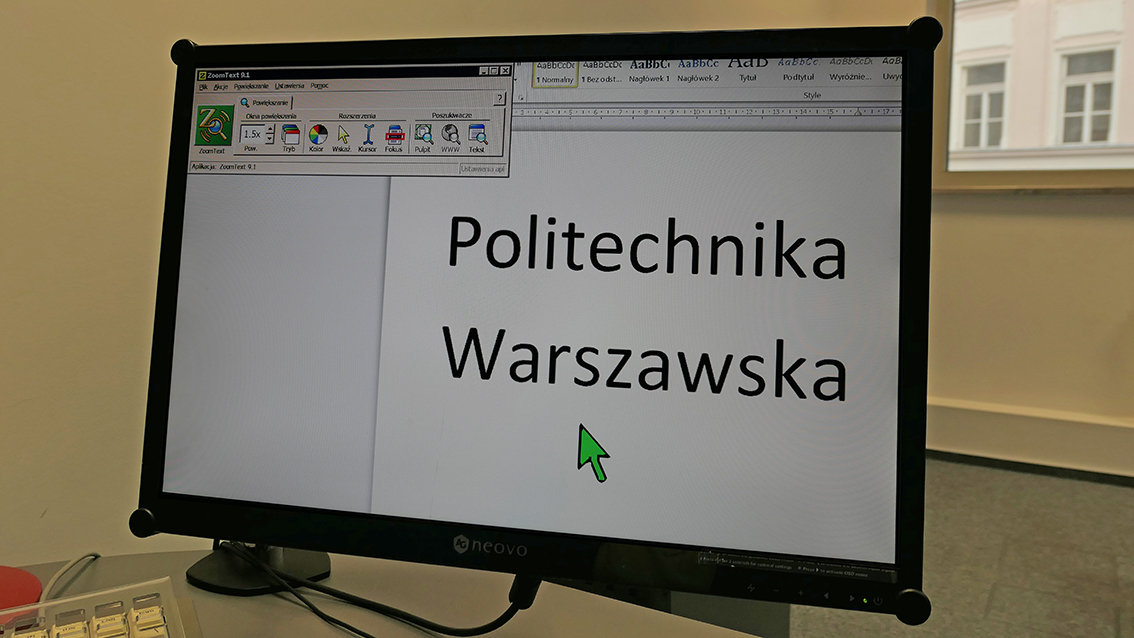
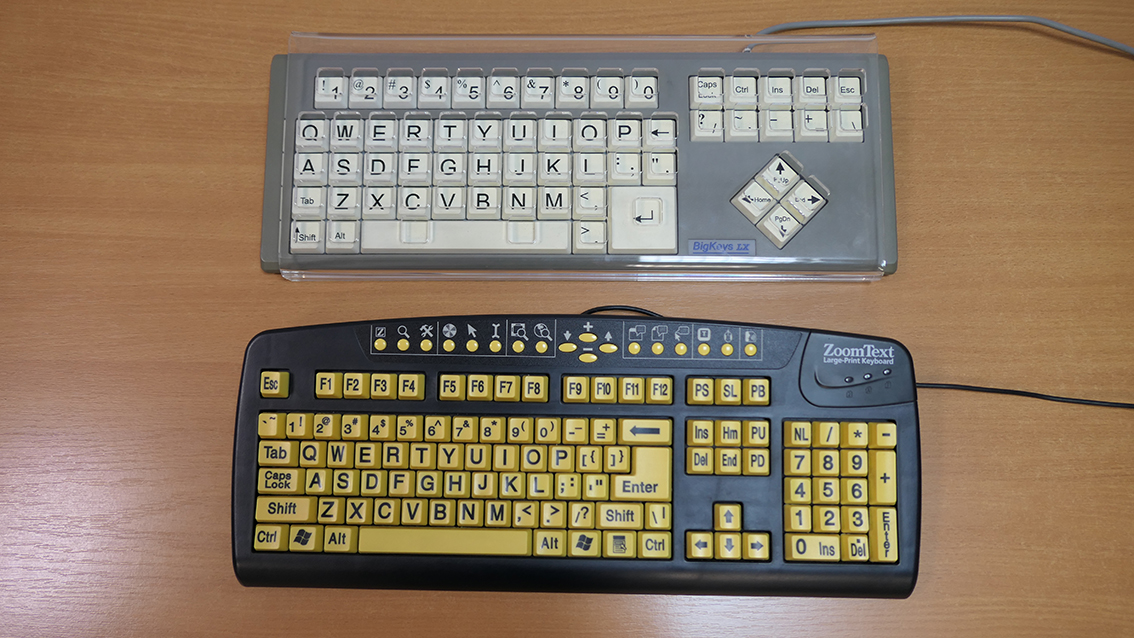
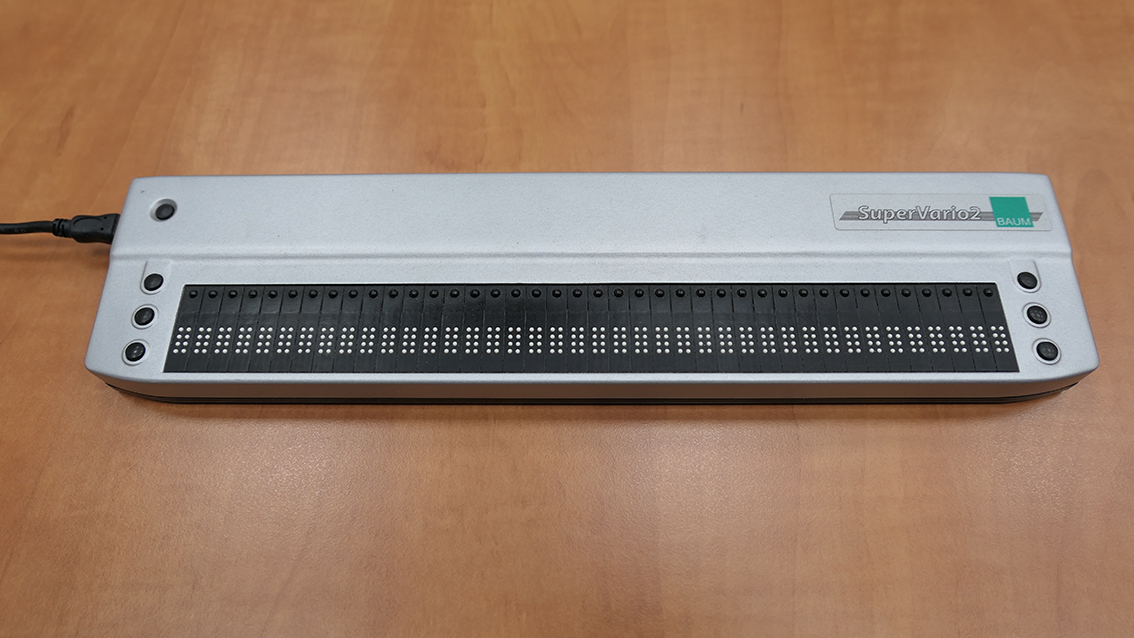
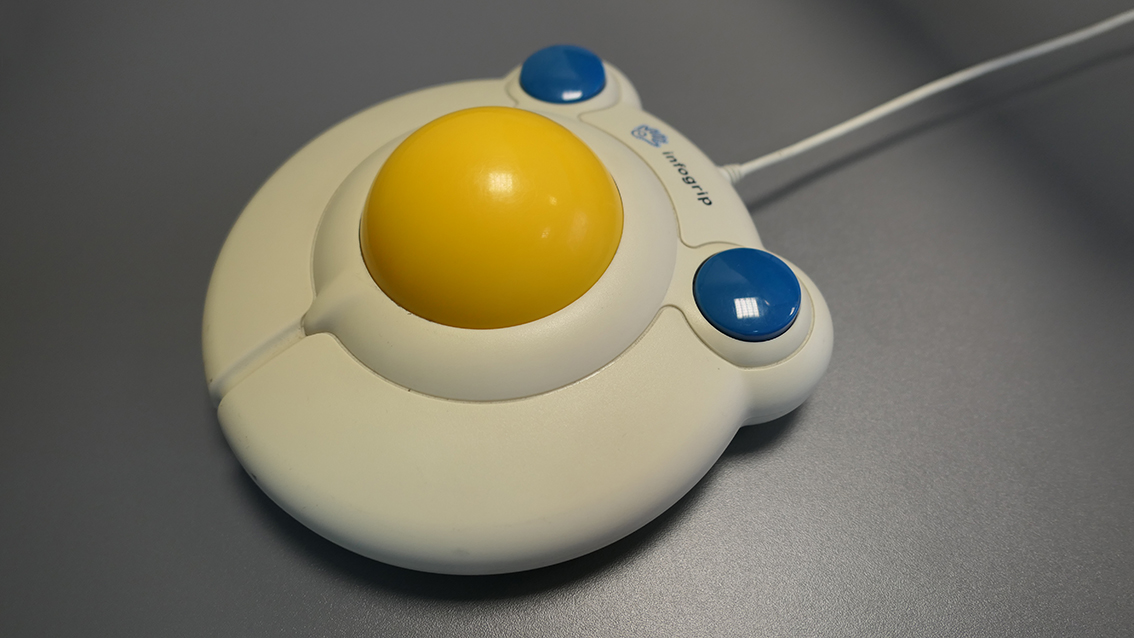
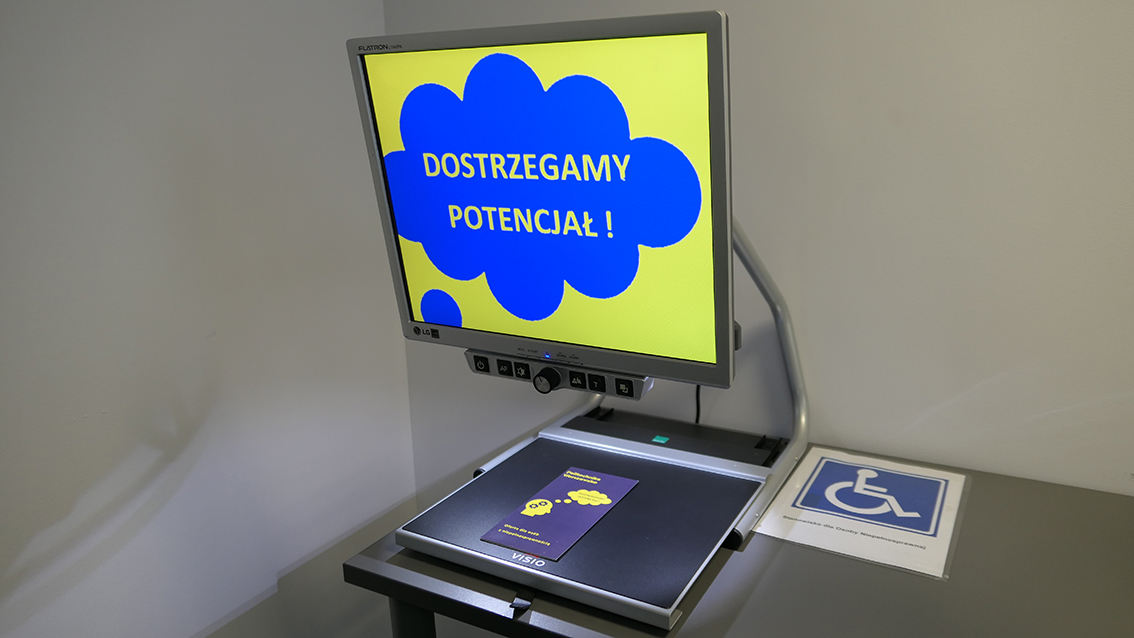
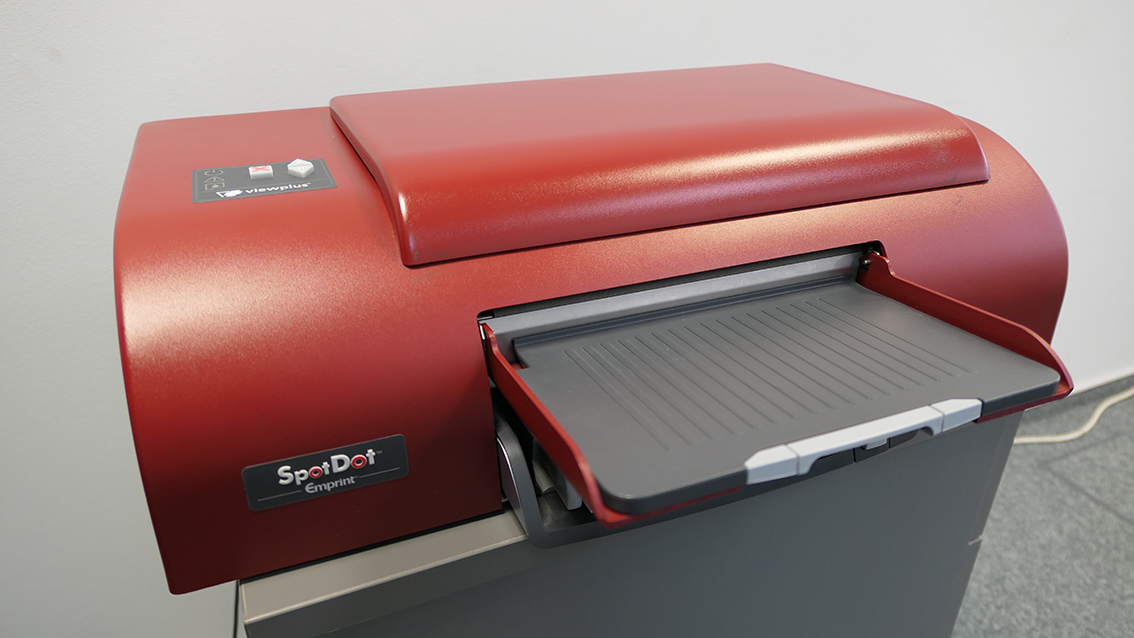
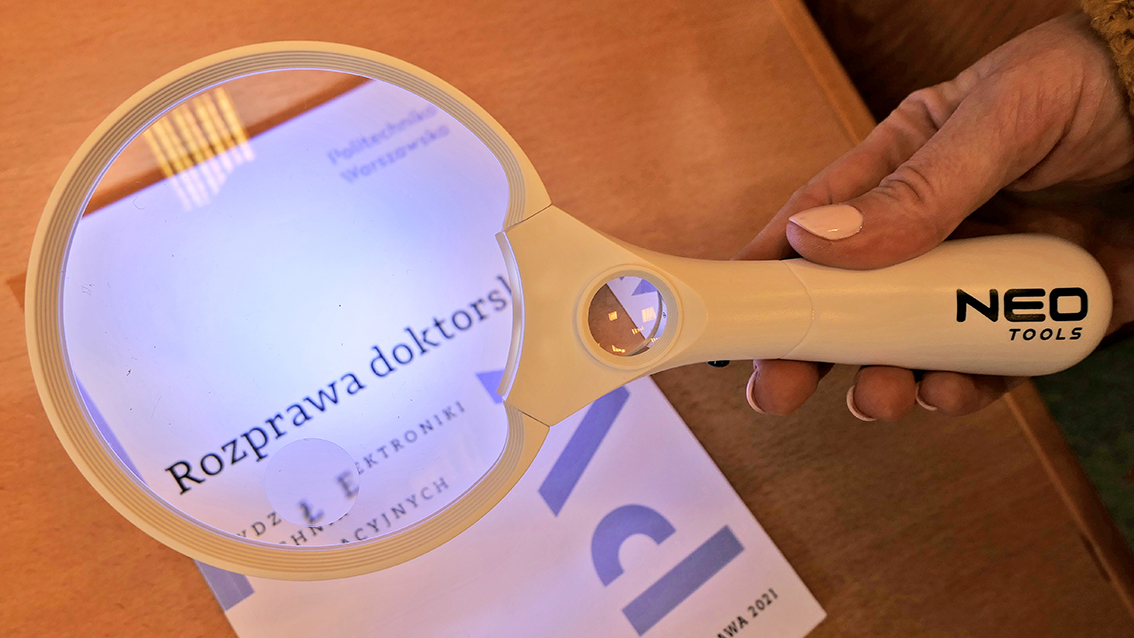
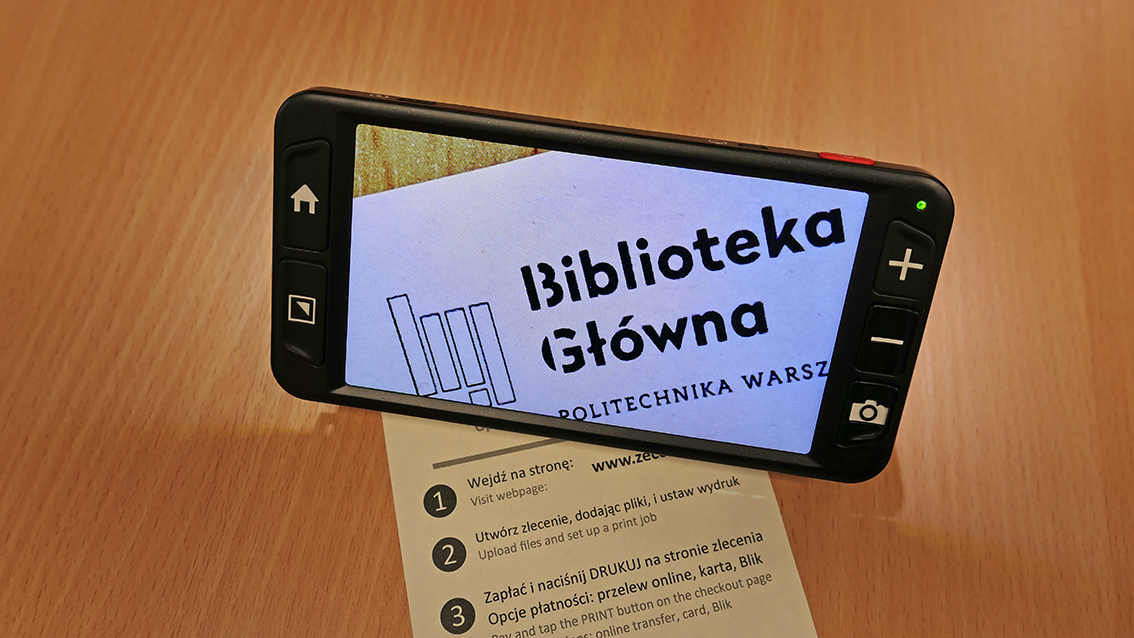
Specially prepared black-and-white Open Stacks maps in large easy-to-read A3 size are available at the library staff stations on each level of the Open Stacks.
The ML Open Stacks opening hours are: Mon.-Fri. 9am to 7pm, Sat. 9am to 4pm
For deaf and hard of hearing users
The WUT Main Library (Main Building) provides services to deaf and hard of hearing users in Polish Sign Language. To take advantage of the opportunity, please report your need to the librarian on duty.
For hearing-impaired individuals who use hearing aids, stationary induction loops have been installed in WUT Main Library and its branches. They are located in user service points: at the librarian's desk in the Student Lending Room (Main Building, room 71), on three levels of the Open Stacks (Main Building, rooms 242, 243, 336), as well as in the South Campus Library, the Faculty of Chemistry Library, and the WUT Branch Library in Płock. These stations are marked with a sticker with an induction loop pictogram. In addition, in the Special Collections Reading Room (Main Building, room 70), people with hearing impairments can use a portable induction loop.
Navigation and location applications
Digital copy request
The WUT Main Library offers free-of-charge ordering service for digital copies from printed library materials for users with disabilities. The requests need to be sent to the Section for Persons with Disabilities.
The Library of Faculty of Materials Science and Engineering and the Library of Faculty of Automotive and Construction Machinery Engineering also offer free-of-charge ordering service for digital copies.
Contact
For more information about facilities for users with disabilities you can contact us by e-mail: This email address is being protected from spambots. You need JavaScript enabled to view it. or phone: 22 234 55 98. You can also receive the necessary information on site on each level of the Open Stacks.
The librarians support users with disabilities in providing the appropriate materials from other floors of the library.
Scanning and printing
According to the WUT ML Regulations, copies of library documents may only be used for didactic or educational purposes, research, or personal use. Systematic and illegal reproduction, collecting on own media, redistribution or resale are prohibited (pursuant to the Act of 4 February 1994 on Copyright and Related Laws Journal of Laws of 2021, item 1062). The copying service covers the collections of the Main Library and its branches, the technical condition of which allows copying. PhD and diploma theses are excluded from copying.
Self-Service Copying
Scanning
Free of charge. Save scans as PDF, TIFF or JPG.
Main Library Open Stacks, level 2 (room 242):
- Zeta scanner - scans in colour; save scans to USB memory stick or send to email; available automatic correction of the curvature of the scanned material
- Zeutschel scanner - b/w scans; save scans to USB memory stick
Southern Campus Library, level 2, room 206:
- Zeta scanner - scans in colour; save scans to USB memory stick; available automatic correction of the curvature of the scanned material
Printouts
Main Library Open Stacks, level 2 (room 242):
The Zeccer printer allows you to print: directly from Zeccer website, by downloading the mobile app or by sending materials to This email address is being protected from spambots. You need JavaScript enabled to view it.. Payment can be made by online transfer, card or Blik.
Price list Type of charge Price A4 page b/w 0,22 PLN A4 page colour 1,20 PLN transaction fee 0,29 PLN
Customised Scanning
We scan documents in formats from B5 to A3 (colour scanning). Formats and prices according to the Price list.
Professional digital copies
The Main Library has specialised fixed and pass-through scanners at disposal. We offer professional digitisation of excerpts from books, journal articles and other library documents in various formats and high resolution. A separate price list applies for copies of library documents from Special Collections, see the Price list.
An order for professional digital copies should be submitted to: This email address is being protected from spambots. You need JavaScript enabled to view it.. In your order, please specify the source document, the format of the digital files and the method of collection.
Collection and payment
Completed orders are sent by e-mail, while a VAT invoice is sent by post. Please confirm receipt of your order to This email address is being protected from spambots. You need JavaScript enabled to view it.. An internal invoice is issued for orders from inside WUT. Payment for the service should be made by bank transfer to:
Bank PEKAO S.A. IV Oddz. Warszawa
81124010531111000005005664
NIP: 525-000-58-34
Please indicate the invoice number as the title of the transfer.
Attention
- When planning subsequent orders, it is possible to select monthly settlement. An invoice is then issued at the end of the calendar month for all orders made during the month.
- For non-standard orders, the price is set individually.
Internet access
Wired network
Computer workstations for searching the library collection
The Main Library and its branches provide all users with access to desktop computers that enable you to:
- use the Primo multi-search engine,
- use the electronic resources held by the library.
Locations:
- ML Open Stacks (levels II and III)
- ML Students Lending Room (room 71)
- Branch Library of the Southern Campus, room 206 (2nd floor)
Specialized workstations for WUT students and staff
For WUT students and staff there are desktop computers that, apart from access to the library resources, also provide:
- Internet,
- Microsoft Office package,
- specialised engineering software (ArcGIS Pro, MATLAB, SOLIDWORKS).
Locations:
- ML Open Stacks level II
- Main Building, Computer Room, room 71A (ground floor)
Wi-Fi network
The Main Library provides free wireless Internet access, administered by the Computing Centre of WUT.
Currently available WIFI networks:
- pw.edu.pl - network for WUT students and staff
- eduroam – network for WUT students and staff and guests who have an account in the eduroam system
How to access
- pw.edu.pl - logging in takes place via the login and password used in the central mail system of the Warsaw University of Technology. If it is necessary to manually set the network parameters, the following parameters are recommended:
- WPA2 Enterprise
- PEAP
- MSCHAPv2
- no certificate
- eduroam - logging in takes place via the login and password generated of eduroam system (instruction). If it is necessary to manually set the network parameters, the following parameters are recommended:
- WPA2 Enterprise
- PEAP
- MSCHAPv2
- no certificate
If you are not eligible for accessing the WIFI facility, there are PCs with access to the Internet.
Rules, regulations & fees
Regulations
Fees for overdue books
The fee for overdue is 0,30 PLN per day for one item. Overdue automatically blocks the library account.
Payments can be made by:
e-Payment Service – PayU – directly from the users’ library account
The electronic payment is available from your library account in the “Loans” bookmark for books which are overdue and have not been returned to the library yet, and in the “Fees” bookmark for books which are overdue but already returned.
Regulations for electronic payments [in Polish]
Safety
Online Payments service is supplied by PayU – a company that provides an online payment system. Find more about the user’s security in PayU
Unblocking the library account
When you use the PayU, your library account will be unblocked almost immediately after the transfer has been made.
For books which are overdue and have not been returned to the library yet you will get 3 extra days for returning them to the library or for renewing (it is possible only if: 1. no one else has ordered the book 2. your account is not blocked 3. you have not exceeded the limit of 3 renewals).
If you prefer a traditional money transfer in a bank or at the post office, you can download and print the payment form (it will appear while choosing the payment method). You will need to wait until the money has been registered in the account and then your library account will be unblocked. It can last up to 4 work days.
Books borrowed from various locations
Fees for overdue books borrowed from various locations (Main Library, faculty libraries, institute libraries) need to be paid separately for each location. You cannot settle the payment for books from different locations by one money transfer.
Directly to the Main Library bank account
Bank account number: 34 1240 1053 5111 4310 0050 0091 . Transfer title: name, surname and number of library card or student WUT ID number.
Download a payment form for traditional money transfer in a bank or at the post office here.
This can be done only for books from the Main Library, its branches and libraries at students dormitories. Attention – this account number cannot be used for paying for overdue books from the faculty and institute libraries.
When the payment has been made, the users’ account will be unblocked within 4 days or after showing the proof of payment in the Library.
Please remember that the fees will be accepted only for books already returned to the library (“Fees” bookmark on the user account).
Cash payments at the Main Library
In special cases, cash payments for late return of books to: WUT Main Library / its branches / Students Hall of Residence Akademik library may be made at WUT Main Building, room 71 (ground floor), Mon. - Fri. between 11:00 and 15:00.
The payment will be immediately debited from the user's account.
List of Divisions
The arrangement of publications in ML Open Stacks
- Select a main division (A-Z).
- A detailed set of divisions refers you to a given set of records in the WUT Catalogue.
- Click the pin icon next to a division name to see its location on the floor plan.
A. General
- A0. General reference
- A1. Scientific information. Bibliology
- A2. Philology
- A3. Language learning
- A30. General studies (languages other than those listed below)
- A31. English language learning
- A32. Chinese language learning
- A33. French language learning
- A34. Spanish language learning
- A35. German language learning
- A36. Polish language learning
- A37. Russian language learning
- A38. Italian language learning
B. Management. Economic sciences
C. Mathematics
- C0. General reference
- C1. Logic. Set theory
- C2. Algebra. Number theory
- C3. Discrete mathematics. Combinatorics. Graph theory
- C4. Geometry. Topology
- C5. Mathematical analysis
- C6. Calculus of probability. Mathematical statistics
- C60. General studies
- C61. Probability theory
- C62. Mathematical statistics
- C63. Stochastic processes
See also -> division B71 Econometrics
Optimization See -> division B72 Operations research
See also -> division B73 Financial mathematics
- C7. Numerical methods
D. Physics
- D0. General reference
- D1. Optics
- D10. General studies
See also -> division J13 Optoelectronics
- D10. General studies
- D2. Thermodynamics
- D3. Statistical physics
- D4. Quantum physics. Quantum mechanics
- D5. Theory of relativity
- D6. Atomic physics. Molecular physics. Nuclear physics. Particle physics
- D7. Electromagnetism. Magnetism. Electricity
- D8. Solid-state physics
- D80. General studies
- D81. Crystallography. Crystal structure
See also -> division F23 Mineralogy. Petrography. Geochemistry - D82. Semiconductors physics
Semiconductor devices. Semiconductors materials See -> division J11 Microelectronics. Electronic components. Electronic circuits
- D9. Plasma physics
- D90. General studies
See also -> division J22 Lasers. Laser technology
Medical physics See -> division N21 Bioengineering. Biomedical engineering
- D90. General studies
E. Chemistry
- E0. General reference
- E1. Physical chemistry
- E10. General studies
- E11. Atomic theory. Molecular theory. Chemical bonds. Supramolecular chemistry
- E12. Chemical structure. Stereochemistry. Crystal chemistry
- E13. Quantum chemistry. Computational chemistry
- E14. Chemical thermodynamics. Chemical equilibria. Phase transitions
See also -> division D20 Thermodynamics - E15. Chemical reactions. Chemical kinetics. Catalysis
- E16. Chemistry of high energy processes. Photochemistry. Radiation chemistry. Nuclear chemistry
- E17. Electrochemistry
- E18. Chemistry of surface phenomena. Colloids
- E2. Analytical chemistry
- E3. Inorganic chemistry
- E4. Organic chemistry
- E5. Chemical technology
See also -> division E70 Chemical and process engineering- E50. General studies
- E51. Chemical industry (and related industries). Industrial chemical products
Agricultural engineering. Plant protection products See -> division F51 Agriculture. Agricultural engineering. Soil science
- E511. Fuel industry. Petrochemical industry
- E512. Pharmaceutical industry
- E513. Cosmetic industry
- E514. Food industry. Microbiological industry. Fat industry
See also -> division N33 Health sciences - E515. Textile industry. Dyeing industry
- E516. Glass industry. Ceramics industry
See also -> division L50 Building industry
See also -> division E60 Plastics industry
- E6. Plastics industry
- E7. Chemical and process engineering
See also -> division E50 Chemical technology
F. Earth sciences. Geodesy
- F0. General reference
- F1. Astronomy. Astrophysics
- F10. General studies
Astronautics See -> division M50 Spaceflights engineering. Spaceships
- F10. General studies
- F2. Geology. Geophysics. Mining
- F3. Geodesy. Cartography. Photogrammetry. Remote Sensing. Cadastre
- F4. Geography
- F5. Agriculture. Forestry. Wood industries
- F50. General studies
- F51. Agriculture. Agricultural engineering. Soil science
See also -> division W26 Land conservation
See also -> division L21 Geotechnics. Soil mechanics. Ground science. Engineering geology - F52. Forestry. Wood industries
Pulp and paper industry See -> division O11 Printing materials science
G. Mechanics
H. Machine technology. Manufacturing technology
- H0. General reference
- H1. Technical mechanics. Strength of materials
- H2. Automatic control of machines and processes
- H3. Mechanical engineering. Fundamentals of machine design
- H30. General studies
- H31. Engineering graphics (technical drawing)
- H32. Machine parts (gears, bearings, clutches)
- H33. Drives
- H34. Operation of machines
- H35. Tribology (friction, lubrication)
- H36. Heat engines (compressors, pumps, boilers, turbines). Refrigerating machinery
- H37. Engines (heat engines, steam engines, combustion engines)
- H5. Mechatronics
- H6. Technological processes and machineries
- H60. General studies
- H61. Casting
- H62. Materials joining and cutting (welding technology)
- H63. Machining. Metal-working machines
- H64. Plastic working
- H65. Heat treatment
- H66. Erosion machining. Laser treatment
- H67. Plastics processing
See also -> division E60 Plastics industry - H68. Assembly technology
- H7. Metrology
- H8. Nanotechnologies
I. Electrical engineering. Power engineering
- I0. General reference
- I1. Electrical engineering. Electrical metrology
- I2. Electric machines. Electric equipment. Electrical installations
- I3. Power engineering. Electrical power engineering
- I30. General studies
- I31. Power engineering. Electrical power engineering
- I32. Power systems. Electrical power networks
- I33. Power stations. Thermal-electric power stations
See also -> division W27 Renewable energy sources. Clean technologies
See also -> division D64 Nuclear apparatus. Nuclear technology - I34. Energy management. Power market
- I4. Industrial electronics. Power electronics
J. Electronics
K. Computer science
- K0. General reference
- K1. Fundamentals of computer science. Computer architecture
- K2. Artificial intelligence
- K3. Operating systems. Concurrent programming
- K4. Software engineering. Programming languages
- K40. General studies
- K41. Software engineering
- K42. Procedural programming languages. Object programming languages (Pascal, C, C++, C#, Objective C, Modula 2, Java, Python)
- K43. Functional languages (Lisp, Scheme, SML, Haskell, F#, OCaml)
- K44. Declarative programming languages (Prolog, Visual Prolog)
- K45. Scripting languages (JavaScript, JScript, VBScript, Perl, PHP)
- K46. Low-level programming languages (symbolic languages, assemblers, macro assemblers)
- K47. Domain-specific language (Matlab, ENBF, Flex, Yacc). Languages for special purposes
- K48. Tag-based languages (LaTex, SGML, HTML, XML, XAML, CSS)
- K49. Compilers. Framework (Eclipse, Visual Studio, Delphi, KDevelop)
- K5. Databases
- K6. Computer networks. Network protocols
- K7. Network security. Computer system security
- K8. Computer graphics. Image processing
- K9. Functional computer programmes
L. Building industry
- L0. General reference
- L1. General building industry
- L2. Geotechnics. Soil mechanics. Ground science. Engineering geology
- L3. Roads construction. Bridges construction
- L30. General studies
- L31. Roads construction. Railway construction
See also -> division M23 Control command and signalling of rail traffic. Railway traffic safety - L32. Bridges construction
See also -> division S44 Industrial architecture. Architecture of outbuildings. Architecture of transport infrastructure - L33. Tunnels construction. Underground structures
- L34. Roads materials. Roads surfaces. Technology of roads materials
- L35. Roads maintenance
- L4. Building design. Building structures. Structural mechanics
- L40. General studies (calculation of building structures, building design)
- L41. Structural mechanics
- L42. Concrete structures. Reinforced concrete structures
- L43. Metal structures. Glass structures
- L44. Wooden structures
- L45. Masonry structures. Stone structures
- L46. High buildings
- L47. Industrial building
- L48. Elements of building structures. Parts of building
- L5. Building industry. Building materials
See also -> division E516 Glass industry. Ceramics industry
M. Transport
N. Biological sciences. Biotechnology. Medicine
- N0. General reference
- N1. Biology
- N10. General studies
- N11. Microbiology. Botany. Zoology
- N12. Cell biology. Molecular biology. Genetics
See also -> division N22 Genetic engineering - N13. Computational biology. Bioinformatics
Medical informatics See -> division N21 Bioengineering. Biomedical engineering - N14. Biochemistry
- N15. Biophysics
- N2. Biotechnology
- N3. Medicine
- N30. General studies
- N31. Anatomy. Physiology
- N32. Clinical medicine. Pharmacology
See also -> division N211 Medical diagnosis. Medical apparatus
Medical ethics See -> division N23 Bioethics
Medical law See -> division N30 Medicine - N33. Health sciences
Food engineering See -> division E514 Food industry. Microbiological industry. Fat industry
O. Printing technology
- O0. General reference
- O01. Encyclopedias. Lexicons
- O02. Dictionaries
- O03. Manuals. Tables
- O04. General studies
- O05. History
Book science. Press science See -> division A12 Bibliology
- O1. Printing materials science. Computer typesetting. Printing techniques. Bookbinding
- O2. Publishing. Bookselling. Distribution of books
P. Law. Social sciences. Political science
- P0. General reference
- P1. Law
- P10. General studies
- P11. International law
- P12. State law. Human rights
- P13. Administrative law
- P14. Economic law. Tax law
- P15. Civil law. Criminal law
Mortgage. Land registers. Protection of tenants’ rights See -> division F37 Cadastre. Property management - P16. Commercial law. Financial law. Banking law
Bill of exchange law. Cheque law. Foreign exchange law See -> division B40 Banking. Finance - P17. Intellectual property law. Copyright law
Inventions See -> division Z21 Technology. History of technology - P18. Insurance law. Insurance
- P2. Philosophy. Religion. Intangible culture.
- P20. General studies
- P21. Philosophy
- P22. Ethics
Business ethics See -> division B11 Organisation and management methods
Environmental ethics See -> division W21 Sustainable development. Ecology
Ethics in science See -> division Z10 Science
Medical ethics See -> division N23 Bioethics
International ethics See -> division P52 International policy
Military ethics See -> division P53 International security. National security - P23. Religion
- P24. Intangible culture
See also -> division S61 Cultural heritage. Archaeology
- P3. Sociology. Social policy. Psychology
- P30. General studies
- P31. Sociology
- P32. Social policy
Housing policy See -> division L13 Building investments. Construction cost estimates
Housing policy See -> division S41 Residential architecture. Defensive architecture
Housing law See -> division F37 Cadastre. Property management - P33. Social communication
- P34. Psychology
Clinical psychology See -> division N30 Medicine
- P4. Labour sciences
- P5. Political science. International relations
- P6. Public administration
- P60. General studies
- P61. Central administration
- P62. Field administration
Local government finances. Local government budgets. Public sector finance See -> division B44 Public finance
- P7. Education. Pedagogy
R. Materials engineering. Materials science
S. Spatial planning. Architecture. Arts
- S0. General reference
- S1. Spatial planning
- S2. Urban planning
- S3. Architecture
- S4. Architecture of buildings (according to the purpose)
- S40. General studies
- S41. Residential architecture. Defensive architecture
- S42. Religious architecture. Cementary architecture
- S43. Architecture of health care facilities
- S44. Industrial architecture. Architecture of outbuildings. Architecture of transport infrastructure
See also -> division L32 Bridge construction - S45. Architecture of research institution buildings. Architecture of buildings for educational purposes
- S46. Architecture of commercial buildings. Architecture of hotel facilities. Architecture of catering facilities
- S47. Architecture of buildings for cultural events and entertainment. Architecture of sports facilities
- S48. Architecture of administration buildings. Architecture of facilities for financial institutions. Architecture of office buildings
- S49. Architecture of farm buildings
- S5. Arts
- S6. Cultural heritage. Preservation of monuments. Museums
W. Environmental engineering. Environmental protection
- W0. General reference
- W1. Environmental engineering
- W2. Environmental protection. Environmental hazards
- W20. General studies
- W21. Sustainable development. Ecology
- W22. Environmental monitoring. Environmental impact assessment
- W23. Conservation of nature
- W24. Air protection
- W25. Water protection
- W26. Land conservation
See also -> division F51 Agriculture. Agricultural engineering. Soil science
See also -> division L21 Geotechnics. Soil mechanics. Ground science. Engineering geology - W27. Renewable energy sources. Clean technologies
See also -> division I33 Power stations. Thermal-electric power stations
- W3. Aerology. Hydrology
- W4. Hydrotechnics
Z. Science. Technology. History
Contact us
Address:
Main Library of the Warsaw University of Technology
Library is located on Main Campus (in the WUT Main Building)
Plac Politechniki 1
00-661 Warsaw
Information services:
phone: + 48 22 234 7300 (Reference Center)
phone/fax : +48 22 628 7184
e-mail: This email address is being protected from spambots. You need JavaScript enabled to view it.